Exhibitions

Exhibitions

Photo: Håkon Bergseth

The Norwegian Museum of Science and Technology 's mission is to preserve the Norwegian cultural heritage in technology, science, industry and medicine, and to communicate the development of the disciplines with emphasis on the last 200 years. Permanent exhibitions with objects from the collections and temporary exhibitions are shown where the museum invites new, exciting and interactive encounters in the past and present.

I/O

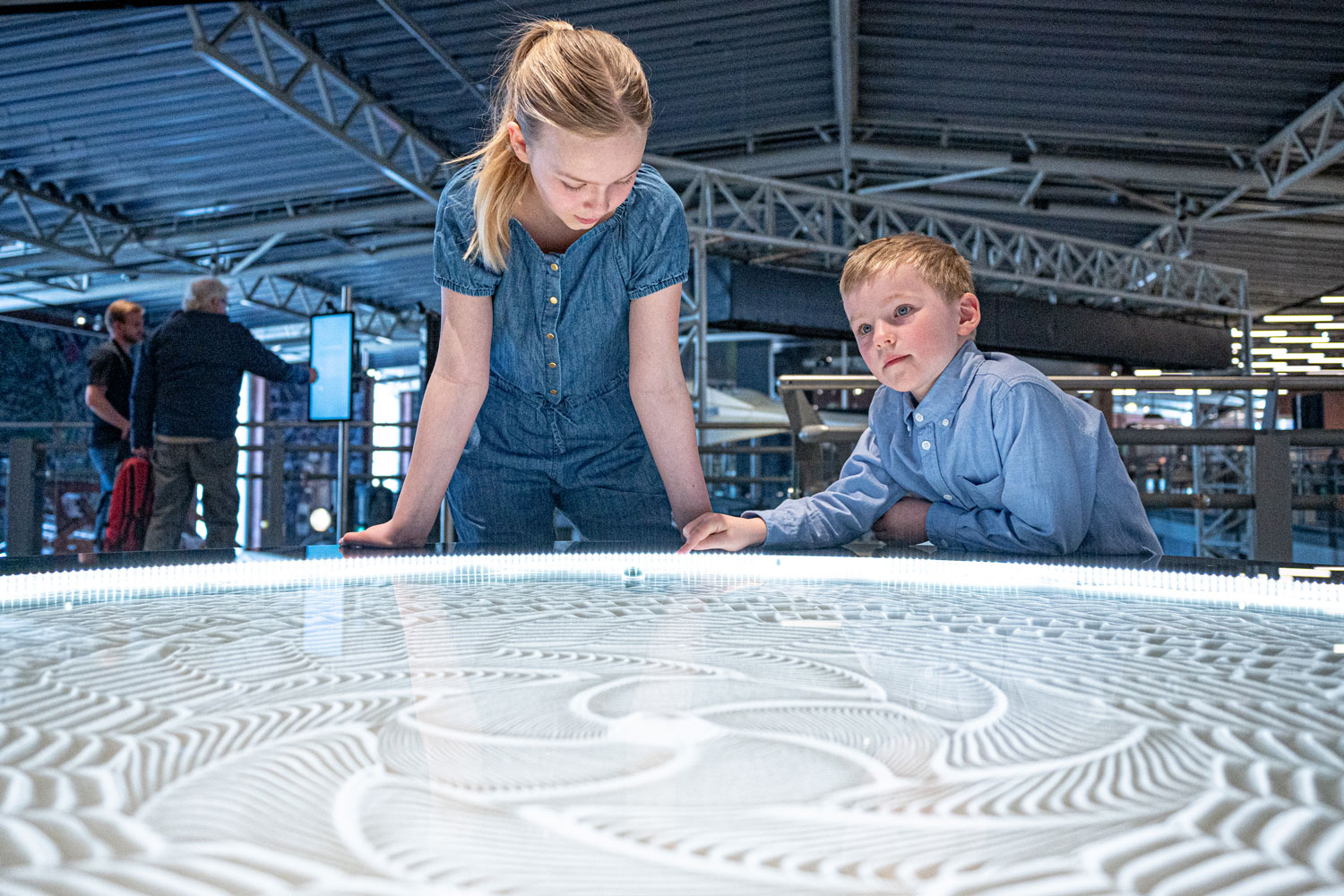
Two children around the Sisyphus House (sand maker) in the exhibition I/OChildren around the Sisyphus House in I/O. Photo: Lars Opstad

The exhibition I/O, which opened in April 2022, is a dynamic basic exhibition on telecommunications and computer technology. This means that it must be contemporary by taking up current topics, releasing it to other players who have something they want to share in the field and contributing to new knowledge. The user experience is partly controlled by artificial intelligence, which in itself is a central theme in the exhibition. Every time one connects to the exhibition using an RFID stick, the public will be presented with new stories related to the team. The museum wants the exhibition to be an arena for ongoing discussions about societal issues, and a place to obtain and contribute to new knowledge for a future-oriented commitment in this important area of ​​technology.  

The exhibition is very popular and more than 200,000 people have physically logged on since its inception, with around 110,000 actively logged-in visitors in 2023. The content and management system behind the exhibition keeps count and creates statistics on an ongoing basis. When logging in, an unceremonious profiling of the visitor takes place and KI suggests, with the help of algorithms, a trail with a story that it assumes will be interesting for this person. The visitors can go for the suggested route or choose themselves from among other stories that have been entered into the system. The statistics show that the course dealing with artificial intelligence has been most popular in the past year, closely followed by the course on computer games and the course on robots. The children's track "things that look like animals in the exhibition" is in a solid fourth place. The object that people have spent the most time on in 2023 is the photo booth on display, which has previously stood somewhere along the Norwegian roads. Not far behind is the Tsetlin chip, which is a technological innovation for a more democratic development of future artificial intelligence, from the research environment CAIR at the University of Agder. The photo booth, somewhat surprisingly, also has the highest score for the number of "likes" or "dislikes", but on average only 64 per cent of visitors "like" it. With almost 10,000 unique respondents, we must be able to assume that this is a credible picture. Such statistics are amusing, but also an interesting approach for the museum to be able to adjust the content of the exhibition to the visitors' preferences.

In order to shed light on various aspects of the technologies, it is important that many voices are heard. Around ten trails have been added during the year, and the exhibition can now offer forty-two different stories. Five of these have been made in collaboration with researchers from the Department of Social Anthropology at UiO as part of the research project Private lives. The tracks are about digital everyday life in Norway, among young adults, among reindeer herding Sami, among campaigners and among people who commute to or live in the village. The collaboration with the researchers has been initiated as one of several strategies to ensure that the exhibition remains dynamic and facilitates voices from outside to enter the museum space. As a result of the research collaboration, I/O has also received its third installation in the designated zone for ambulatory art and research. The exhibition The limits of privacy: new togetherness - new dividing lines opened in September and will be on display until the summer. It succeeded the video art installation Site Visits by Boris Kourtoukov (RU/CA) and Amelie Dinh (CA) which was shown from January. The work, which visualized Wikipedia and Youtube as three-dimensional websites, also featured a VR experience for the audience.

The work to create an interactive opportunity for visitors to engage with all the objects the museum has in the collection, but which are not presented in the exhibition today, is close to completion in 2023. Here there will be an opportunity to explore objects on a large screen and also vote for what you find interesting for a future physical presentation in the exhibition. In line with the dynamic ambition, objects can also be replaced or added in I/O. During the year, several objects have been added: Among other things, the front panel of the IBM machine at Kjeller, which was the first machine outside the USA connected to the ARPA network. This marked the 50th anniversary of the internet.  

The large reactor in the exhibition, where visitors can meet the artificial intelligence in discussion with themselves about current societal issues related to the exhibition's technologies, has contributed to many engaged experiences. The installation is based on the Chat GPT3 language model, which has received a lot of attention this year. This is how I/O has hit well on one of the most current technology debates. At the same time, this is an advanced and experimental installation which has not unexpectedly presented any operational problems. The ambition is to further develop content and ensure operation in the reactor.

Two sit on a bench and look at the artwork
Photo: Maria Reinlie Borgeraas

Site Visits

Site Visits is an artwork by Amelie Dinh and Boris Kourtoukov, which was displayed in the I/O exhibition's temporary zone for art and research projects. The work is based on well-known websites such as YouTube and Wikipedia and turns them into 3D landscapes. Experienced through VR glasses or as a video projection on a large surface in the exhibition, the digital landscapes become an overwhelming physical experience. With lingering camera guidance over structures and details that are repeated, each website (site) gets its own visual identity. The forms express the website code and various types of contributors to the page and thus offer the visitors some unexpected ideas that they can keep for their next visit to such websites. The exhibition was curated as part of the goal that I/O should be a dynamic exhibition where other voices can come in and challenge us with new ideas, insights and reflections on the context in which we stand with digital technology. The work had a vernissage on 26 January with speeches from the artists and a finale with an artist talk in September 2023.

The limits of privacy

More visitors exploring the artwork that resembles the organ of the heart.

From the exhibition opening The limits of privacy. Photo: Håkon Bergseth

In September, the exhibition Private life's borders: New encounters - new dividing lines opened inside the permanent exhibition I/O on information and communication technology. It addresses highly topical topics such as privacy and digital interaction and offers a sensual approach and experience. The boundaries of private life is an intimate and tactile room within the room that forms a contrast to the main exhibition. Where I/O communicates through AI and digital solutions, visitors are invited here to a sensory experience and to use their own experiences as digital users. The exhibition invites reflection on new social dividing lines, polarization, loneliness, and what bodily proximity means for communication. The exhibition also provides an insight into digitization in the relationship between humans and animals, through the use of drones and GPS in reindeer husbandry.

The exhibition stems from the research project Privatlivets Grenser. Sociality and belonging in digital everyday life at the Department of Social Anthropology, UiO and the Norwegian Institute for Natural Research. It has been developed in collaboration with The Norwegian Museum of Science and Technology and the Academy of Performing Arts at Østfold University College. The research was carried out by: Marianne E. Lien, Cecilia G. Salinas, Tuva Beyer Broch and Tom Bratrud. The exhibition design was by the three master's students in scenography: Lisa Birkenbach, Irina Kommissarova and Solveig Dagsdottir. The exhibition was funded by the Research Council of Norway under the SAMKUL program.

A chassis from a 1929 Cadillac hanging diagonally from the ceiling in the communications hall.
A chassis from a 1929 model Cadillac hangs in the Communications Hall. Photo: Jill Bottolfsen

Other news from our exhibitions

During the year, new objects have entered the museum's permanent exhibitions, while some objects have been replaced. A chassis from a 1929 model Cadillac was set up with the help of the Friends of the Museum and hung from the ceiling of the communications hall. An artwork called "To serve", which is a dress made from a mask during the pandemic by the artist Marit Amalie Røed, became part of the exhibition Life and death. The front panel of the IBM machine at Kjeller, which was the first machine outside the US connected to the ARPA network, was added to the exhibition I/O to mark the 50th anniversary of the internet. In the Musikkmaskiner exhibition, the control panels from the Elektronmusikstudion (EMS) in Stockholm, which were used by the Norwegian composer and studio manager Knut Wiggen in the 1960s and 70s, were returned to the owner Scenkonstmuseet, after having been with us since the opening of the exhibition in 2009. Three of the cars that are normally exhibited in the communication hall - Crown Prince Olav's "Baby Cadillac" from 1912, King Haakon's Minerva from 1913 and the open Buick that transported Crown Prince Olav through Oslo's streets on 13 May 1945 - were shown throughout the year as a separate exhibition about royalty cars in the museum's temporary hall.

CONTRIBUTIONS TO EXHIBITIONS AT OTHER MUSEUMS

The museum has several objects that have been loaned to other museums for longer periods, such as Norway's first plane (Start) at the Defense Aircraft Collection Gardermoen, the Ekebergbanen's first regular car at the Sporveismuseet, several cars at the Norwegian Road Museum and large parts of the objects at the Telemuseet in Sørvågen and in Lærdal . Among other things, the museum has lent a Hasselblad camera and material by Grete Prytz Kittelsen to the National Museum. In 2023, the museum has also contributed to exhibitions at other museums for shorter periods. We have lent a model of the hospital made in the 1940s to Bærum Hospital, which they will use in the celebration of their 100th anniversary in 2024.

Upcoming exhibitions 2024

Conservator and photo archivist work with an old film projector in the exhibition
The museum's conservator Tone Rasch and photo archives Even Attramadal are working on the exhibition Energi in the time of climate crisis. Photo: Jill Bottolfsen

New energy exhibition

The museum's new exhibition Energy in the time of climate crisis is a journey through Norwegian energy history, from the past, present and into the future. The story begins with the water wheel and the fossil steam engine - two things that show the difference between renewable and fossil energy sources. The exhibition also deals with nuclear power, solar power, wind power and other energy sources that are currently under development. The energy theme embraces broadly. Energy can be described in technical and scientific terms, but also related to broader societal contexts. Turnover and use of energy must be understood in light of political, social, economic and cultural conditions. The museum's collection of objects provides a unique opportunity to describe the development and use of various forms of energy in Norway, both fossil and renewable. Not least, this applies to the electrification of society in the industry and households from the late 1800s to the present. The exhibition has a historical structure, and objects from the museum's collections appear. The historical is framed by today's energy crisis. Because we are in the midst of the debate on how to resolve this crisis, the exhibition must also handle a future perspective. In the exhibition, the oracle is the place where the audience is invited to participate in the discussion of what the future community can look like. In this part of the exhibition, not only the technological challenges related to the energy use of the future are discussed, but also the need for a more sustainable organization of society.

The exhibition aims to combine the science centre's focus on interactivity and specialized installations with the spatial and conceptual expressions of the classic museum exhibition. Our hope is that this "integrated model" creates a new type of museum experience. The museum has worked actively with the participation of the public and other external parties through open discussion meetings at the museum, interaction with Linderud School and films in a "Speakers Corner" where interviews with people from various positions express their views on the topic. Parts of the exhibition have been developed in collaboration with external partners within interactivity and new technology.

The exhibition has been made possible through the collaboration with Equinor Morgendagens helter. Ocean Sun and Biogass Oslofjord have also supported the exhibition. The exhibition opens on 25 January 2024.

The network project Sustainable Energy Narratives, led by The Norwegian Museum of Science and Technology in collaboration with other museums and institutions in the Network for Industrial and Technological History, is supported by the Directorate of Culture.

Model of an eye.
Photo: Håkon Bergseth

Models

From autumn 2024, a new exhibition about models is planned in the museum's temporary hall. Models have a long tradition at The Norwegian Museum of Science and Technology . We find several models among the first objects from the establishment of the museum in 1914, and today the museum has hundreds of models in its collections. The exhibition will show models of all kinds – small and large, new and old, detailed and imaginative. There will be models of everything from steam engines to the body's organs, from bridge structures to cars. They will reflect the breadth and many different exhibitions in the museum. The models tell about how knowledge has been produced, practiced and communicated at our museum for more than a hundred years. In 2023, a separate website has been created for the exhibition and “thinginger” (workshops) related to teaching models from the Bergseminaret in Kongsberg and wax models of wombs from the Rikshospitalet in Oslo were held.