
WEEKEND AND HOLIDAY PROGRAM
The museum carried out and developed many communication schemes through 2023 for weekend and holiday visitors. In collaboration with Oslo Science Centre the museum has continued its work from 2022 to operate and train employees in various schemes related to AI, coding and digital creativity. This work could be seen, among other things, during the winter holidays, where visitors could experience the Micro:bit orchestra, program algorithmic art, make AI stickers, watch science shows and solve various creative tasks in the inventor's workshop at the creation workshop, Teknoteket.
We aim to focus on educational and social dissemination programs aimed at families with children. During the summer holidays, a soap bubble course was held for the very little ones, a rocket workshop, a windmill workshop and several communication programs linked to themes in the exhibitions. The communication program "Hurrah for children!" themed, for example, health policy and IVF through a point-by-point tour and activity aimed at families and children from the age of five. Through theme-focused activities, we hope to be able to promote dialogue and strengthen reflection within families.
The purchase and testing of an electric goods bicycle was a new dissemination and communication initiative in 2023. The bicycle was profiled, and the transport box was filled with simple physics and chemistry experiments as well as a skeleton. The purpose was to be visible in the center of Oslo and Frognerparken. On rainy days, the bicycle was used inside the museum.
In 2023, we were able to use the terrace outside the Communications Hall. The area was upgraded, and the activities were nicely framed by tents, shelves and flower boxes with lush plants. Several of the tiles were painted in fresh profile colours.
During the autumn holidays, the LEGO festival was once again held, including LEGO assignments and a Duplo corner for the little ones in the Aviation Hall, where this year's theme was What will The Norwegian Museum of Science and Technology like in 100 years? Other activities in the autumn of 2023 included programming sand printers, 3D printing and steam railway models.
With the upcoming energy exhibition in mind, several activities related to energy have been developed, including light-up cards where visitors can make a card that lights up with a simple circuit, and a guided tour about water wheels that deals with the history of water wheels and Solli sawmills.
The Venneforeningen's family Sundays were held on 4 June and 26 November. In addition to the museum's regular activities, the visitors were able to experience activities with radio amateurs, open Halvorsen's workshop, and not least a steam locomotive from the Norwegian Model and Steam Association that the little ones could drive around on the museum's terrace.
Visitors could get to know the exhibitions better by hunting for secret letters in the Museum Hunt puzzle and through the mobile app Bædi og Børdi, children could hear about several of the museum's objects in a fun and creative way.

Lino print outside on our newly opened terrace. Photo: Gorm Gaare
EXTERNAL ARENA
In addition to the number of visitors to the museum, 16,071 visitors have been registered at external venues.
The most important arenas in 2023:
- In collaboration with Deichman and Norway Makers, the museum has organized a Maker Festival at Deichman Bjørvika with radio-controlled cars, sand printers and soap bubbles. The festival was a success with 17,000 visitors.
- During the World's Coolest Day, the museum contributed with activities where children could control pre-programmed radio-controlled cars through a car track at Akershus Fortress. The event was carried out in collaboration with Sparebankstiftelsen DNB.
- Many science shows have been carried out, including at the national kick-off for the Environmental Protection Agency's Batterijakt and at the 60th anniversary celebration for the Apotekermuseet. In collaboration with Forskningsdagene and OsloMet, around 400 students were able to experience science shows at the Holmlia centre. Ice cream was made with liquid nitrogen at the Natural History Museum in connection with Geology Day, and countless soap bubbles were blown at the Id festival at the Town Hall Square and various other children's festivals.
- In the summer of 2023, we did a successful pilot with our newly purchased Promo-El cargo bike. It had its own branding, a skeleton in the goods box and a cyclist with little tricks up his sleeve. We cycled around places where there were many people, such as Frognerparken and in the center of Oslo.
- The Talent Centre has taught at four upper secondary schools in Oslo, in addition to Kongsberg and Larvik.
- In collaboration with Oslo municipality and the Center for Natural Sciences, a teacher's course has been given to around 800 teachers on students with high learning potential and creative school methodology.
- LEGO building at the children's festival at 3KT at Aker Brygge.
- The Norwegian Museum of Science and Technology owns two listed buildings in Bergen. One is the transmitting station of Bergen Radio at Rundemanen. In collaboration with Museum Vest, we have presented the radio station's history and activities, including amateur radio. We were open 13 Sundays this summer and received 840 visitors.

Countless bubbles were blown on the Coolest Day in the World. Photo: Joachim Solum
In 2023, the school visit was 41,554 at the museum and 5,281 at venues outside the museum. In total, school visits ended at 46,835, which was 575 fewer than in 2022. Kindergarten visits ended at 8,232, which was an increase of 995 from 2022. A total of 37,421 pupils, teachers and kindergarten children received a learning offer under the auspices of the museum, an increase of 2,217 from 2022.
The school offer spans several subject areas, such as history, medicine, social studies, natural sciences, programming and maths. The new offerings in 2023 were Treetop Cabin (grades 5-7), micro:bit robot orchestra (grades 5-10) and LydLab – Create music for video (grades 7-10). Astroamp was reintroduced for 5.-7. steps and launched as a new VGS offer. Of the new offers, Astroamfi was the most popular. The museum also organized Research Square for students from 6th grade and up, in collaboration with UiO. Almost 1,000 school pupils and teachers visited us on this day. In the last two weeks before Christmas, schools were offered a free Christmas Science Show and the Christmas Planetarium. This was particularly popular in the last week before the holiday.
As in previous years, science shows were the most popular offer. The show is staged twice daily in the last four weeks before the summer holidays. Programming was also very popular in 2023 and Oslo Science Centre has worked a lot to further develop the offer, as well as to increase capacity. The schools could choose from a total of 20 programming offers, from 1st grade to VGS. Other popular offers were a tour of technology history with Highlights (3rd step to VGS), industrial history with The Industrial Revolution (8th step to VGS), the various creative activities (3rd step to VGS) and the offers in medicine, body and health (1 .step to VGS).
The school visit in 2023 had a slight decrease from previous years. It was especially in the weeks before the summer holidays, when the museum had a drop in visitor numbers. It was the unannounced school classes that the museum missed in the 2023 high season. Previously, the museum has had a higher number of classes on Oslo visits, which typically visit several cultural institutions during the day. In 2024, the museum will work to map the causes and solutions to the declining number of visitors.
The subscription scheme for Nordre Aker continued in 2023, with 5,684 pupils and teachers making use of the offer, roughly the same as in 2022. The subscription scheme was extended to also apply to kindergartens after a trial period in 2022. The offer has been well received among the district's kindergartens. 2,096 kindergarten children with teachers visited us in 2023. The number of kindergarten children who participated in an educational program increased by over 300 children compared to the previous year.
In 2022, the museum produced two boxes with teaching plans for AKS 1.-2. steps, via the Mini exhibition project. The program called Mummies - Life and Afterlife is held by a teacher at the school. 5 schools and 350 pupils made use of the offer in 2023. The feedback from pupils and teachers is very positive.

Photo: Gorm Gaare
EVENTS AND CONFERENCES
The event program will update the museum's exhibitions, research, collections and archive. During 2023, around 40 events were held, many programmed in collaboration with others.
Late Night Thursday
Throughout the year, we have kept the museum open until 19 on Thursdays, except during the summer holidays and Christmas Eve. Our creative workshops have had drop-ins, and visitors have been able to try out 3D printers, sand printers, AI image programs and programmable objects. In addition, we have had classic analogue board games and LEGO building tables as social activities these evenings.
On 19 October, the museum started a youth club. In the first instance, the youth club is for applicants to the Talent Center programme. It is every Thursday, and the young people sign up from time to time. The youth club is supported by Sparebankstiftelsen DNB.
LATE
The museum's evening format for everyone over 18 was re-established in 2023 with monthly events. SENT has had a fixed program consisting of quizzes, creative activities, analog games, LEGO, bar and VR games. Open meetings and talks, exhibition openings, an award ceremony and the LEGO festival were included in the SENT programs throughout the year. The terrace was used for a bar and quiz during the summer's event.
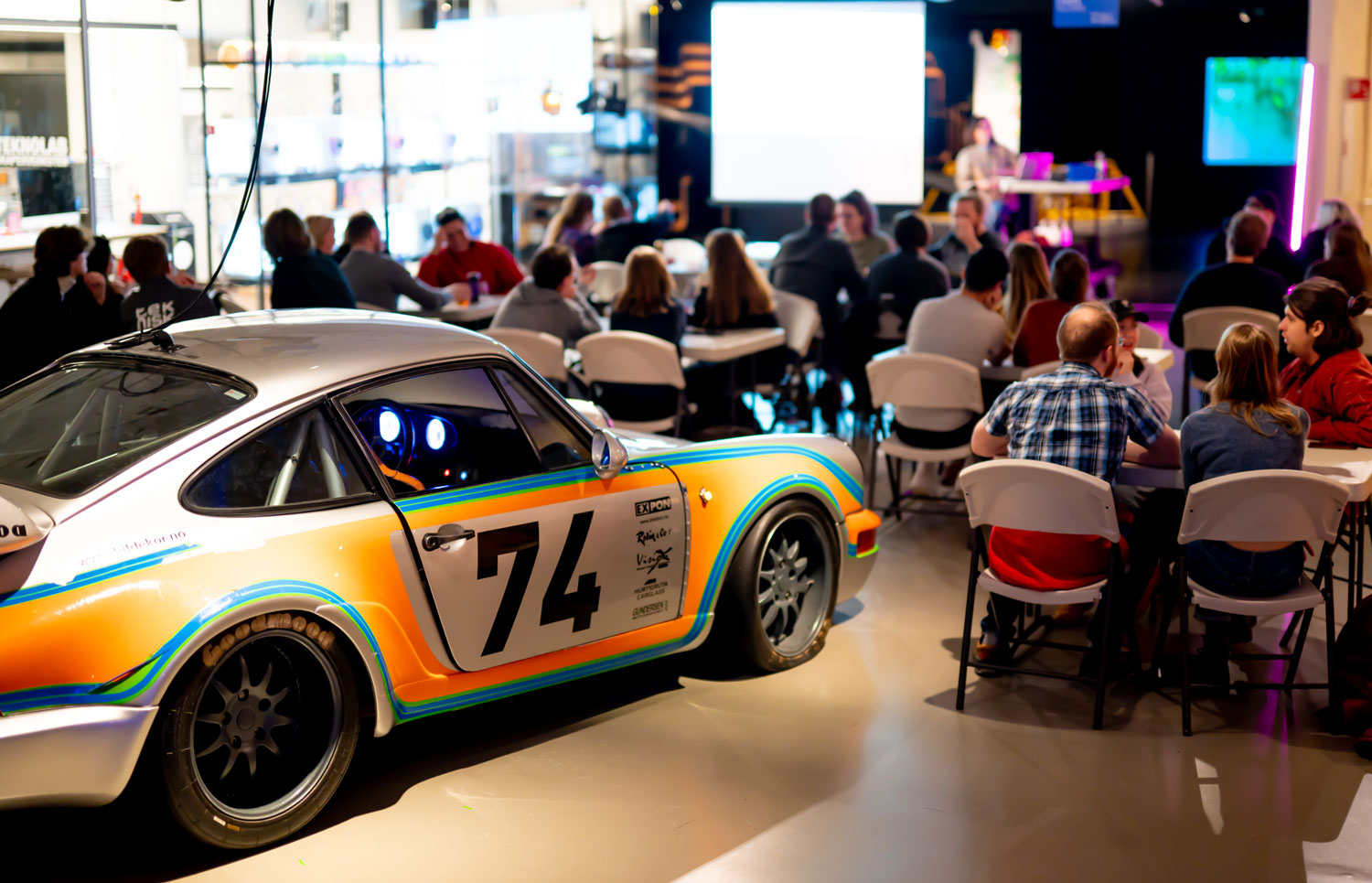 The museum arranges quizzes during all SENT events. Photo: Lars Opstad
Exhibition openings in I/O
On 26 January we marked the opening of a new digital artwork in I/O, Site Visits by Boris Kourtoukov and Amelie Dinh. The work turned websites into 3D landscapes based on the websites' own code structures. The artists themselves presented their works during the opening. In the exhibition, a separate zone has been set up where artists and researchers can present works.
On September 28, Borders of Privacy: New Interactions - New Boundaries opened at I/O, an exhibition that examines how new digital technologies intervene in our lives. It stems from the research project Borders of Privacy; Sociality and Belonging in Digital Everyday Life, at the University of Oslo and the Norwegian Institute for Natural Research. It has been developed in collaboration with The Norwegian Museum of Science and Technology and the Academy of Performing Arts at Østfold University College. The opening was addressed by the coordinator of the exhibition, Cecilia Salinas, research leader for Borders of Privacy Marianne Lien, and professor at the Academy of Performing Arts Karen Kipphoff.
Conversations
How do we talk about energy: On April 27, we invited to an open meeting where we wanted to explore how we talk about energy in Norway today as part of the development of the upcoming energy exhibition. The program went from introductions with a wide range of perspectives, ecology, electrochemistry, economics, global justice and the humanities, to discussion tables where guests, presenters and exhibition project staff shared their observations with each other, which were ultimately summarized in a panel discussion.
The Method of Things: On June 6, we marked the launch of the book The Method of Things: The Topography of Museum Knowledge, with museological reflections and mingling with the book's editors, authors, and colleagues.
Site Visits: On the last day of the artwork's display, September 7th, we invited a conversation about websites with artist and programmer Boris Kourtoukov.
After the pandemic: On November 30, visitors could join curator Phil Loring in the exhibition Life and Death in a conversation about experiences and memories after the corona pandemic.
Technology history lecture series
Technological history lectures provide current insights and historical views on the development of technology in work and everyday life, infrastructure, industry, research, medicine and health, natural sciences and engineering. The lecture series is organized by The Norwegian Museum of Science and Technology in collaboration with the Technology History Group at Tekna, NITO – Oslo branch and The Norwegian Museum of Science and Technology 's Friends Association.
This year's seven lectures have been:
Oslo water supply by Ingjerd Mørck, geologist at the Municipality of Oslo, Water and Wastewater Administration – 26 January.
National tourist routes by Sidsel Sandelien, retired civil engineer from NTH – 23 February.
GPS 50 years by Steinar Thomsen, director of the department for positioning, navigation and timing (PNT), satellite communication and security at the Norwegian Space Centre – 30 March.
The Bergen Royal Road by Geir Paulsrud, cultural historian at the Norwegian Road Museum – 27 April.
The start of the internet by internet pioneer Dag Belsnes – 25 May.
When will the cod return to the Oslofjord? by Sissel Jentoft, researcher at CEES – 28 September.
ENERGY in the time of the climate crisis by Ketil G. Andersen, first curator The Norwegian Museum of Science and Technology – 30 November.
Girls and technology
TENK Tech Camp was organized for the seventh time at the museum on 11 and 12 August. It is a free summer camp for girls aged 13-18, organized by TENK - the Tech Nettverket for women.
Girl Tech Fest was held at the museum for the third consecutive year on October 24. 200 girls from the 5th grade participated in workshops that gave them a taste of how they can help shape value-creating technology in the future. Minister of Culture Lubna Jaffery and journalist/ presenter Selma Ibrahim visited the event, which was organized by the National Center for Science Recruitment, ICT Norway, the ODA network, TENK - Tech Network for Women in collaboration with the museum.
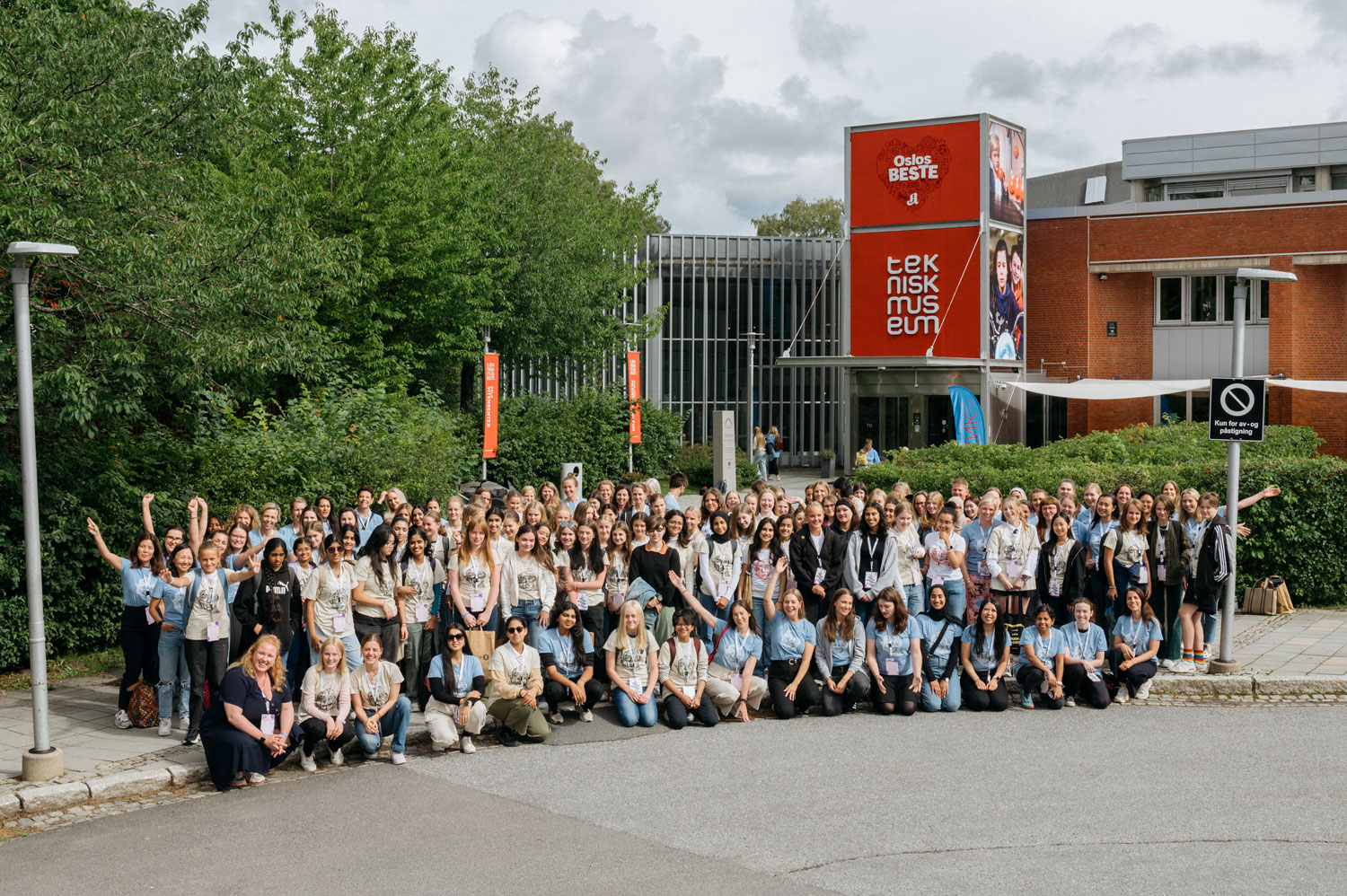 Photo: Georg Aamodt
Research square and festival
In collaboration with the Faculty of Medicine, the Department of Psychology, the Department of Pharmacy and the Faculty of Dentistry at the University of Oslo, we organized a Research Festival on 21 September for 950 school students and on 23 September for even more weekend visitors. At Forskningstorget, our visitors were able to meet heart and brain researchers, learn CPR, take photos with sunscreen under UV light, hear about bacteria that create energy and bad bacteria in the mouth, learn about why zebrafish are used in medical research, explore in their own sensory orientation on a bicycle with VR glasses and hear about how sustainability and health are connected.
Conferences
European Association for the History of Medicine and Health (EAHMH): The Medical Museum organized a conference dinner, award ceremony and a special tour of Life and Death on August 31st.
Artificial Intelligence in Schools: On November 6, the conference Artificial Intelligence in Schools was held. Almost 100 teachers and educators from science centers in Norway were present at lectures and workshops. Topics covered were: How can children and young people use technology creatively and sensibly and understand the challenges it creates; How can they develop their digital creativity and judgment using artificial intelligence; and what pedagogical tools can you as a teacher use to introduce students to technology in a safe and practical way and at the same time make them understand the ethical dilemmas we face?
Trust in Things: Together with Museum Vest and the University of Southeast Norway, The Norwegian Museum of Science and Technology the conference Trust in Things, a research conference on communication in museums, in Bergen on November 29 and 30.
Other events
- On March 2, professor and author Malin Eberhard-Gran gave a presentation on pregnancy-related health in the lecture How the first 9 months shape the rest of your life.
- On April 11, the mini-exhibition Picturing the future we want opened . It is a collaborative, cross-cultural art project where young people from Nairobi and Oslo have learned to make woodcuts and lino prints.
- On September 3rd, we reopened the doors of the broadcasting station, Bergen Radio at Rundemanen on the occasion of Get Out Day, with a demonstration of radio technology and Morse code in collaboration with Museum Vest.
- On October 21, the museum was the venue for the event Talk with your eyes - try assistive technology, where visitors could try making music, playing games and communicating with eye control, switches or breathing, in collaboration with Digjobb, among others.