
FOLK
– from breed types to DNA sequences
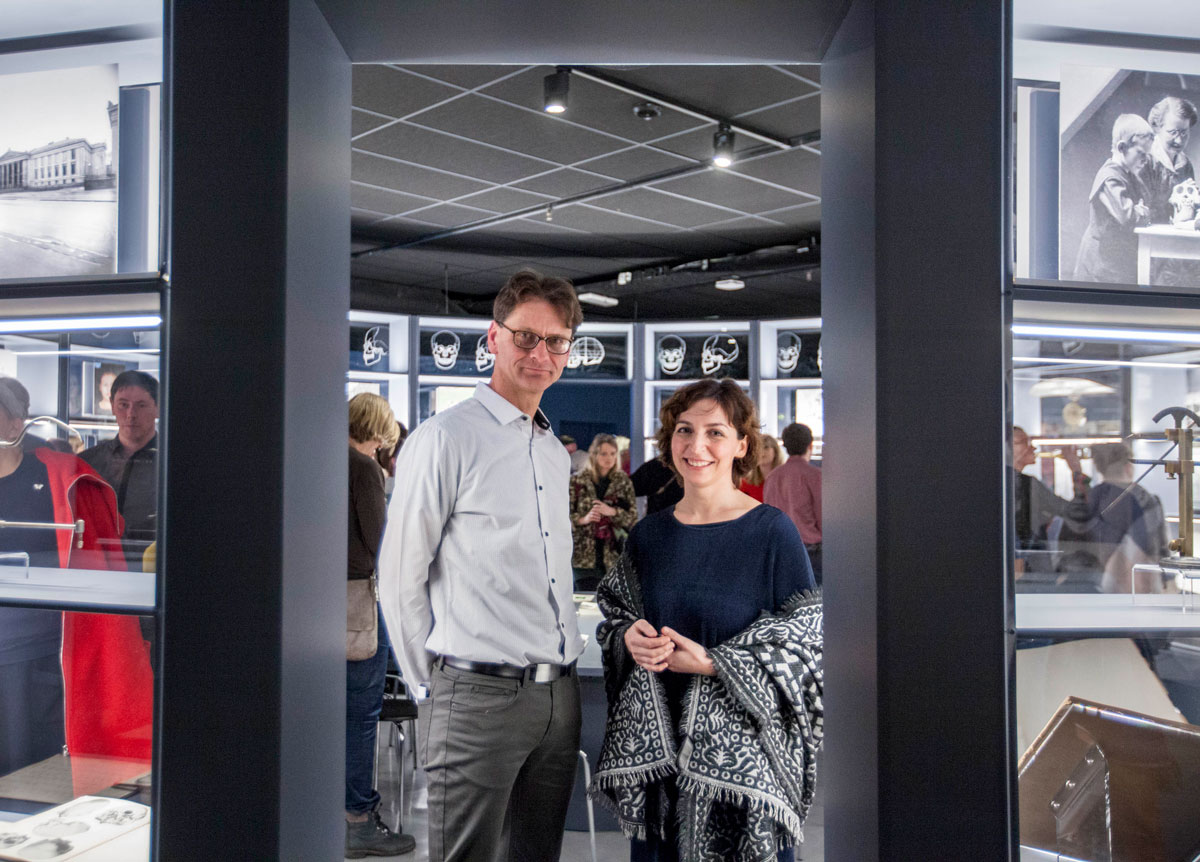 - Race as a biological concept should have been dead a long time ago. But racial thinking and related ideas are unfortunately on the rise. This unpleasant paradox is the background for the exhibition PEOPLE, say the exhibition curators Jon Røyne Kyllingstad and Ageliki Lefkaditou. Photo: Åsa MikkelsenThe exhibition PEOPLE explores the historical and contemporary studies of human biological variation and the interaction between research, society and culture. The exhibition's message is clear: We all belong to the same species, Homo sapiens, and our DNA is more than 99% identical. This small variation is the product of an interaction between genes, environment, migrations and contact between people. Because of this, we cannot draw clear boundaries between distinct groups. These groups do not exist in nature. The heyday of scientific racism may be over, but racial ideas live on in various ways – not only in extreme ideologies, but also in established ways of thinking and how we relate to each other in daily life.
The exhibition opens up for reflection on the long and problematic history of interest in the biological similarities and differences between humans. Such research has helped to legitimize slavery, colonialism, class differences and nationalism, and is still linked to the powerful forces of identity narratives. PEOPLE points out the links between historical race research and examples of exploitation, discrimination, brutal assimilation and extermination of millions of people around the world. But visitors also encounter resistance to racist ideologies from researchers, activists and politicians.
 - The questions about past scientific racism and its effects, as well as the ethical and political implications of DNA research, are often hidden in societal debates. FOLK brings such connections to the fore. We contribute with a critical attitude and historical awareness, concludes the senior curator of health and medical history at the Medical Museum, Ageliki Lefkaditou. Photo: Håkon Bergseth
The idea of race has not only had a catastrophic human cost. It has also led science astray in its efforts to map the evolutionary history of humanity and to explain biological differences between people. In the last two decades, genetics has undergone a technological revolution, producing vast amounts of new data about individuals and populations. In the present-day part of the exhibition, visitors gain insight into how this is changing our understanding of human diversity and take part in a discussion about the opportunities and challenges of research.

- Racism is not just about brown skin. It's about Sami, Tatars and Roma. There is more and more research on this, but not enough. I was at the Folk exhibition at The Norwegian Museum of Science and Technology , and I was completely dizzy, says performing artist, playwright and musician Camara Lundestad Joof. Photo: Håkon Bergseth
The exhibition discusses science as a process, striving to understand how the world works. But science is always part of society and limited by the individual abilities of researchers and their institutional commitments. In an age of “fake news”, a critical approach to research is important. FOLK points out how contemporary research is still surrounded by difficult questions. These questions are scientific, political, social and ethical. Access to genetic material, language, methods and theories used, and the interpretation of results are still controversial.
The activity The Sound of the People invites visitors to express the concepts of identity and belonging through sound images that describe emotions. Our emotions and the sounds we associate with them are as diverse as our identities, origins, cultures and ways of being. With this activity, curiosity and reflections are opened up in many ways about how people are alike and different.
FOLK should be an open and inclusive arena that stimulates discussions and makes it possible for all visitors to engage with the topic.
The exhibition is produced in collaboration with the University of Oslo: Cultural History Museum, Department of University History (MUV, UiO). Co-producers are Árran Lule Sami Centre, Grorud Youth Council, Setesdal Museum. The exhibition is funded by the Research Council of Norway and Fritt Ord.
The museum as a meeting place and dialogue arena
 The museum as a dialogue arena. Photo: Håkon Bergseth
For the museum, it is important to use the institution as a starting point for exploratory conversation and real participation. In 2018, various types of events and meetings were held. Many of these have been connected to the Medical Museum's main initiative PEOPLE, others have been based on the museum's other themes and collections: On September 2, there was a launch of Inger E. Nitter's book Den indre polferden. Psykosen som bilderspråk, with a display of some of Nitter's banners and a conversation between her, art historian Ingeborg Høvik and literary scholar Marie-Therese Federhofer. On September 28, at the event Researchers' Night, in collaboration with Forskningsdagene, psychologist Christian Schlüter participated in a discussion on personality, artist Martin White in a discussion on psychiatrist CW Sem-Jacobsen and filmmaker Ellen Ugelstad in a discussion on mental health. On October 24, the first meeting in the discussion series Medisinske rom. Diagnosens makt av stabelenen took place. Nine special invitees and over 100 visitors spent the evening discussing the soon-to-be-historic diagnosis of transsexualism, to become a little wiser together.