


Dissemination and activities
The permanent exhibition Life and Death, which opened in 2021, remains a mainstay in the communication of The Norwegian Museum of Science and Technology and the National Medical Museum. In 2025, it was again the museum's most popular exhibition when it comes to school visits, with a total number of visits of 8,928. Life and Death receives a lot of positive feedback from our visitors.
The Directorate of Health supported the development of a teaching program on sexual health (9th grade). In 2025, the museum held workshops with, among others, Sex and Politics, Queer Youth, master's students and students from Media and Communication at Sørumsand VGS. The offer will be tested in week 6 of 2026, and will be offered from April.
On October 18, the museum was the venue for the event Talk to your eyes - try assistive technology. Visitors could try making music, playing games and communicating with eye control, switches or breathing. The event was in collaboration with Elevkanalen-TV2 Skole, Digjobb and SKUGsenteret at the Cultural School in Tromsø, as well as several companies that work with assistive devices for alternative and augmentative communication (ASK). Isabella Tengsareid-Caggiano presented the children's book about Little who lost her voice, which she created using only eye control.
Meeting with Memories is a facilitated visit program for people with dementia. We have guided tours with a dialogue of remembrance for groups from day care centers and nursing homes. Photographs, audio recordings and touching old objects get the conversation started. In 2025, guided tours were given to 20 groups with the themes of A Working Life and Happy Weekend. There were both people with dementia living at home in day care centers and residents from nursing homes and residential institutions. Support from Den kulturellte spaserstokken meant that we could welcome more groups and be two mediators with the groups.
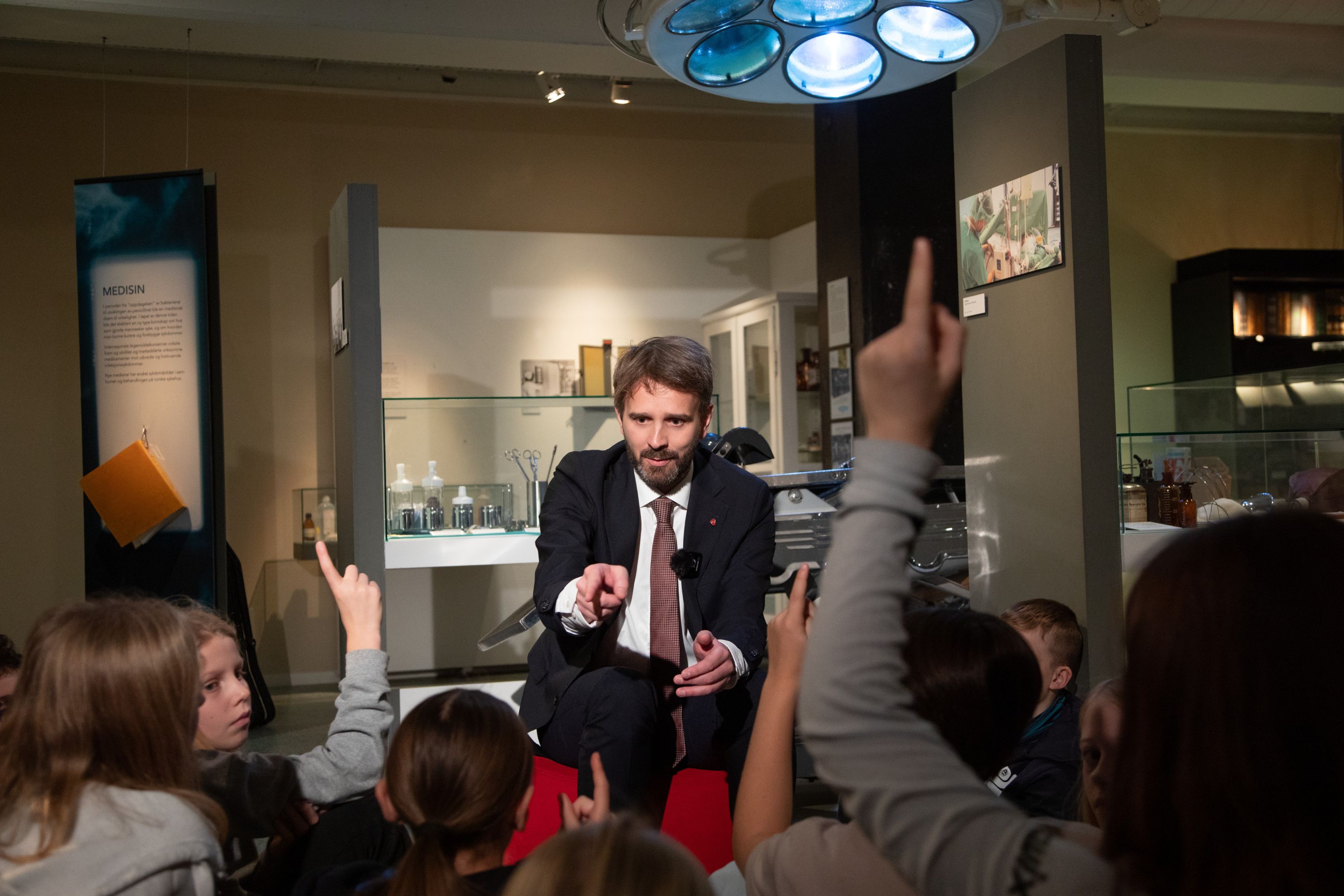 Minister of Health and Care Services Jan Christian Vestre met with 6B from Grefsen School. Photo: Håkon Bergseth/ The Norwegian Museum of Science and Technology
Ask a Minister was held for the second year in a row, where one of the government ministers was invited to the museum to meet a school class in our exhibitions, so that the students had the opportunity to ask the minister relevant questions. Minister of Health and Care Jan Christian Vestre answered questions about social media and unhealthy eating habits and also competed in who was the best at washing their hands. We will continue in 2026.
As part of the Research Days, the museum collaborates with the University of Oslo on a free research square where school students and the general public encounter current research through demonstrations, activities and meetings with researchers. Five research groups from the Faculty of Medicine, in addition to researchers and students from the Department of Psychology and the Faculty of Dentistry, as well as the interdisciplinary international student project iGEM from the Faculty of Mathematics and Natural Sciences, participated in the research square this year.
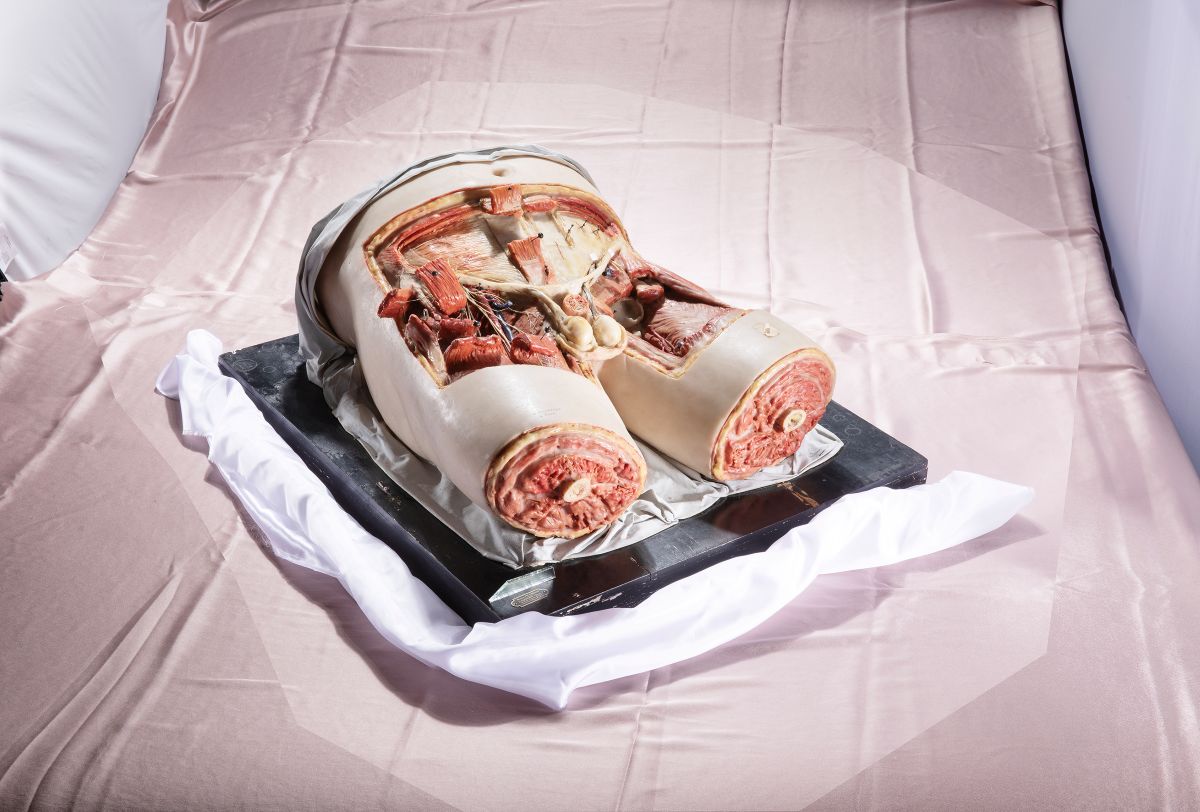
Models of the human body
The temporary exhibition Models and Miniatures opened in November 2024 and has been on display throughout 2025. Medical models of the human body have a central place in the exhibition, as one of four exhibition sections.
The exploration of models from the medical collection began with three wax models from the model maker Maison Tramond in Paris around 1900. Several wax models were borrowed from the Department of Pathology at UiO, and new medical models were added to the collection. The Bergesen Foundation has contributed support to this exhibition section.

Women's Health Festival
The National Medical Museum was the initiator of Norway's first festival on women's health, held at The Norwegian Museum of Science and Technology on 25 and 26 October 2025. The museum, together with key players from medical and research communities, health policy, the women's movement, volunteerism and health technology players, are behind the initiative. Our main partners were the Women in Medicine and the National Centre for Women's Health Research at OUS.
The festival is based on the recognition that gender has an impact on health and treatment, and that the need in the population to learn more about women's health is great. A new, knowledge-based arena like this festival can help build culture and lasting networks between patients, professional communities and decision-makers.
The 2025 program focused on health in specific life stages and how we navigate knowledge about women's health today. The topics were presented in panel discussions and conversation cafes, presentations and demonstrations, in activity squares, in participatory workshops and a performance. A school offering on sexual health for middle school students was also developed.
The support for the Women's Health Festival, with more than 20 organizations and 400 festival participants, confirmed the need for such an arena. The National Medical Museum and the main partners will continue the collaboration and organize the festival again in 2026.

National museum network for the history of health and medicine
The National Medical Museum has been responsible for the National Museum Network for the History of Health and Medicine (NMHM) since the early 2000s. The network has consisted of a number of health and medical history museums or similar institutions, with a wide range of institutions in terms of size, geographical affiliation, fields of work and working methods.
From 2024, the Directorate of Culture established a grant scheme for three-year support for museum networks, but NMHM's application was rejected. Several of the network's members are smaller hospital collections subordinate to hospitals, and do not qualify for the Directorate of Culture's requirements. The rejection means that from 2025 the network has no longer been one of the Directorate of Culture's museum networks. The network has therefore not had physical collections this year, and its activity has been reduced to operating the joint website and sending newsletters, but it is planned to apply to the Directorate of Culture again at the next call for applications.

Artifacts
The annual Artefacts conference was held at The Norwegian Museum of Science and Technology 12–14 October. Artefacts is an international museum network for professionals in the fields of technology, medicine and the history of science, with the aim of promoting the use of artefacts and material culture in research. This year's conference was the 30th in a row. The last time it was held here was in 2007. The conference brought together around 50 people from Europe, North America and Asia.
The main theme of this year’s conference was “Care and Repair”. The theme linked together presentations related to the history of technology, the history of medicine and conservation work in a way that reflected the network’s and The Norwegian Museum of Science and Technology ’s academic breadth, not least considering that the National Medical Museum is an integral part of our museum. Care has been a much-discussed topic within the medical humanities, while repair and maintenance have been of great interest to historians of technology. However, bringing these conversations together is something that has not been done before. The conference was very successful, with several parallel sessions and space for open discussions.
Twelve of the presentations from the conference will be compiled into a publication in the Artefacts Network book series, published openly by the Smithsonian Institution Scholarly Press. One of the museum's conservators is the editor-in-chief of this publication.