
Oslo Science Centre

Photo: Gorm Gaare/ The Norwegian Museum of Science and Technology

Oslo Science Centre at The Norwegian Museum of Science and Technology is a popular science experience and learning centre for technology, natural sciences and mathematics – an arena where visitors can experience, learn or renew their knowledge on their own terms. One of The Norwegian Museum of Science and Technology 's most important social missions is to actively contribute to science recruitment by spreading knowledge about technology, industry, science and medicine.

Oslo Science Centre helps create enthusiasm, interest and knowledge. The science centre collaborates closely with the university and college sector to enhance competence rooted in curricula and the school's educational goals.
 

OV technological school bag Thomas B. FjærtoftPhoto: Thomas B. Fjærtoft/ The Norwegian Museum of Science and Technology

In 2025, we strengthened our role as a regional player for schools and teacher competence, and we reached a new milestone: for the first time, over 500 school classes have participated in teaching programs led by our educators at the science center. This represents both high activity and great demand for practical science learning in the region. Together with the Sparebankstiftelsen DnB and their KulTURbuss , Buskerud schools were offered a free bus to and from the science center and the museum. This was a very popular offer that quickly filled up.

The year also included major events that brought together many students and strengthened interest in science across the board, such as science days for grades 5–7 in collaboration with Tekna, where 1,200 students participated in activities within AI, biology, physics, and rocket launches.

Girl and a science center teacher looking at a computer and coding a car, in a classroom
Photo: Lars Opstad/ The Norwegian Museum of Science and Technology

Creation workshops Teknolab and Teknoteket

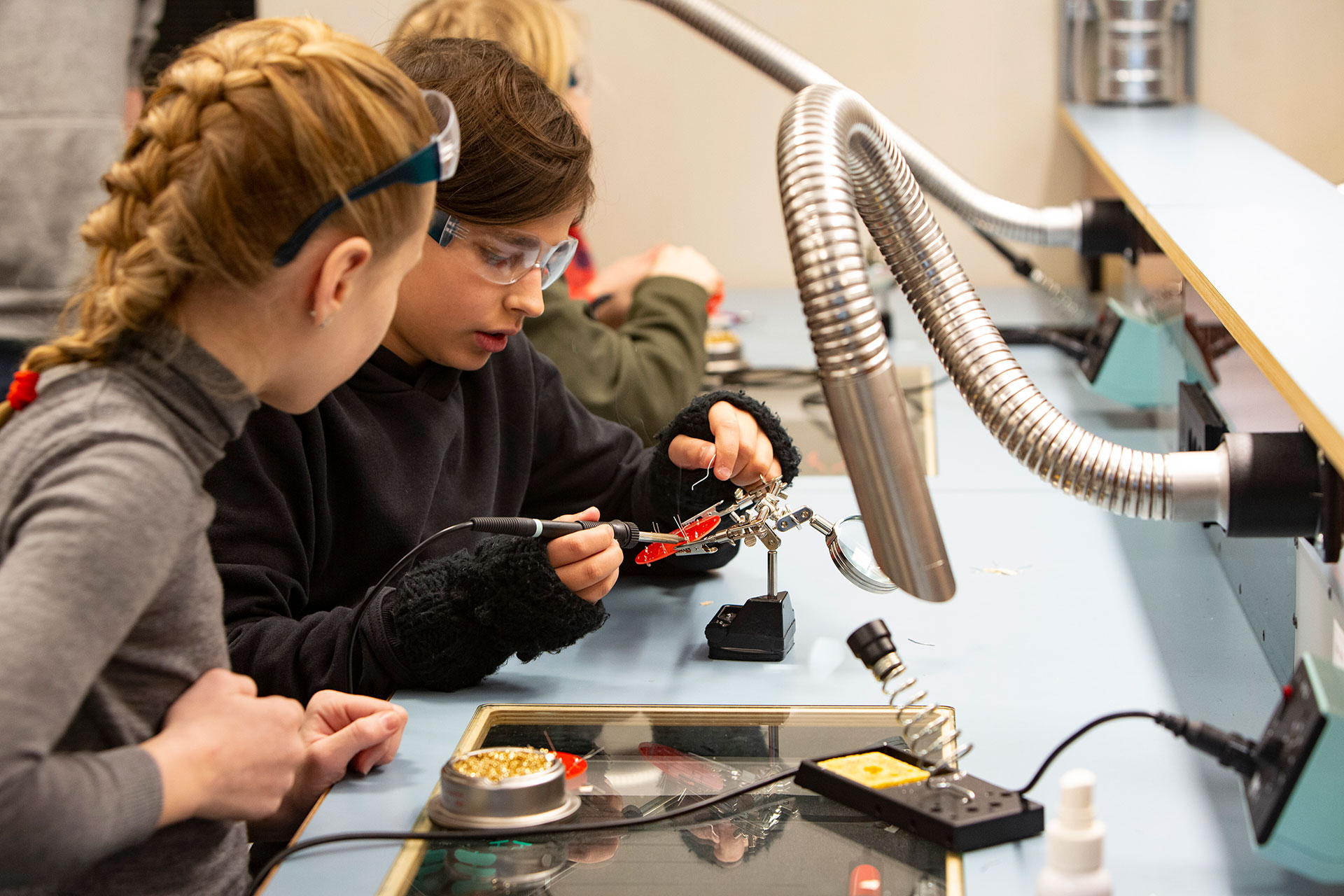
The Teknolab and Teknoteket maker workshops are central to the science center's offerings to school and leisure audiences. The workshops provide space for exploratory, hands-on learning – where participants program, work with electronics and use digital fabrication (such as 3D printing) to see the connection between theory and practice.

In 2025, we continued to deliver a wide range of teaching sessions and workshops. The weekly planning shows a high completion rate and parallel runs with up to 8 bookings on the same day. During the autumn holidays, the team was heavily involved in the public program with responsibility for LEGO Spike missions and pop-up activities focusing on technology and science for the whole family.

Practical learning

The maker workshops offer hands-on experiences that make science and technology concrete and accessible. Schoolchildren and leisure audiences encounter technology "for real", and work with activities where exploration, error and improvement are a natural part of learning

Commitment and creative joy

Through creative work, from programming and building to soldering and prototyping, we facilitate mastery and motivation. When participants create something themselves, both ownership of the learning and the joy of science increase.

Interdisciplinarity

The creator workshops combine science, programming and creativity, and contribute to holistic learning where participants see the connections between subject areas

Accessibility

The workshops are used both by school classes on weekdays and by leisure audiences on weekends and holidays. In 2025, we also worked purposefully to lower the threshold for participation through collaboration and initiatives that gave more schoolchildren access to transportation, entrance and teaching.

Nine employees from The Talent Centre
Never boring with the gang from The Talent Centre . Photo: Jill Bottolfsen/ The Norwegian Museum of Science and Technology

TALENT CENTER IN SCIENCES

The Talent Centre in Science has been established as a follow-up to the Science Strategy and is an adapted educational offer for students with great learning potential. Starting in the fall of 2025, we have chosen to offer admission to students from grades 5-10. This shift has been made following a strong request from parents and schools who see a widespread need for an adapted educational offer for younger students. The Talent Centre is based on theoretical science subjects and integrates this with technology development, prototyping and practical application.

In 2025, The Talent Centre had great visibility and activity. Over 700 students have been offered a year-long unit at the talent centre . We have also significantly increased our teacher training activity and in 2025 have trained 1,516 teachers in our region.

An important development in 2025 was also the collaboration with the Municipality of Oslo to test a pilot project in which three schools test a local talent center offer. Students receive in-depth and exploratory working methods inspired by The Talent Centre , while teachers receive guidance and resources to build this into their teaching. The experiences from the pilot will be used to develop models that can be scaled to more schools in Oslo, so that more students can receive well-adapted education at their home school.

In 2025, The Talent Centre had activities and student groups at the following locations:

  • The Norwegian Museum of Science and Technology , Kjelsås
  • Hersleb upper secondary school, Oslo
  • Bjørnholt High School, Oslo
  • Persbråten upper secondary school, Oslo
  • Bjerke upper secondary school, Oslo
  • Haugenstua school, Oslo
  • Sophie Radich Junior High School, Lillestrøm
  • Thor Heyerdahl High School, Larvik
  • The Newton Room, Larvik
Four adults sit at a long table with a computer and notepads
Photo: Thomas B. Fjærtoft/ The Norwegian Museum of Science and Technology

THE CREATIVE SCHOOL – WHERE CREATIVE CULTURE MEETS SCHOOL CULTURE

The Creator School is a concept where the culture of creation meets the culture of school, developed in collaboration between the Science Center and the science centers. The goal is to integrate practical and creative learning into everyday school life, so that students have the opportunity to explore technology and science in an engaging way.

In 2025, the Creator School was still an important framework for how we develop and implement practice-oriented programs for schools and teachers: the teaching is based on the principle of meaning and mastery, and on methods that support inclusion in the learning community. 

Central goals are that students will experience meaning and mastery through playful and practical activities, and that the creative school methodology contributes to a more varied and engaging school that equips students with skills for the future.

Young people looking at a 3D printer
Photo: Lars Opstad/ The Norwegian Museum of Science and Technology

SkaperLab youth club

The SkaperLab Youth Club at the museum has been an arena for young people interested in science, engineering and technology between the ages of 12 and 16 during the year. Every other Thursday, participants have had the opportunity to explore science through practical experiments and creative projects. The offer has been free, and the science center has provided light refreshments for the participants. 

The youth club has used the museum and science center's facilities to offer a variety of activities. Participants have also had the opportunity to work on their own long-term projects with assistance from the science center's educators and subject experts. SkaperLab introduces and allows children and young people to work on topics such as soldering, astronomy and digital fabrication. 

We have seen increasing popularity this year, and want to scale SkaperLab to become a weekly offering during 2026.

Students see a large flame in a classroom
Science Center educator Linnea in action. Photo: Terje Alming/ The Norwegian Museum of Science and Technology

Knowledge on wheels

In 2025, we developed Science on Wheels as an outreach program where science showmen from Oslo Science Centre travel to schools in Akershus and conduct science shows for the entire school. The initiative was made possible through support from Tekna Oslo and Akershus branch, who wanted to reach children throughout their catchment area. The project is funded by Tekna and will continue in the spring of 2026. The program quickly became very popular, and the ten available science shows were booked in less than 24 hours.

Towards the end of the year, a clear basis was laid for scaling up the initiative: In collaboration with Equinor, Knowledge on Wheels in the school year 26/27 and 27/28. Knowledge on Wheels will visit schools where distance, finances or logistics make it difficult to visit the science center. From autumn 2026, the scope will be expanded significantly, with a plan for 30-45 school visits and an expected reach of 6,000 to 9,000 students.

More about the science center

One of The Norwegian Museum of Science and Technology's most important social missions is to actively contribute to science recruitment by disseminating knowledge about technology, industry, science and medicine to the general public. Through Oslo Science Centre and its school activities, the museum works to create enthusiasm for the disciplines and provide knowledge about and interest in this. Oslo Science Centre collaborates closely with the university and college sector to offer updated competence development to the school system rooted in curricula and the schools' pedagogical goals. Operating funds come from the Ministry of Education and Research through the Research Council of Norway. The mandate is to work for increased interest and recruitment to science studies and professions.