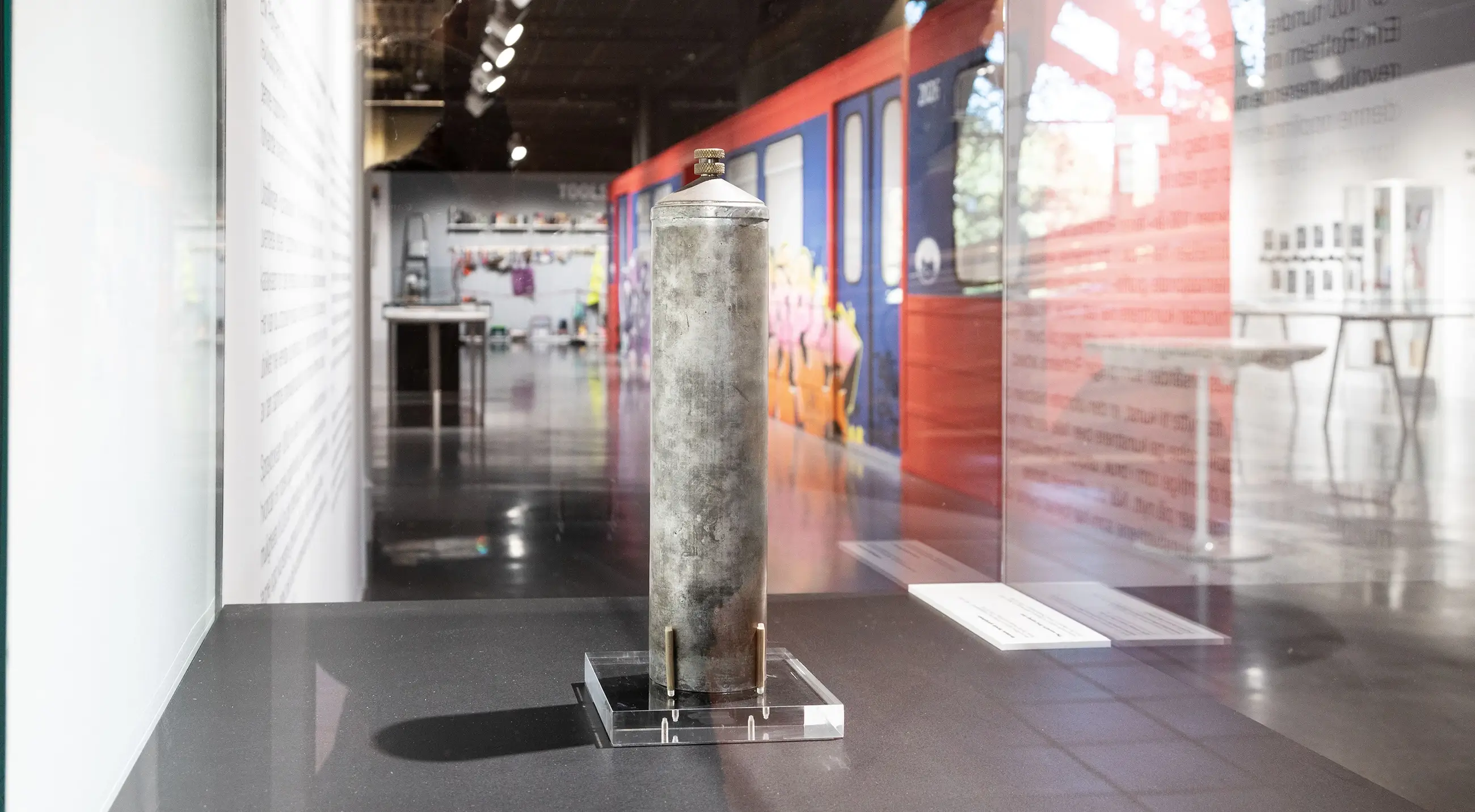
The world's first
spray can
Did you know that the spray can is a Norwegian invention? Erik Rotheim submitted the patent application on October 8, 1926. The example that was made at Alnabru in 1933 by Alf R. Bjerckes in collaboration with Rotheim, is the world's first!
By Dag Andreassen
Erik Rotheim and the factory had collaborated for a few years to develop Rotheim's patent from 1929 on a "method for spraying or distributing liquid liquids or semi-liquid masses" - Norwegian Patent No. 46613. The Norwegian had also applied for patents in several other countries, and among other things was granted American patent US Pat. No. 1800156 in 1931.
The collaboration between Rotheim and Bjercke never resulted in any profitable product. The production method for the bottles was too expensive, the nozzles became clogged and the propellant gas dimethyl ether, which Rotheim first used, was both expensive and dangerous. Instrument maker Frode Mortensen, who i.a. had participated in the development of Birkeland's electric cannon, made several attempts to create a better nozzle, and in 1936 took over the production rights for the Rotheim boxes from Alf Bjercke. His new company Morton System experimented with both insecticides and canned varnish, but went bankrupt in 1939. Rotheim's mother Erica and his brother Hagbart then started their own company Elromix, to exploit the inventions, after the inventor died suddenly of appendicitis only 40 years old old (Aftenposten 5 June 1957).
At the same time, the American Goodhue worked at the chemical giant du Pont with similar solutions. Rotheim had made several sales promotions for the patents in the USA, and had meetings with, among others, du Pont for possible license production. They had refused, i.a. because they considered the propellant gases too dangerous. They therefore instead developed their own solutions rather than paying to use the Rotens patents. Another explanation may lie in the fact that, after the outbreak of war in 1939, the American state seized patents held by German or supposedly German persons or firms, so that American industry was free to use these patents.
The inventor's mother, Erica Rotheim, is said to have tried to negotiate a replacement for this after the war. under the quite correct argument that Rothheim was not German at all. The family also believed that du Pont owed them a license for many millions of produced spray cans. It is unknown whether this led to any compensation, but Rotheim's name in any case became better known also in the USA beyond the 1950s. The Rotheim family's company Elromix does not appear to have been active after 1940.
When Goodhue obtained its own patents on various methods of "insecticide application", in practice spray bottles, it was with propellants they had developed under the name Freon - chlorofluorocarbon compounds known as CFCs, which led to the commercial breakthrough for the spray can. Also important was the first major customer: the US Army, which needed insecticides for soldiers during the Second World War, and ordered millions of cans that du Pont sold as "bug bombs". When the war was over, the technology was well-proven and well-known, and a number of new products found their way into spray cans, such as paints and varnishes, hair care products and perfumes, detergents and floor cleaners, and still insecticides.
After 1970, the focus was on the environmentally harmful effects of the CFC gases that were released into the atmosphere from all spray cans and other waste areas, such as refrigeration plants. Today's spray cans therefore use other propellants.
So who invented the spray can? Rotheim died aged just 40 in 1938, never experiencing any success. After 1950, his name was also promoted internationally by, among others, the European Aerosol Federation, which was founded in 1959 to bring together the industry that wanted to use and develop the spray technology. An award in Erik Rotheim's name, the Rotheim Medal, is still awarded by this organization to people who have distinguished themselves in the aerosol industry. In any case, it is a sign that Rotheim also stands strong internationally as one of the industry's important inventors. But as is often the case with innovations, there are several who may deserve such a place. The American Goodhue is often mentioned in the same breath as the one who managed to create a usable and profitable product based on his own patents - if it was more than inspired by Rothheim's patents. In any case, the fact is that the breakthrough for the spray can only came when the giant du Pont made a bet - and the US Army was ready to buy an unlimited number of cans.

Rothheim's patent drawing. Photo: NTM

