Public Health, Phone Bills and Nesquik
After 1945, photography has gone from being something exclusive to becoming a natural part of almost everything we do, and it is difficult to imagine everyday life without it. When the toothpaste tube is empty, we snap a picture and send it to the person in the store. Eighty years ago, such a photographic shopping list would have been unthinkable. Photographs have now become so common and natural that we hardly notice them, nor the extent to which they shape our lives. They have become invisibly present.
The changes have happened both gradually and abruptly. With photography, step counts and telephone bills were recorded, our bodies were scanned, and with the disposable camera, everyday life was captured on film. Some photographs have shaped our national self-image. Others have had a direct impact on society, working life, and industrial development. More than a book about what photographs show, this is a book about what photography does.


1. In 1986, the Japanese film manufacturer Fuji launched the first disposable camera, the Fujicolor Quicksnap. The camera body was made of plastic and contained a roll of film with space for 27 exposures. When the film was used up, the entire camera was handed in, broken open, the camera body destroyed and the film developed. The disposable camera quickly became popular and by 1996 half of all cameras sold were this type of "use and throw away" camera.
– Photo: Håkon Bergseth / NTM
2. In the 1950s and 1960s, color took over Norwegian photography. Advertising photographers led the way in adopting new technology that involved new infrastructure with their own color labs for development and new knowledge about lighting and color tones for the photographers.
- Photo: Jan Fredrik Sohlberg / NTM
Invisible Present is not a presentation of greats, the most important Norwegian photographers or photographs. Rather, it is a story about all the images that have shaped and are shaping our lives. It shows how photographic practices have entered society and how photographs have been produced, used and received. The most important photographs in this book are therefore the images that testify to what photography has done in Norway. It is photography that could reveal tuberculosis, contain traces of the causes of the Alexander Kielland accident.
Photographer Schwartzmann's Atelier
Sometime in the late 1930s, photographer Olav Væring photographed Morgenbladet's farm in Lille Grensen. The square in front of the farm is bustling with life, and the apartment building is adorned with advertisements and signs for various businesses. Just ahead of the large sign for Franz Schultz we can see "Photographer" and "Schwartzmann". These are the shop signs of the Jewish photographer Bernhard Schwartzmann. In 1933 he moved into a new and modern studio at Lille Grensen 7, where he ran a portrait studio and sold cameras and film to the amateur market.

Photographer Bernhard Schwartzmann's shop and studio in Lille Grensen, Oslo, 1930s.
– Photo: O. Væring / NTM
In November 1942, Bernhard Schwartzmann, like several other Jewish photographers, was forced to flee. That same autumn, the Law on the Confiscation of Jewish Property came into effect, and Schwartzmann's assets and wealth were confiscated and transferred to the Norwegian state. Alf Henry Mathiesen took over the studio and shop.
Schwartzmann survived the war and returned after the liberation. Whether the negative archive was preserved, we do not know. Several Jewish photographers who returned encountered destroyed archives and had to fight to get back both their businesses and their investments.
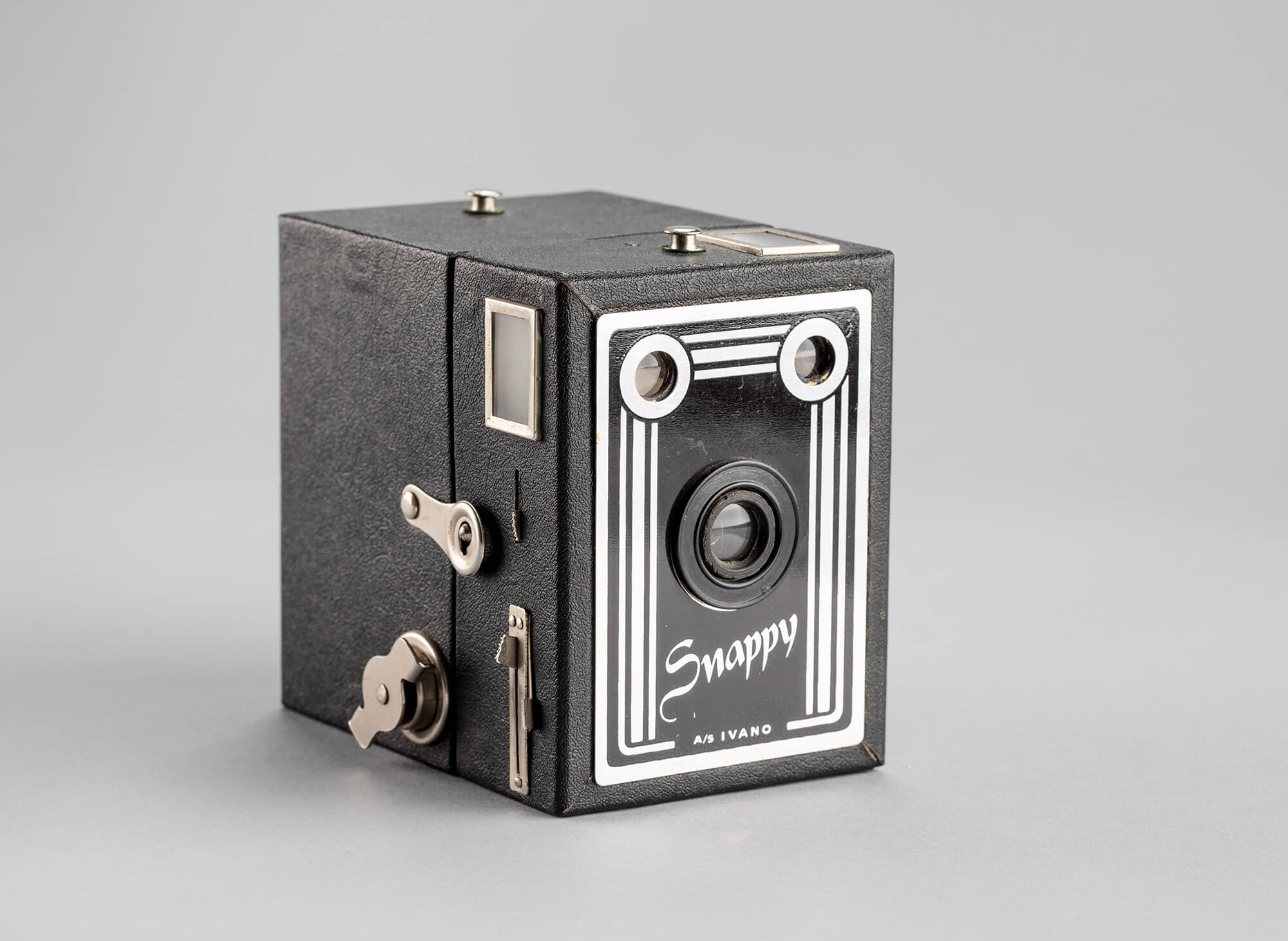
Snappy
The Snappy was a simple cardboard box camera aimed at the amateur market and is probably the only mass-produced Norwegian camera. However, not many were produced. Production began in the fall of 1951 and for a few short months it was possible to buy a Norwegian-made camera.
In the years after World War II, there were strict restrictions on the import of photographic equipment, including cameras, to Norway. Several people tried to start a crisis production of equipment, but few got access to the necessary basic goods. Ivar Nordviste from Valdres managed to maneuver between free lists and import restrictions controlled by the photo importers.
In the fall of 1951, he was able to advertise "Snappy", a camera that could be purchased for 40 kroner and of which 20,000 were now to be produced. How many were actually produced is unclear. The import restriction was soon relaxed and it became easier to buy other, well-known cameras from established manufacturers.

Snappy box camera, 1951.
– Photo: Håkon Bergseth / NTM
Chapter overview
The book is written by the museum's photo archivist Thale Sørlie in collaboration with conservator at the Norwegian Folk Museum Anja Langgåt, curator at the Preus Museum Hege Oulie and research librarian at the National Library Harald Østgaard Lund.
The photo book provides long-awaited knowledge about photography, an important theme in the museum's collections, and is based on a long-term research project funded by the Directorate of Culture and the institutions themselves. See reviews of the book from Kunstavisen, Museum and Kunstpodden.
"How to Develop a Photo History" Places the book within existing photohistorical research and describes the book's methodological and theoretical choices. The book jumps straight into an established photographic culture with the goal of describing an interaction between society and photography.
It fills a knowledge gap in Norwegian and international photography history, where the period between the 1940s and the 1990s has been little treated. "The material turn", visual culture, science and technology studies, and business history have been central theological frameworks.
"In the service of society" Photography was considered vital to a number of activities related to the reconstruction of the country, such as medicine, education and training, the construction of infrastructure and industry. But it was also about giving the reconstruction work a visual form through textbooks, postcards and exhibitions.
It has a clear government perspective, and shows how the governments in the period after World War II used photography as a tool in the reconstruction, both in a literal and visual sense.
"Professional Struggle" Examines the consequences, or lack of consequences, of World War II and the war settlement for Norwegian photographers and the photographic industry in Norway.
Shortages of goods and import restrictions gave industry organizations a high degree of control over professional practice, while also delaying technological development for Norwegian photographers.
It was not until the mid-1950s that import restrictions on photographic equipment were eased, and Norwegian photographers were allowed to take part in the technological developments that had occurred just before and during the war
"At Home" takes us home to the Gulbrandsen family in Drammen. From a consumer perspective, the chapter examines the everyday photographic practices of an average family in the 1950s and 60s.
The chapter looks at the photographs they had in glass and frames on the living room wall, those that were pasted in albums or projected onto a sheet on the living room wall, but also the photographs that were consumed via newspapers and magazines, and eventually received directly into the living room.
"To fight with the camera" Contrasts both the instrumental use of the authorities and the consumption of the average family described in the previous chapters. This is about how the countercultures of the 1970s and 80s, be they anarchists, communists, feminists or environmentalists, used photography politically.
The chapter discusses whether the countercultural movements through this helped to establish new photographic practices and a new view of photography.
"Pictures in the Hour" examines photography more instrumentally, as a tool in connection with the rationalization of society in the 1970s and 80s, where photography took part in the post-war mantra of productivity growth.
The photographic industry itself also underwent a rationalization, which contributed to lower prices, faster access, and a sharp growth in the use of photography.
"Collection and Division" looks at the consequences of this massive growth in the 1970s and 80s, a period that marks a high point for analog photography.
A number of forces came together to give photography an institutional and cultural anchoring through recognition as art, as culture worthy of preservation, and as an object of research, while at the same time the photography profession was professionalized through new educational programs and several professional organizations.
"Into the Network" Moving into the digital age, we examine the technological prerequisites for the distribution of photography, such as telephoto and the internet, and the major upheavals it brought to the photographic industry in the 1980s and 1990s.
News images, advertising images, historical images and private photos found their way online in various ways, and photography became increasingly ubiquitous.
In the face of changes in the media landscape, cultural and social life, and in the face of photographic technology itself, questions were raised in the 1980s and 1990s, both visually and in text, about what photography was and could be.
"New Visual Consciousness" takes a closer look at how genres and established practices were challenged in magazines and art, in a public where photography became more and more prevalent.
"New Visual Consciousness" takes a closer look at how genres and established practices were challenged in magazines and art, in a public where photography became more and more prevalent.