The accident
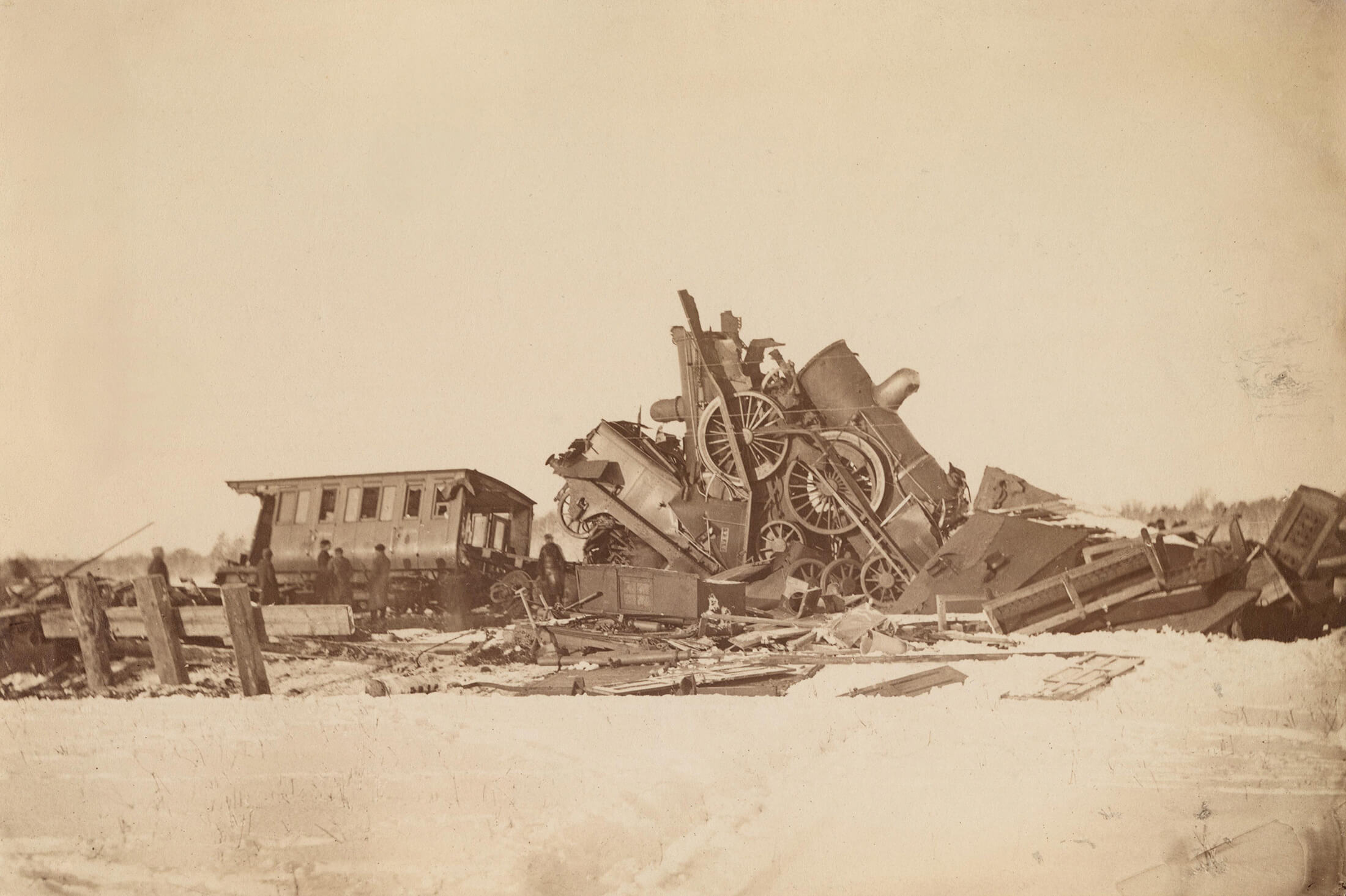
On a snowy November night in 1875, a delayed express train en route from Malmö to Stockholm skidded past a set of signal lights. It collided with an oncoming train in Lagerlunda, Sweden, killing nine people. Swedish physiologist Alarik Frithiof Holmgren (1831–1897) suspected that the trains crashed because railway workers were color-blind and had mistaken the colors of the signal lights.
He tested 266 employees to find out. The results counted 13 colorblind people, almost five percent. The study, which was published in several languages, helped transform color blindness from a curiosity into both a scientific field and a topic of public debate. The first standardized color vision test—perhaps one of the very first modern “visualization technologies,” as science historian Donna Haraway has called it—emerged from that accident.

Debris after the train collision in Lagerlunda, Sweden, in 1875. Holmgren believed that confusion between red and green signals may have contributed to the accident.
Recent research (Mollon and Cavonius 2012) suggests that the collision had several causes, but does not rule out that impaired color vision may have played a role.
– Photo: Railway Museum
In the article I use the term “color blind”, in line with my historical sources. Today, “color vision deficiency” is a more precise term. As the Norwegian physician and historian Erlend Hem wrote in 2004: “It has nothing to do with blindness, but means that color perception is altered.” It is, in short, a different way of looking at things.
Color synthesis test
150 years ago, scientists realized that they shouldn’t ask people to name colors during color vision testing. One reason was that people can disagree widely about what colors are called. This is also reflected in how color words vary from language to language and from one historical period to another. Another reason was that practice played an undefined role. As British surgeon Charles Roberts wrote in 1881:
"No decisive results can be obtained as to the efficacy of a person's color-sense by asking him the names of certain colours. One person's perception of colors may be irreproachable, yet his power of expression may be defective; whereas another may be colour-blind, but practice may have taught him the names of colours.”
Aware of these limitations, Holmgren designed his color vision test around actions rather than words. He asked test subjects to group a series of objects according to the color they perceived them to be. In developing the test, he tried colored glass, colored paper, chemical solutions, and silk.

Zephyr yarn embroidery, USA 1870-1890.
– Photo: Raynham Hall Museum
In the end, the choice fell on an industrially produced material known in German and the Scandinavian languages as zefyrgarn and in English as “Berlin wool”. It was an airy merino wool, dyed in Berlin with new synthetic aniline dyes. Zefyrgarn was cheaper and more vibrant than naturally dyed alternatives. In Stockholm, as throughout Europe, it was cheap and easy to find in every color of the rainbow.
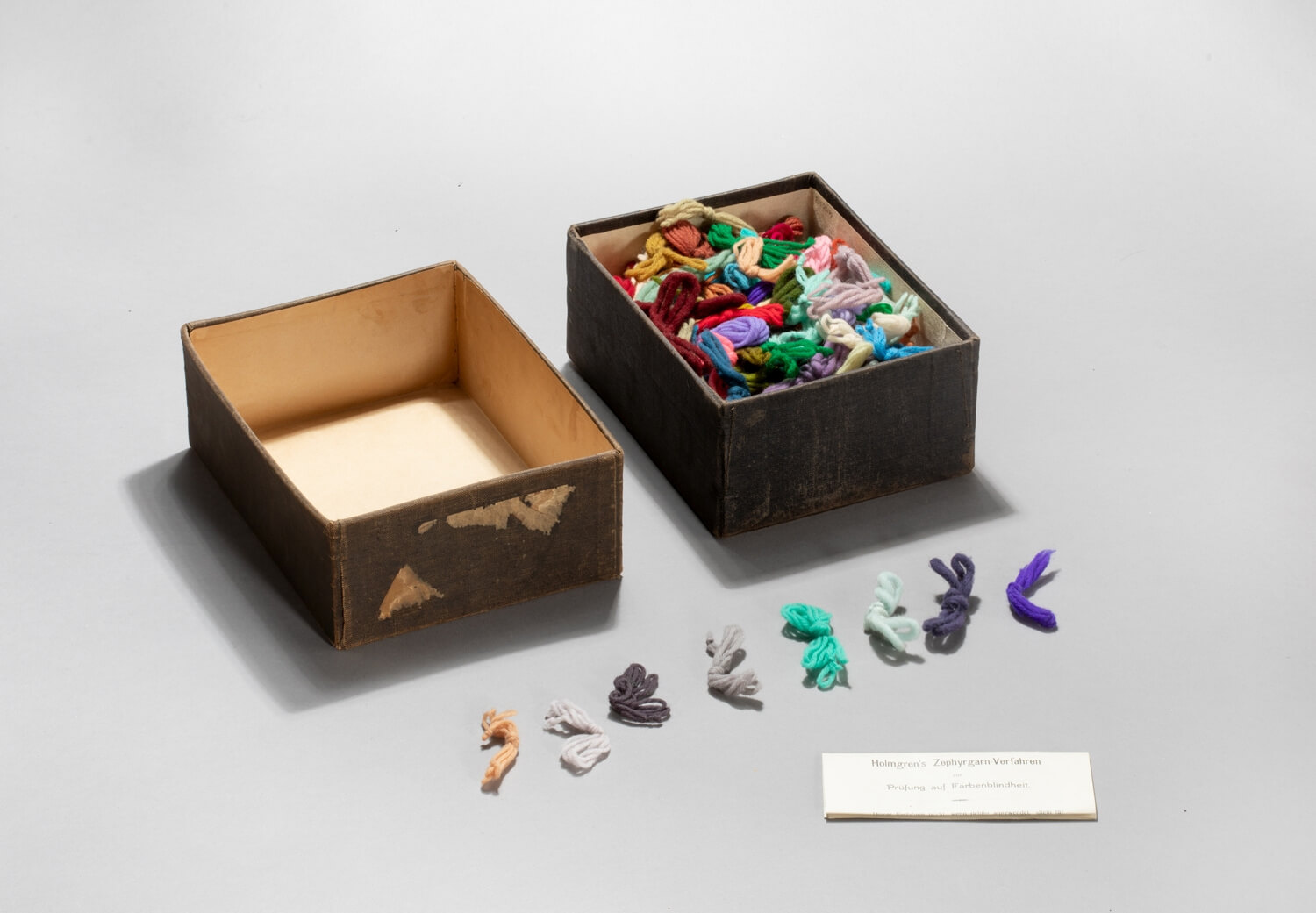
To conduct the test, Holmgren laid out a pile of 80–100 small bundles of marshmallow yarn on a table in daylight. The pile contained bundles in eight rainbow colors as well as brown, gray, pink, and purple—in at least five shades of each color, from pale to saturated. Without using color names, he asked the test subject to pick out the bundle that matched a pale green sample. A quick and accurate response meant normal color vision; an error or hesitation triggered another round with a bundle in dark purple to identify the specific type of failure—red, green, or blue.

The colors on the bundles of berline roll (zephyr yarn) have barely faded. The test came in an unmarked box with a small German-language insert and may have been made at home or assembled in Norway according to Holmgren's instructions.
Later versions, particularly from the United States and the United Kingdom, had simpler instructions and metal badges that made the test easier to administer and score.
– Photo: Håkon Bergseth / NTM
A disease?
Armed with his test, Holmgren set about collecting statistics on a large scale. Together with his assistants, he tested 7,953 Swedish railway employees, 4,225 sailors, 2,752 orphans, 1,851 soldiers, 1,523 students, 649 mill workers, and 321 prisoners and guards. Almost all of those tested were men, because women did not work in professions where color blindness was considered dangerous.
Holmgren's colleagues comprised an international network that used the same standardized test, and they measured populations in Norway, Finland, Denmark, the Netherlands, Germany, Austria, Switzerland, and the northeastern United States. The same number kept coming up: 4 to 5 percent. About one in twenty men tested positive for color blindness. The researchers were surprised by how high the number was.
Very few of the colorblind people knew they were. As Holmgren put it: "First and foremost, one should remember that color blindness is not a disease in the sense that it is associated with some kind of suffering, which prompts the color blind to seek medical advice." And yet he and his colleagues called the process of identifying it a "diagnosis"—a linguistic choice that suggested a patient in need of treatment. Thus, the choice of words did not agree well with Holmgren's own position.

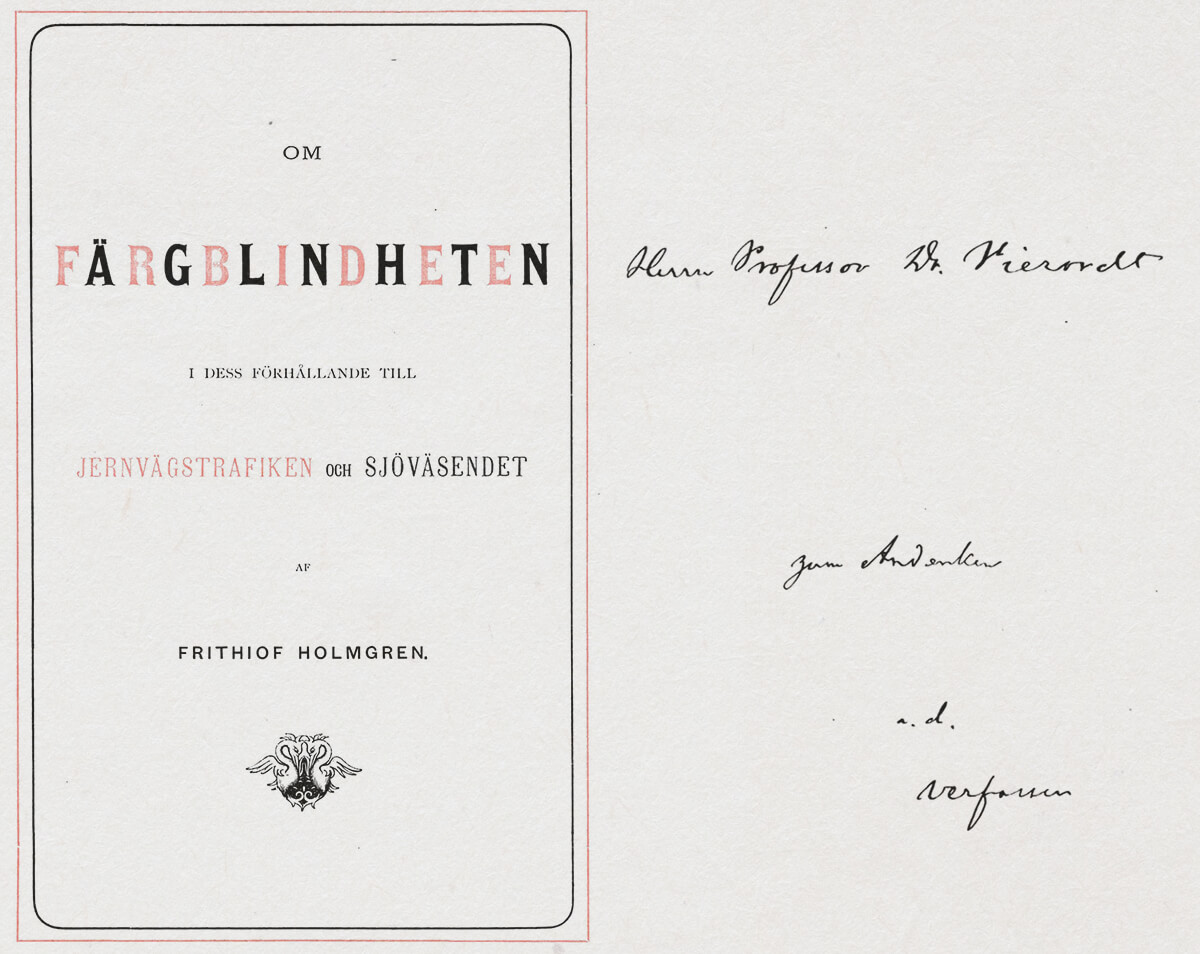
The cover of Holmgren's main work, On color blindness in its relationship to jernvägstrafiken och sjöväsendet (1877).
In the final chapter, he explains the theory behind and method of the yarn test, which he believed had only one significant weakness: it had to be carried out in daylight.
– Photo: HathiTrust Digital Library
The majority of people with impaired color perception, however, were not actually color blind, but fell into an intermediate category—“feeble color sense” in the parlance of the time. Before standardized color vision tests could provide a diagnosis, a person with impaired color perception did not necessarily experience their vision as impaired. The test did not simply identify these people—in the case of the milder “feeble color sense” category, it actually created them.
Colorblind women
Holmgren had a Norwegian colleague and occasional critic named Anders Daae (1838–1910). Daae was a physician in Kragerø, later a prison warden, and a pioneer in fingerprint identification. In the 1870s, he became part of the international network of researchers who used Holmgren's yarn test to compile statistics on color vision.
Daae wrote in 1878 that the boundary between normal color vision and color blindness was rather arbitrary. Arbitrary or not, the classification nevertheless had real consequences. He lectured to other doctors in Kristiania about the importance of testing sailors and railway workers for color blindness to prevent accidents like the one in Lagerlunda, Sweden, with which this essay began.
In 1877, Daae Holmgren conducted a test on 413 Norwegian schoolchildren, half boys and half girls. None of the girls he tested were color blind, and only five of them showed impaired color perception. Among the boys, the well-known proportion of 4.88 percent tested positive for color blindness, and a further 5.36 percent showed impaired color perception.

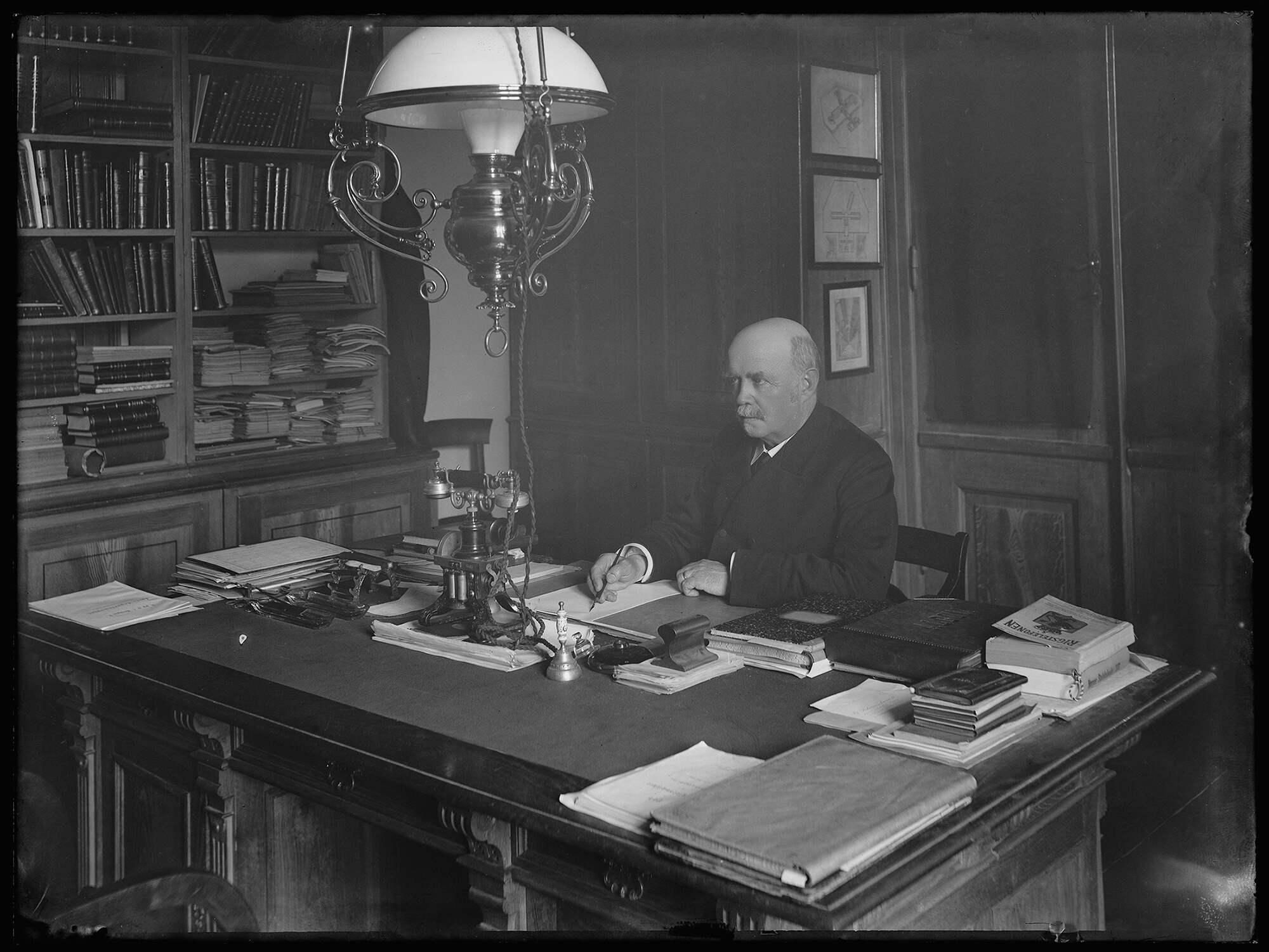
Prison director Anders Daae at the desk with his elaborate telephone at Botsfengselet in Kristiania in 1904. Daae worked as a doctor in Kragerø from 1864 to 1887, before becoming prison director in Trondheim and later Kristiania.
In 1894, prisoner Lars Erikson attempted to kill him at Trondhjem Prison, but a prison guard was killed instead.
– Photo: National Library
It is now well established that many forms of color blindness are linked to a mutation on the X chromosome, making it a sex-linked trait that is far more prevalent in XY than in XX bodies. However, in the 1870s, there was not enough data to convince male scientists that men were truly inferior to women in this respect.
American vision expert Benjamin Joy Jeffries argued in 1877 that women were “probably” just better at hiding their color blindness from test takers. Social expectations regarding women’s knowledge of clothing and cosmetics gave them practice and pressure to learn to name colors correctly: “most likely future statistics, based on true methods of testing, will reverse the now quite general impression as to their having better color-perception.”
Daae was not convinced. He relied on his own data and stated in 1878 that women "only extremely rarely" showed signs of color blindness. He suspected that women's sharper sense of color was somehow hereditary, and wrote that "the sharper sense of colour, which the Fruentimmers have acquired and developed over many generations through the pursuit of colored objects, is inherited essentially sexually or to the same sex."
He did not know the mechanism, but he pointed, albeit uncertainly, towards a sex-linked genetic explanation. Darwin had published his theory of sexual selection only six years earlier, and here we may see Daae grappling with the implications of this new evolutionary theory.
Confusion colors
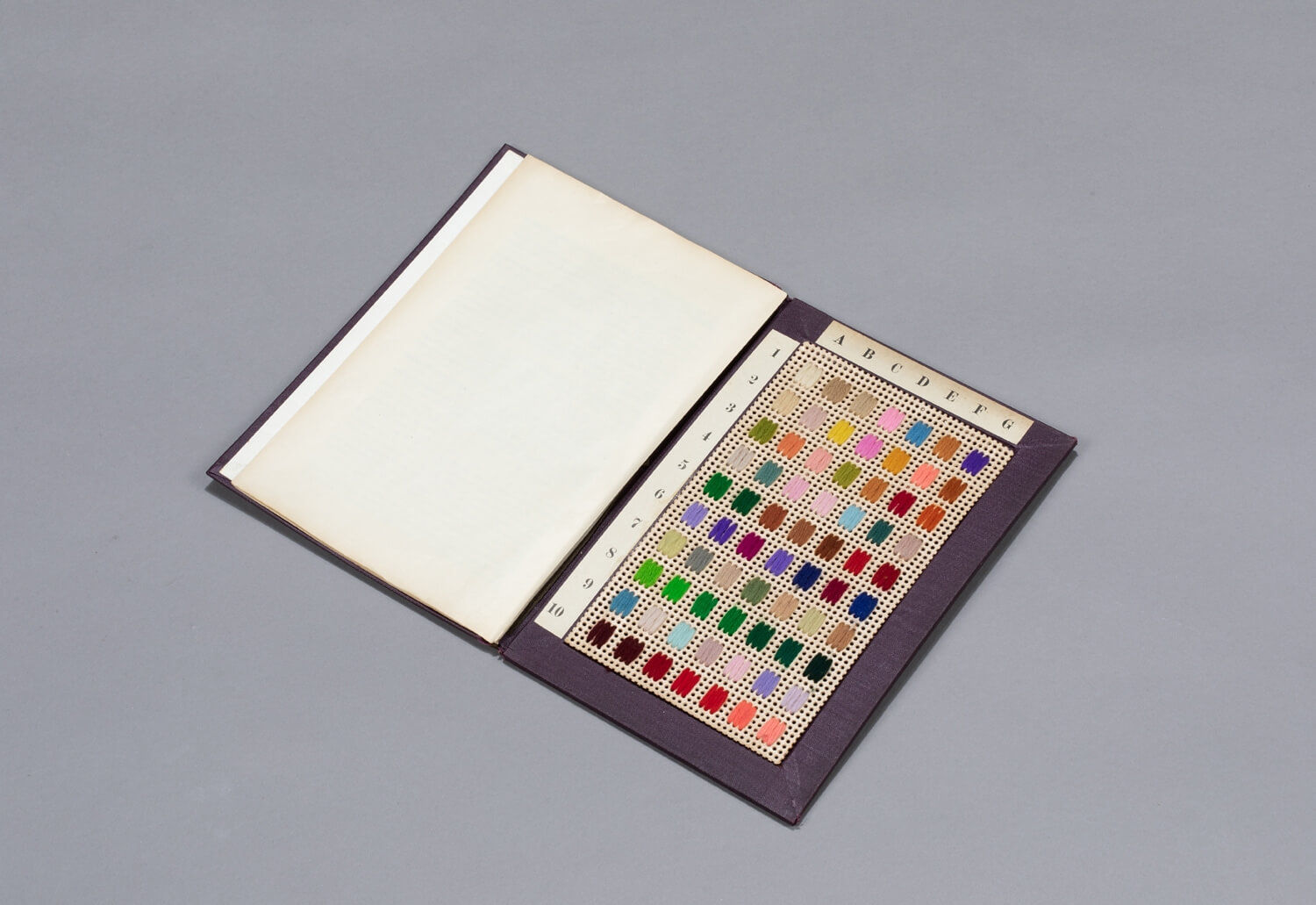
Daae also had his own opinions about Holmgren's test. He thought it was unnecessarily complicated, and in 1877 he created his own variation using zephyr yarn embroidered – probably by his sister Sophie, who owned an embroidery shop – on a small piece of coarse textile in a 7 x 10 checkerboard pattern.
To a normal-sighted eye, the color combinations looked almost random, except for one all-green row and one all-red row. To a color-blind eye, it was not random at all: impaired color discrimination caused certain mixed rows to appear uniform, the same color in lighter and darker shades. The trap was hidden in broad daylight—a color-blind test subject gave himself away by seeing order where a normal-sighted person saw variation.
To a normal-sighted eye, the color combinations looked almost random, except for one all-green row and one all-red row. To a color-blind eye, it was not random at all: impaired color discrimination caused certain mixed rows to appear uniform, the same color in lighter and darker shades. The trap was hidden in broad daylight—a color-blind test subject gave himself away by seeing order where a normal-sighted person saw variation.

The examiner went through the rows and asked if they appeared to be variations of one color. An unexpected “yes” (except for rows 8 and 10) indicated impaired color perception.
The letters and numbers were added by a German colleague; earlier versions of the test had a slightly different color scheme.
– Photo: Håkon Bergseth / NTM
Daae designed his test so that it could be used by a wider circle than Holmgren had intended – general practitioners, railway and naval doctors, teachers and textile workers. It required no preparation and contained only 10 yes-or-no answers. Because it was flat, it could be inserted into a thin booklet and distributed all over the world. It was first published in Kragerø and was quickly picked up by a publisher in Berlin. Copies of the test can be found in museums and libraries throughout Europe and North America. It was still in print as late as 1898.
The test identified what Daae called “red-green blindness,” and merged Holmgren’s red blindness and green blindness into one practical category—still in use today, and still with Daae’s definition: a tendency to confuse red with green. As Daae wrote: “In practical terms, it is of no interest to distinguish between green blindness and red blindness. Common to both types of color blindness is the inability to distinguish with certainty between red and green, that is, between the colors that are accepted as signal colors both on board ships and on railways.” He was pragmatic: the test had to work and save lives, regardless of who won the scientific argument about trichromatism.
Wool and satellites
Daae designed his test to be used by a much wider audience than Holmgren had intended – general practitioners, railway and naval doctors, teachers and textile workers. It required no preparation and contained only ten yes-or-no answers.
Because the test was flat, it could be inserted into a thin booklet and distributed worldwide. It was first published in Kragerø, before a publisher in Berlin quickly picked it up.
Copies of the test can be found today in museums and libraries throughout Europe and North America. It was still in print as late as 1898.
The test identified what Daae called "red-green blindness" and merged Holmgren's red blindness and green blindness into one convenient category. The category is still in use today, with Daae's definition: a tendency to confuse red with green.
As Daae wrote: "In practical terms, it is of no interest to distinguish between Greenblindness and Redblindness. Common to both types of color blindness is not being able to distinguish with certainty between red and green, i.e. between the colors that are accepted as signal colors both on board ships and on railways."
He was pragmatic. The test had to work and save lives, regardless of who won the scientific argument about trichromatism.
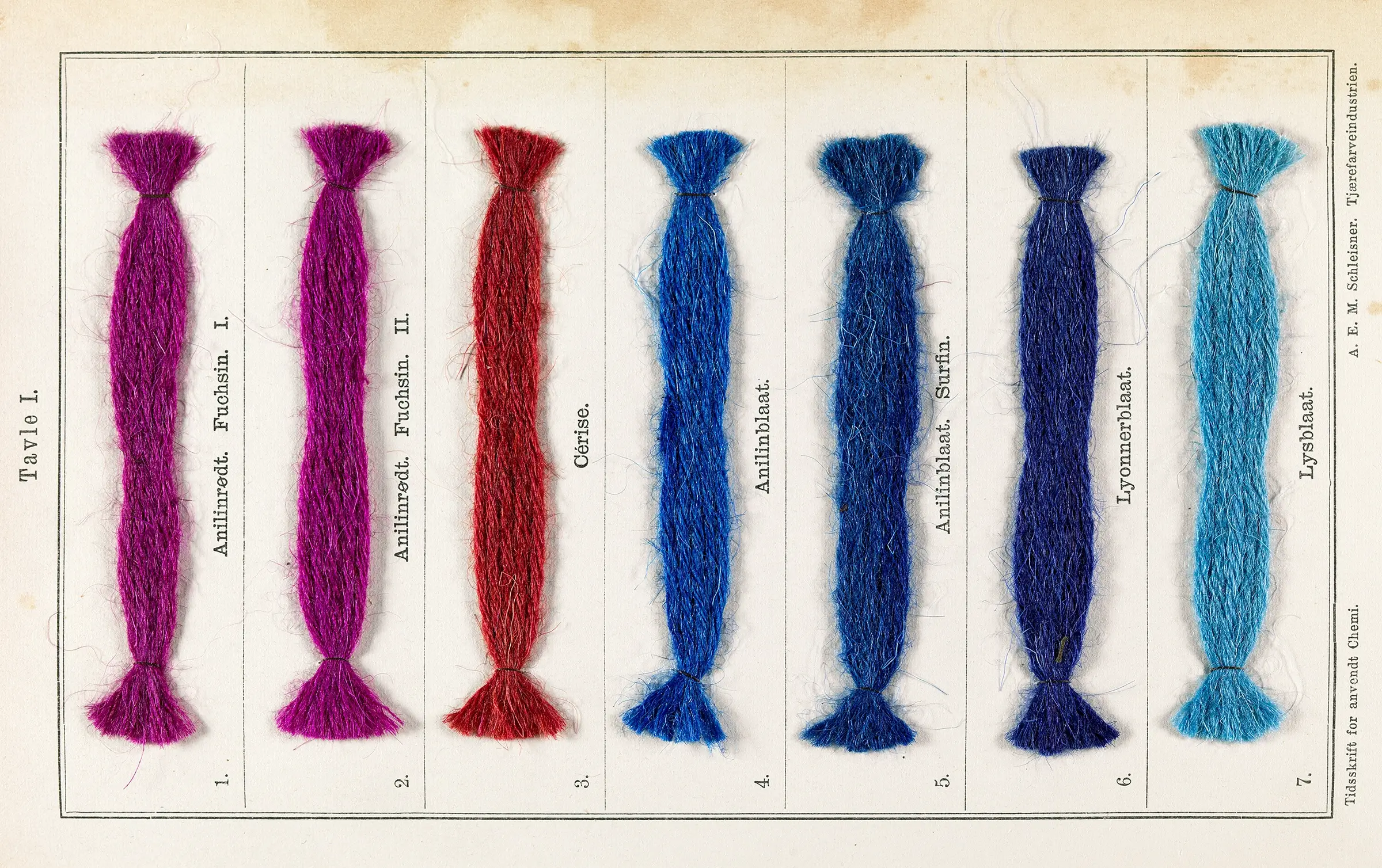
Color samples from Schleisner's article series on aniline dyes.
– Photo: Fredrik Oftebro
As Haraway formulated it: "Feminist objectivity makes room for surprises and ironies at the heart of all knowledge production: we are not in charge of the world. We just live here and try to strike up non-innocent conversations by means of our prosthetic devices, including our visualization technologies.".
These devices include electron microscopes, computer monitors, CT and MRI scanners, space cameras, satellite surveillance systems, color enhancement techniques, and so on – and more modest technologies such as embroidery thread synthetically dyed in a wide range of colors.
The fact that our current understanding of color perception, and our dazzling visualization technologies, are partly rooted in a Swedish train disaster in 1875 – and in one man’s reworking of his sister’s embroidery board two years later – does not weaken our appreciation of science. On the contrary, it strengthens it.