Arctic imperialism
Three flags were thrown into the Arctic midnight sun – one Norwegian, one American and one Italian. The flags represented the nationalities of the men who had organized and jointly led the expedition: polar hero Roald Amundsen from Norway, adventurer and wealthy son Lincoln Ellsworth from the United States and Italian engineer Umberto Nobile. Amundsen had taken the initiative for the expedition, Ellsworth provided funding, and Nobile was the airship’s designer and captain.
The flight to the pole from Ny-Ålesund in Svalbard had gone without a hitch, but the expedition was far from over. The main goal was to fly over the Arctic Ocean to explore the white areas on the map between the North Pole and Alaska. This goal was achieved when the ship landed in Teller, Alaska, on May 13.

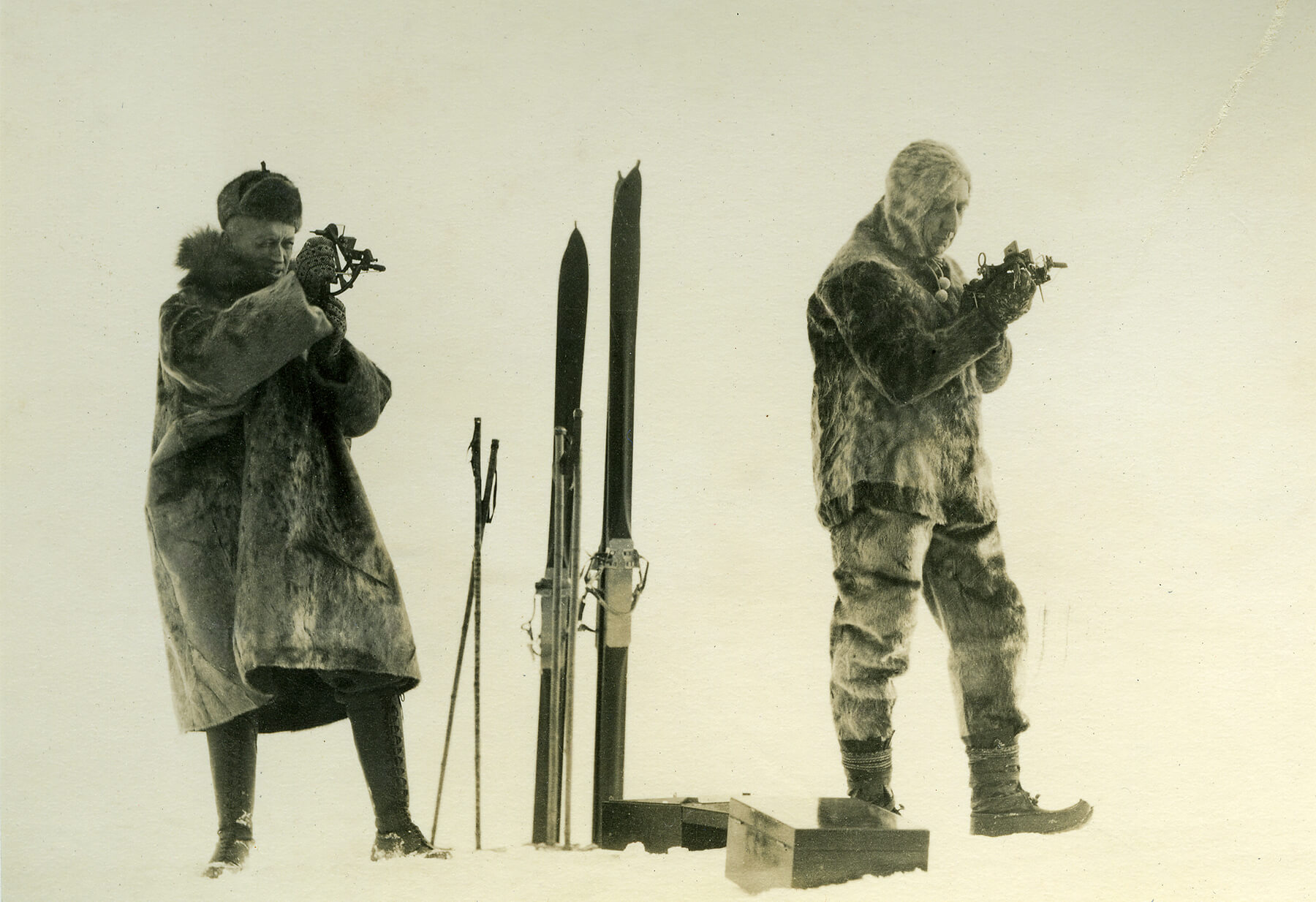
Lincoln Ellsworth (left) and Amundsen (right) test the sun compasses in Ny-Ålesund before the flight towards the North Pole.
– Photo: Paul Berge/NTM
Races on ice and in the air
Roald Amundsen's interest in the North Pole was not new. In 1909, he had been on his way there, but changed his plans when it became known that the Americans Cook and Peary had claimed to have reached the North Pole, a claim that was later doubted. Amundsen secretly changed course and instead threw himself into the race to the South Pole, which he reached in December 1911 ahead of the Briton Robert F. Scott.
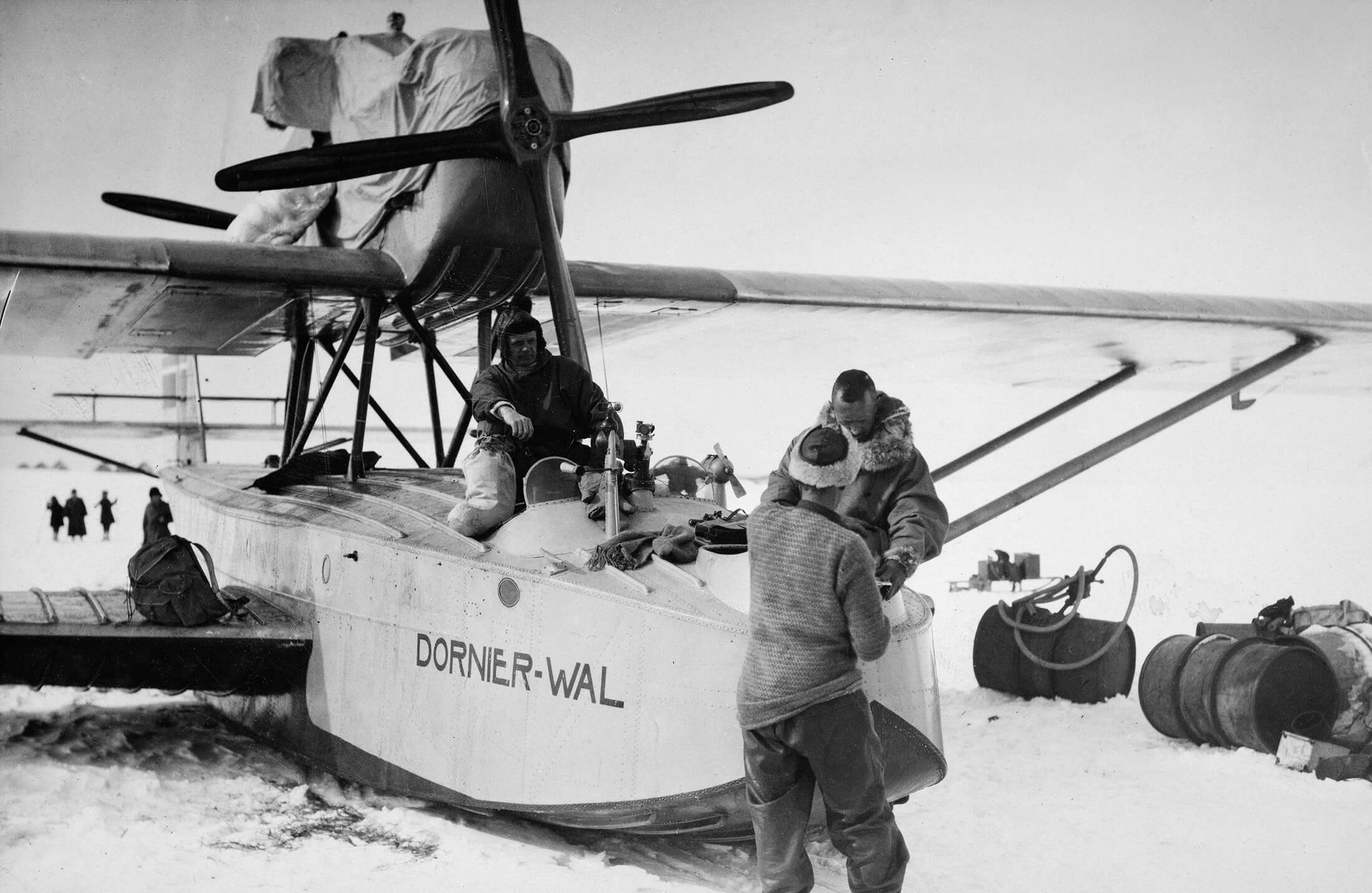
The development of aviation opened up new ways to conquer the Arctic, and Amundsen gave in to the temptation. He had obtained his pilot's license in the United States during World War I, and an expedition by plane to the North Pole would make him the first person to reach both poles. With financial support from Lincoln Ellsworth, in 1925 he acquired the flying boats N 24 and N 25 from the German Dornier Wal and headed north.
The expedition consisted of six people, including the pilot Hjalmar Riiser-Larsen and Ellsworth as navigator. The plan was to fly from Ny-Ålesund and land on the ice at the pole point to investigate whether it was solid land or just ice, before returning. That did not work out. After an emergency landing on an ice floe, N 24 was no longer airworthy, and after weeks of hard work, the entire crew barely managed to make it back to Svalbard aboard N 25. Despite the failure, the expedition became a media event of great proportions.

Roald Amundsen's Dornier Wal flying boat "N25" before takeoff from Kings Bay, Svalbard in 1925.
– Photo: Paul Berge/NTM
The idea of using airships instead of airplanes arose during the planning of the flying boat expedition. Amundsen believed that airships were well suited for use in Arctic regions. Compared to airplanes, they had a longer range and could carry more weight, while at the same time reducing the risk of life-threatening emergency landings, as airships could be repaired in the air to a greater extent.
After Lincoln Ellsworth once again agreed to provide a significant amount of dollars, Amundsen and his inner circle began planning a new North Pole expedition. Hjalmar Riiser-Larsen, who had learned to fly airships in England, believed that the most suitable airships were found in Italy.
Giants of the Air
Today it is impossible to see a photograph of a 1920s airship without being filled with sadness and nostalgia. The images tell the story of a species that is extinct. In the past, things were different: back then, airships represented the avant-garde of technology, one of the most advanced creations of industrial society.
Germany was the leading country with its giant zeppelins. They focused on rigid airships, built around an aluminum skeleton that gave the ship a fixed shape throughout its length. The hydrogen gas that provided buoyancy was distributed in separate containers inside the skeleton, and the canvas stretched over the outside ensured that the ship kept its shape regardless of the amount of gas.
At the same time, the rigid airships had clear weaknesses: they could be difficult to maneuver and were very vulnerable to wind. Several countries therefore experimented with other designs, not least in Italy.

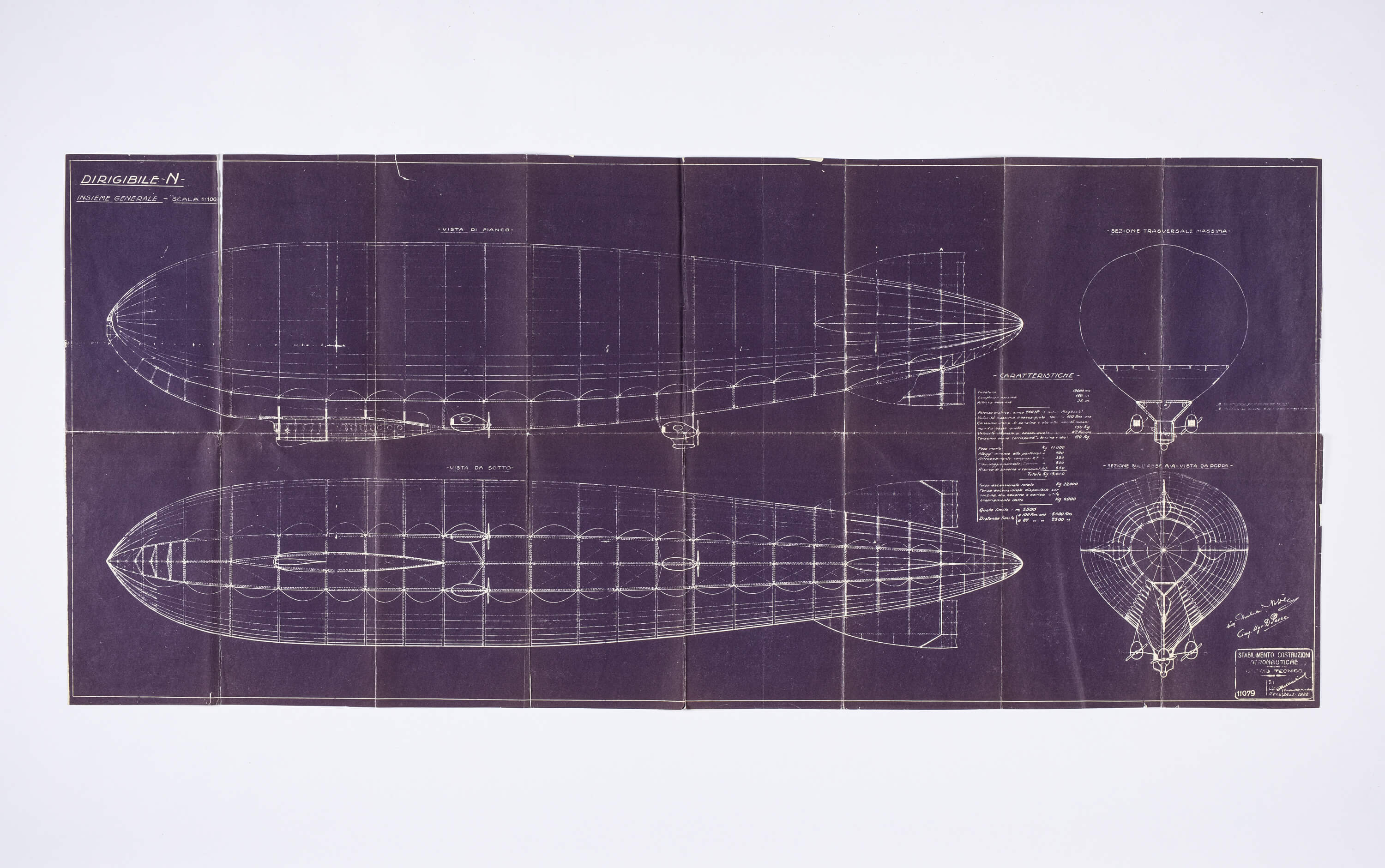
Blueprint of the airship N-1, with the text "Dirigibile - N - insieme generale - scala 1:100", signed Umberto Nobile 1922.
– Photo: Håkon Bergseth / NTM
Engineer Umberto Nobile held a high position at a military government aircraft factory outside Rome, where he led the development of what became known as semi-rigid airships. Instead of a continuous aluminum skeleton, Nobile opted for a solution in which only the front and stern of the ship were stiffened, while the gas tanks in the middle were held in place by more flexible structures.
Heavy components such as the engine and wheelhouse, called the gondola, were attached to a rigid aluminum keel that ran underneath the ship and held everything together. The design also meant that the airship lost its shape when the gas pressure decreased.
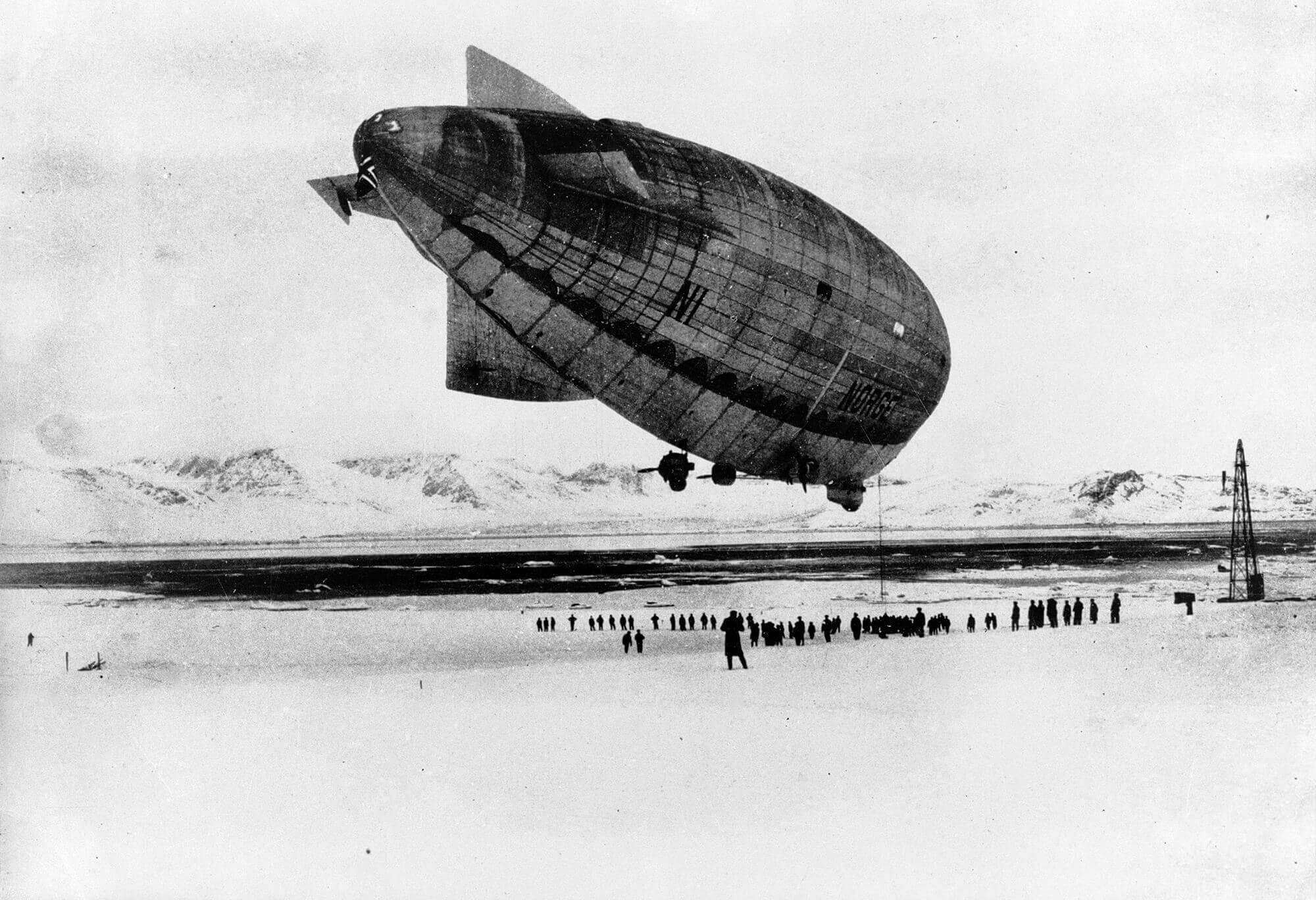
The new ship, named N1 - Nobile 1 - after its designer, was ready for test flights in the spring of 1924. It was smaller than the German zeppelins, but still towered well: 106 meters long, 24 meters high and 19 meters wide. Three Maybach engines, each with 245 horsepower, enabled a cruising speed of about 80 kilometers per hour.

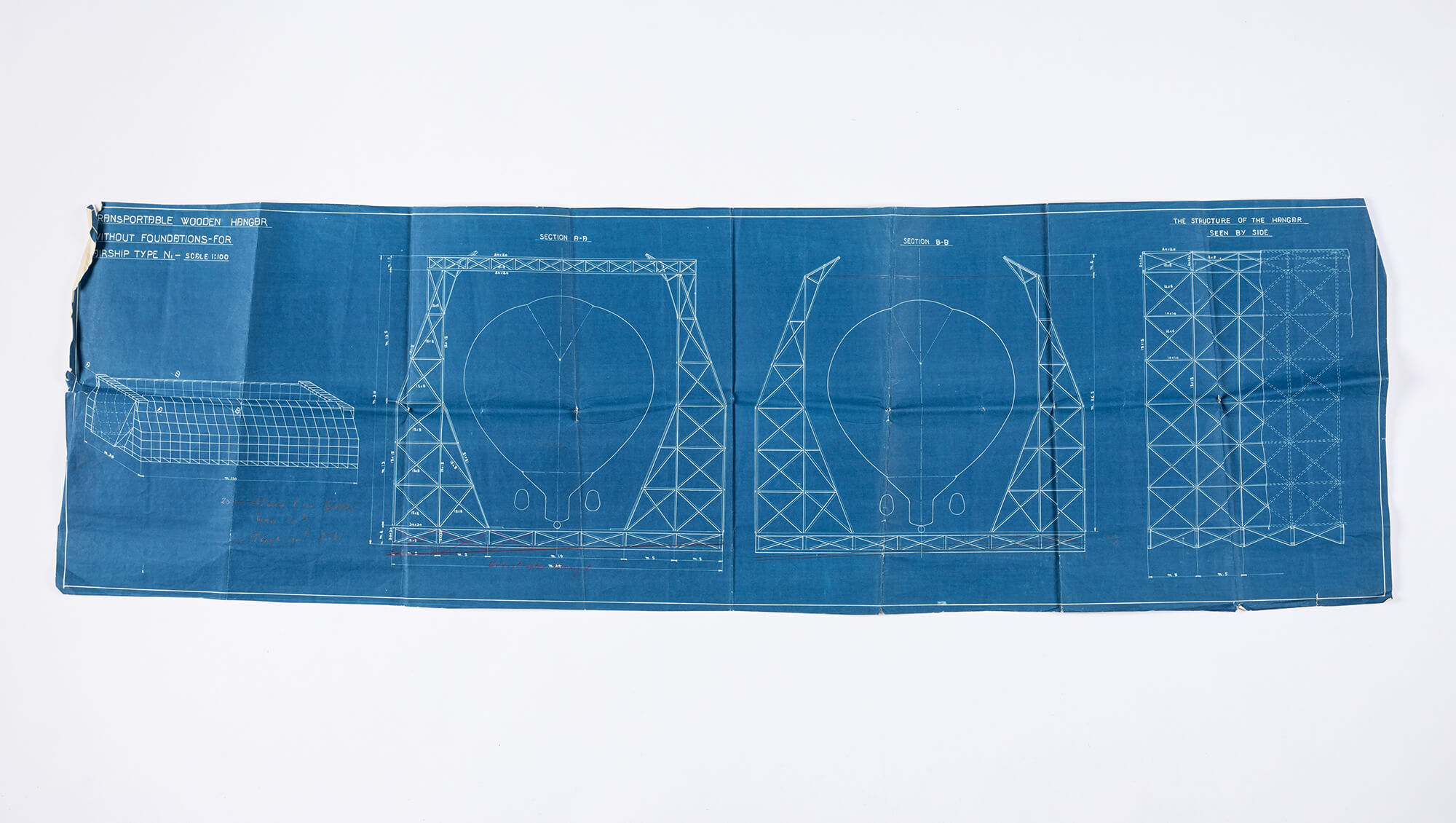
Blueprint of a portable hangar set up for the airship Norge in Ny-Ålesund by engineer Diderich H. Lund.
– Photo: Håkon Bergseth / NTM
N for Noble – N for Norway
In the autumn of 1925, Hjalmar Riiser-Larsen was sent to Rome to negotiate the purchase of N1. The Italian government, led by Prime Minister Benito Mussolini, was willing to sell. For Mussolini, the expedition was an opportunity to showcase the fascist state as a technologically leading aviation nation. The price was set at $75,000, with an agreement that Italy would buy the ship back for $46,000 if it returned in reasonably good condition.
Lincoln Ellsworth and Roald Amundsen were present when the contract was signed in Rome. The head of the Norwegian Air Sailing Association, editor Rolf Thommessen, put his name to the contract. The association contributed heavily to the financing of the expedition, was the formal owner of the airship and took responsibility for organizing the construction of the infrastructure on which the ship depended.
Flying the ship from Rome to the starting point of Ny-Ålesund on Svalbard was a demanding task in itself. Along the way, the airship had to make several stopovers, and it depended on special masts to which it could be moored. Such masts existed in some places in Europe, but not in Norway. In addition, a hangar was needed on Svalbard for maintenance and protection from the weather.

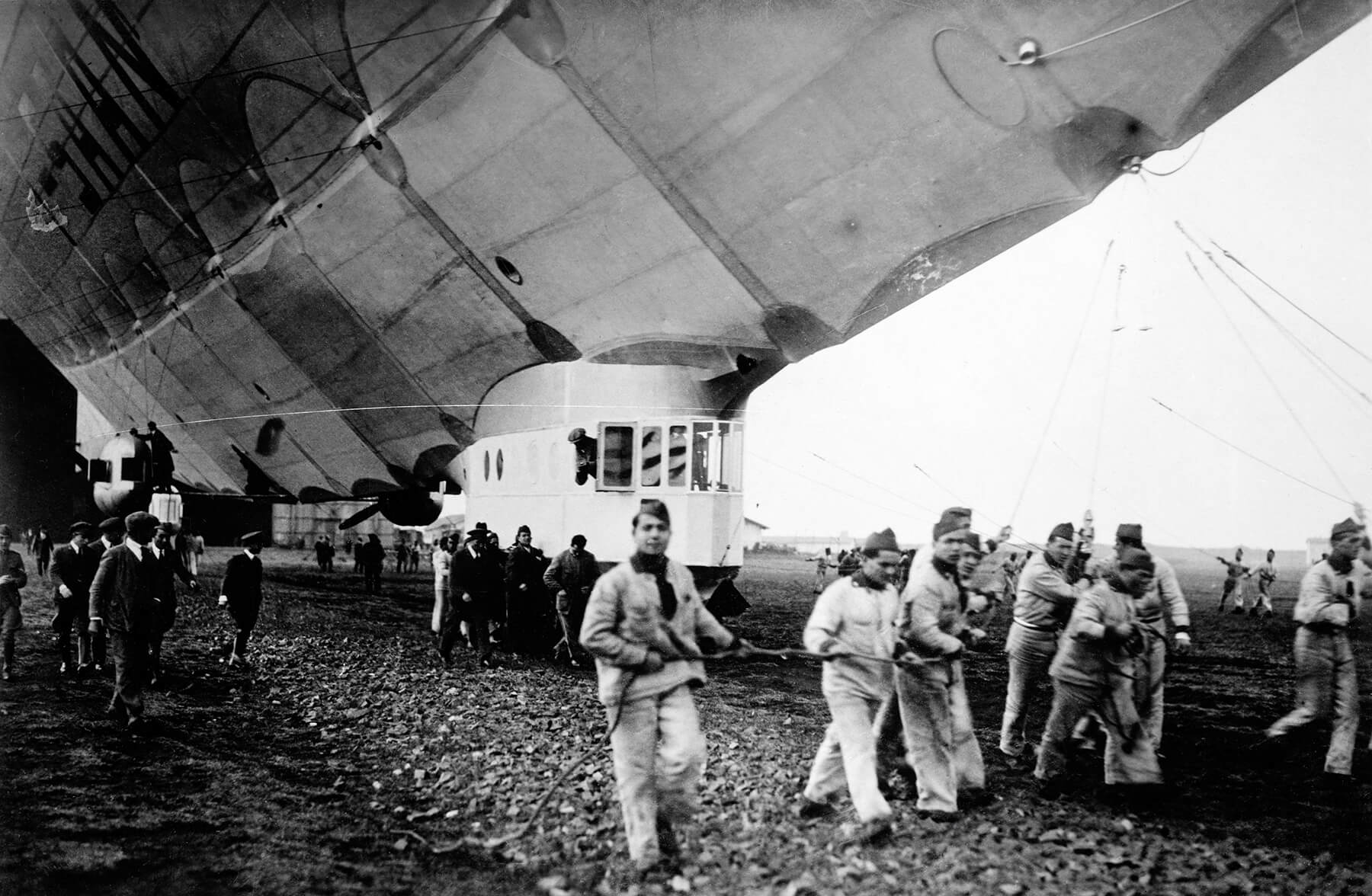
The airship is out of the hall, the markings I-SAAN have not yet been painted over. Ciampino Airport in Rome, March 1926.
– Photo: Paul Berge / NTM
First Lieutenant Johan Høver of the Norwegian Air Sailing Association coordinated the work. In the late autumn of 1925, he traveled to Ny-Ålesund to find a suitable site for the construction of a hangar and mooring mast. Before the ice froze, 50 tons of iron and 600 cubic meters of wood had to be shipped in, along with large quantities of concrete for casting the mast and hangar's anchor points.
Under very harsh weather conditions, master carpenter Ferdinand Reinhardt Arild led the construction of the hangar. Umberto Nobile sent schematic drawings for both the hangar and mooring masts from Italy, which were then processed and adapted in Norway by engineer Diderik H. Lund.
Lund had previously completed the 35-meter-high mast at Ekeberg in Oslo and supervised the construction of a similar mast in Vadsø, which was manufactured in Italy and transported to Norway in parts. In March 1926, he traveled to Ny-Ålesund to contribute to the final phase of preparations.
Both the hangar and mooring mast were completed two days before the ship with Roald Amundsen and Lincoln Ellsworth on board arrived in Ny-Ålesund on April 19. At that time, the airship had already taken off from its base in Rome and was heading north.

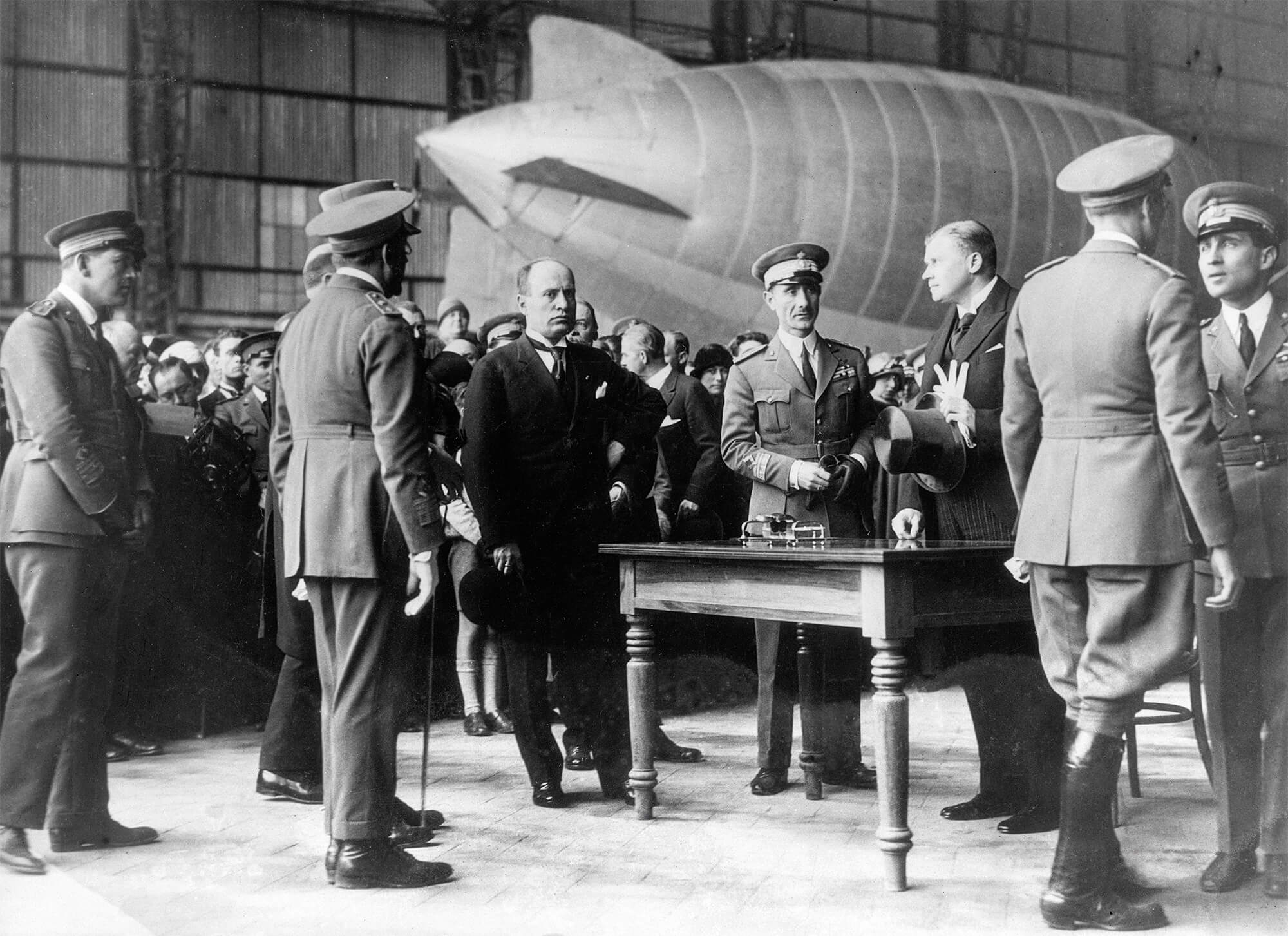
The airship is transferred from Benito Mussolini to editor Rolf Thommesen, head of the Norwegian Air Force Association. Rome, 29 March 1926.
– Photo: Paul Berge / NTM
From Rome to New Ålesund
A few weeks earlier, Roald Amundsen and Lincoln Ellsworth had been in Rome. They were both present at Ciampino Airport on March 29, when Benito Mussolini, together with the Italian King Victor Emanuel III, handed over the airship to its new owners. At the same time, it changed its name from Nobile to Norge.
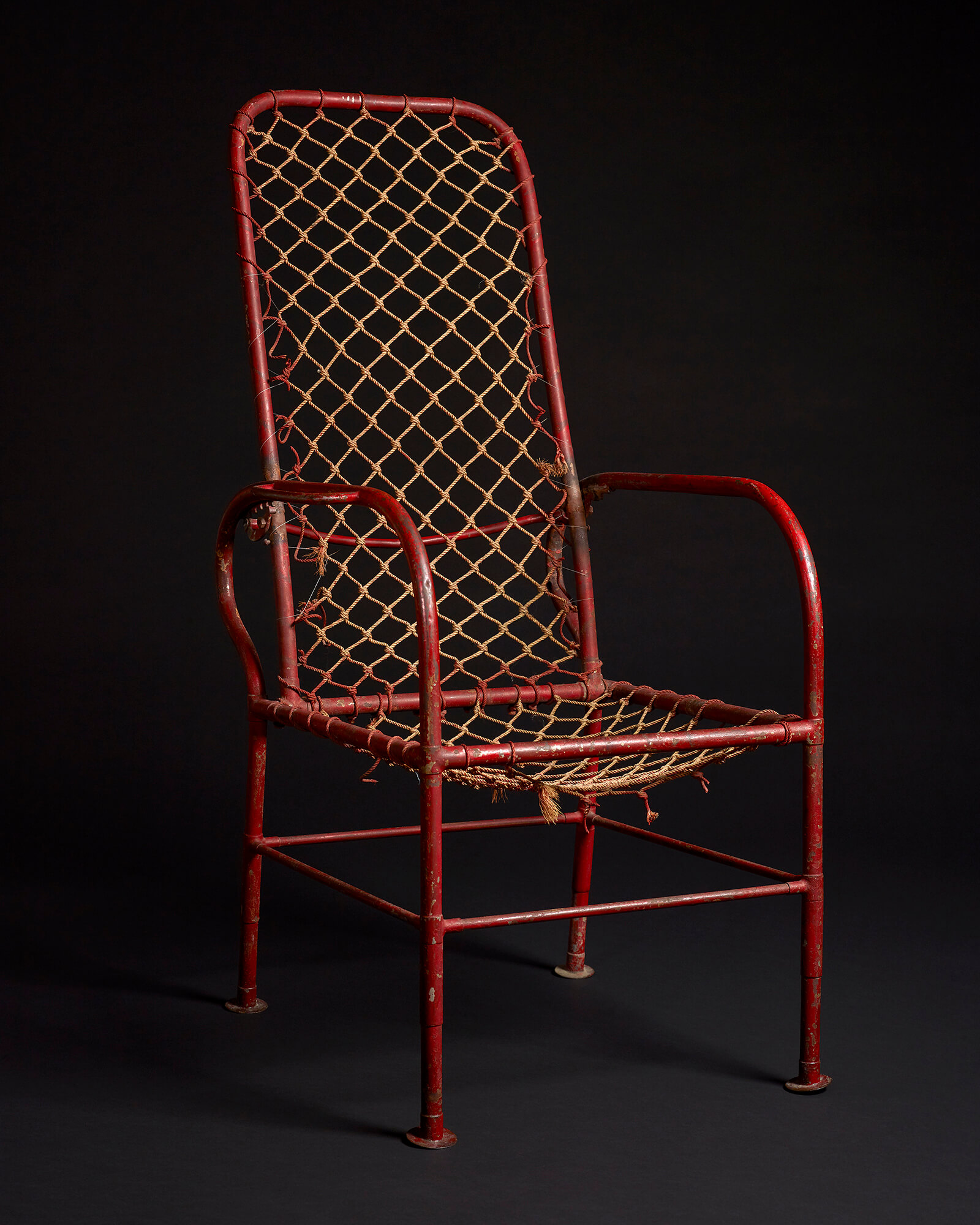
The ship had undergone several important changes before delivery. The luxurious salon with designer furniture had been removed, as had the separate cabins. To save weight, a new, smaller gondola had been built, extremely spartanly furnished and consisting of only one room. Even the original roof was gone – anything that could reduce flight time had to be removed.


1. Chair that belonged to the gondola interior of the N-1 in Italy. Given by Major Høver to The Norwegian Museum of Science and Technology .
– Photo: Mari Karlstad / UiT
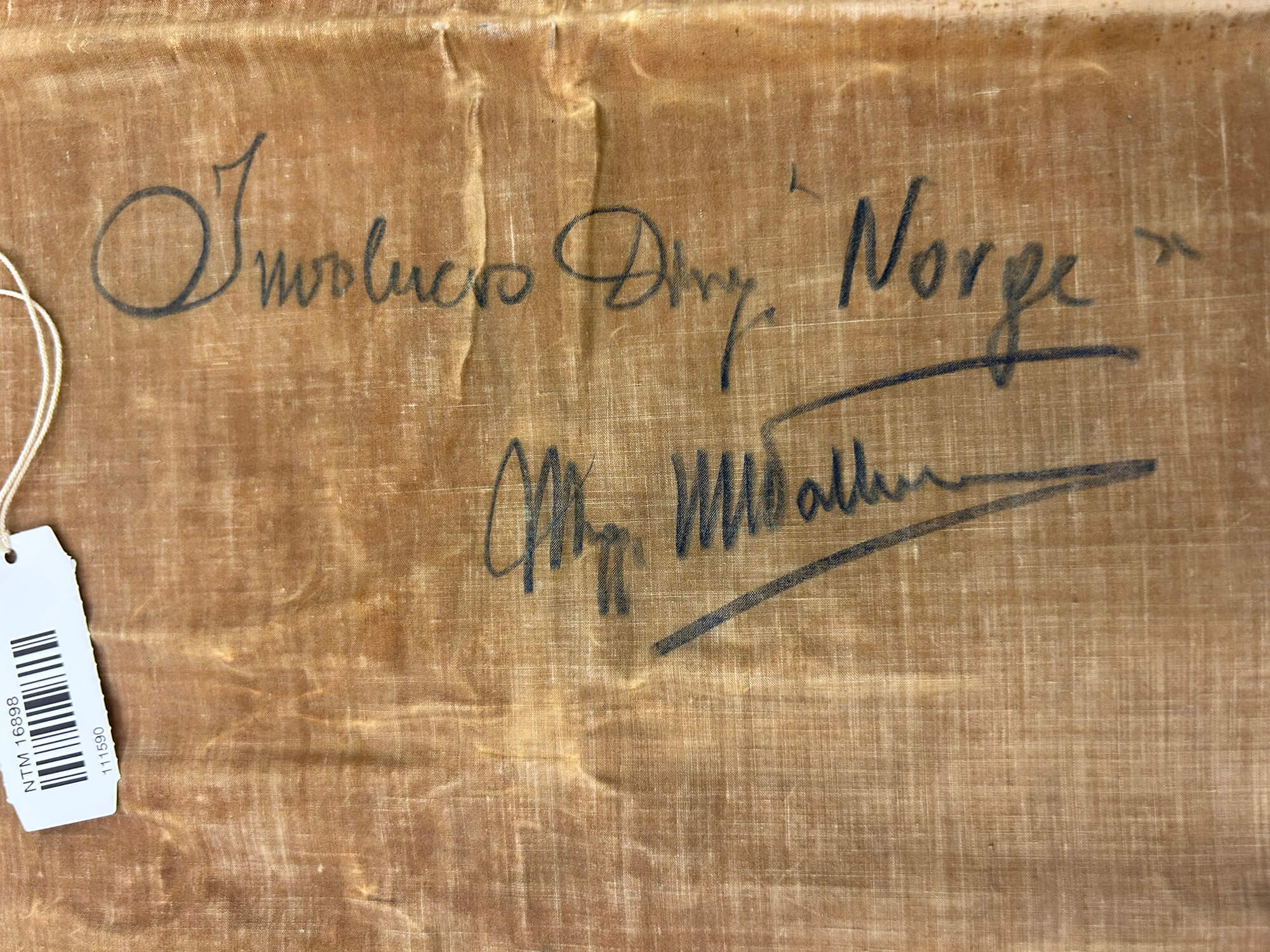
2. Section of a sample of oiled silk fabric from the balloon of the airship Norge, donated by Umberto Nobile to the Technical Museum.
– Photo: Tone Rasch / NTM
The expedition, which bore the name The Amundsen–Ellsworth–Nobile Transpolar Flight, officially began when the airship left Rome on April 10, 1926. Of the three leaders, only Umberto Nobile was on board for the first leg. He was both the ship's designer and its captain.
The crew on this leg consisted of six Italians, as well as the Norwegians Hjalmar Riiser-Larsen, Oscar Wisting and Gustav Amundsen, Roald Amundsen's nephew. Nobile's fox terrier, Titiana, was also on board. The owner was not without a sense of publicity.
The journey north received great attention in the international media and went without major problems. After the first stopover in Pulham, England, the ship docked at the mooring mast at Ekeberg on April 14. Thousands of Oslo residents flocked to the event and turned the event into a public celebration. The next stopover was Leningrad in the Soviet Union (today St. Petersburg in Russia), before the trip continued to Vadsø. On May 7, the airship finally arrived in Ny-Ålesund. Everything was now ready for the next, crucial stage.
Not a race
When the airship Norge landed in Svalbard, the opportunity to become the first to reach the North Pole from the air was still open. It now turned out that several people wanted this trophy.
On April 30, American polar explorer Richard Byrd had arrived in Ny-Ålesund in his three-engine Fokker plane. He was leading an expedition planning a round-trip to the North Pole from Svalbard, and time became a crucial factor: Would they make it before Norway was ready to depart?
There was no runway at the site, and the Americans had great difficulty getting the plane on its wings. After several attempts – in which members of the Norway expedition also contributed – Byrd and pilot Floyd Bennett took off on the night of May 9, heading for the North Pole. They returned after 16 hours and claimed to have reached the pole, a fact that was later strongly doubted, as the time spent was considered short.
Roald Amundsen congratulated Byrd and emphasized that the two expeditions were not competitors. Byrd had flown over the Pole, while the Norway expedition aimed to fly over the entire Arctic Ocean.

The airship Norge is steered towards the mast, Ny-Ålesund, May 7, 1926.
– Photo: Paul Berge / NTM
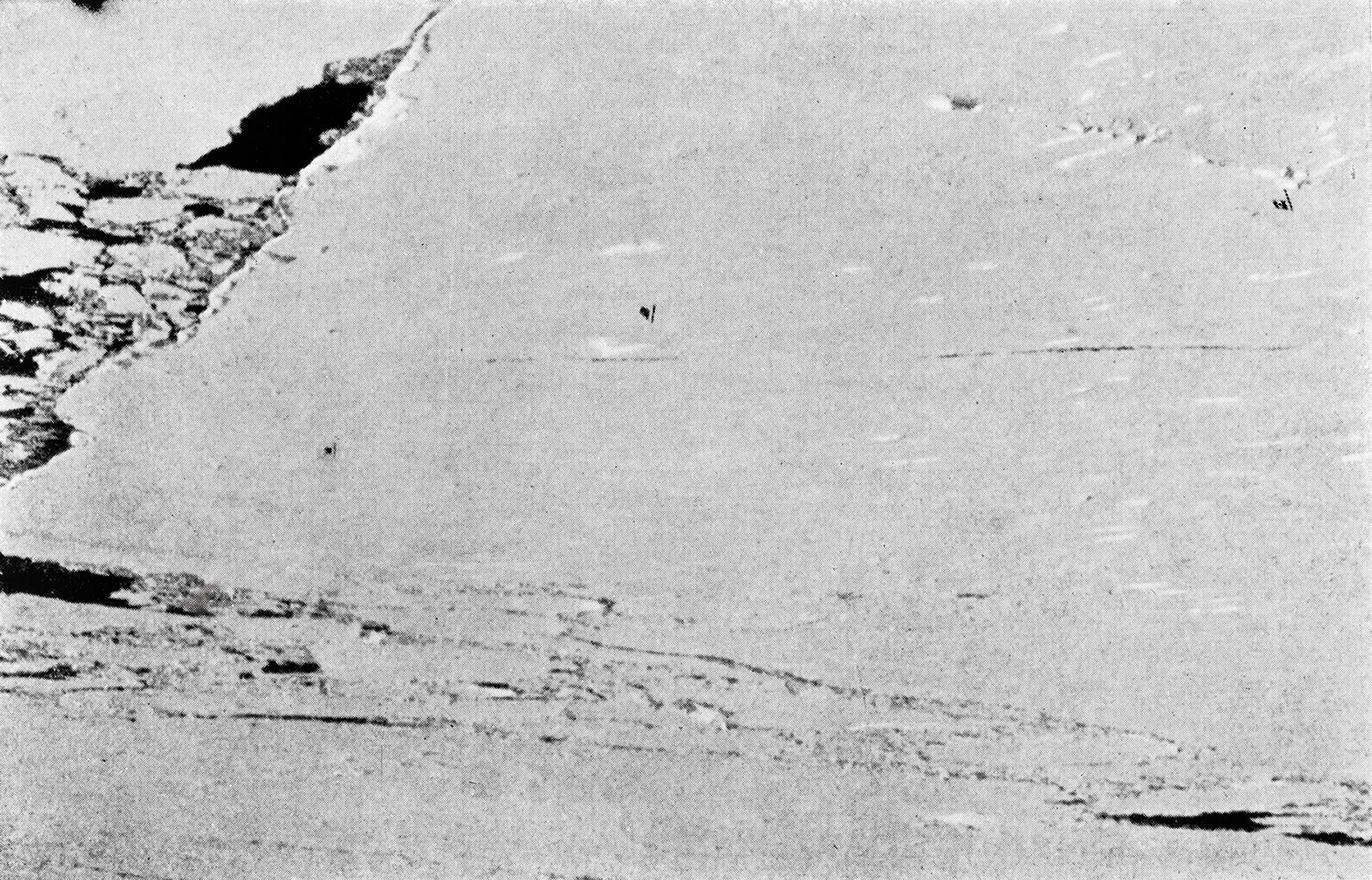
Two days after Richard Byrd had set his record, another Arctic feat was ready. The airship Norge took off from base at 09:55 on Tuesday, May 11, with 16 men and a fox terrier on board – eight Norwegians, six Italians, an American, a Swede and Titiana. The Pole was reached without drama at 01:25 the following day, and Roald Amundsen gave Oscar Wisting the honor of throwing the Norwegian flag onto the ice. The two had conquered the South Pole together in 1911 and were now the first people to have been to both poles.
On the further journey, Amundsen took a seat in the front of the gondola. Here he sat motionless for several hours, scouting for new land. The Norwegian prime minister had made it clear that any newly discovered areas would have to be claimed by Norway. The airship was now in a place where no man had been before, but to Amundsen's disappointment there was little to see – just ice, and more ice.
Then the fog came drifting in, making visibility almost impossible. It also led to dangerous ice formation on the ship, and lumps of ice were thrown from the propellers onto the canvas. On the morning of May 13, the Norway approached the coast of Alaska, but strong winds blew it off course. It was not until many hours later that they found the coast again, and although no one knew exactly where they were, they decided to land.
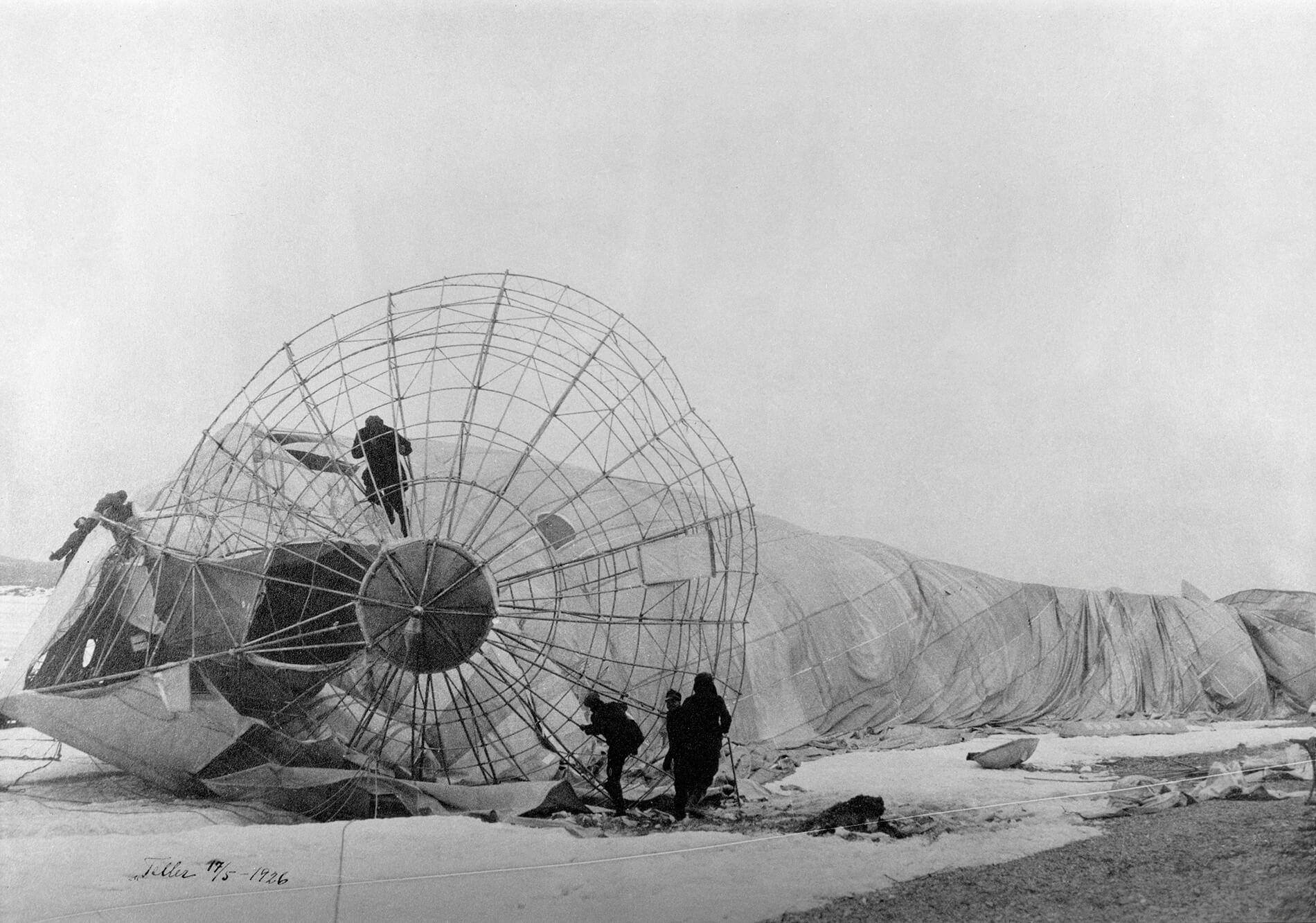
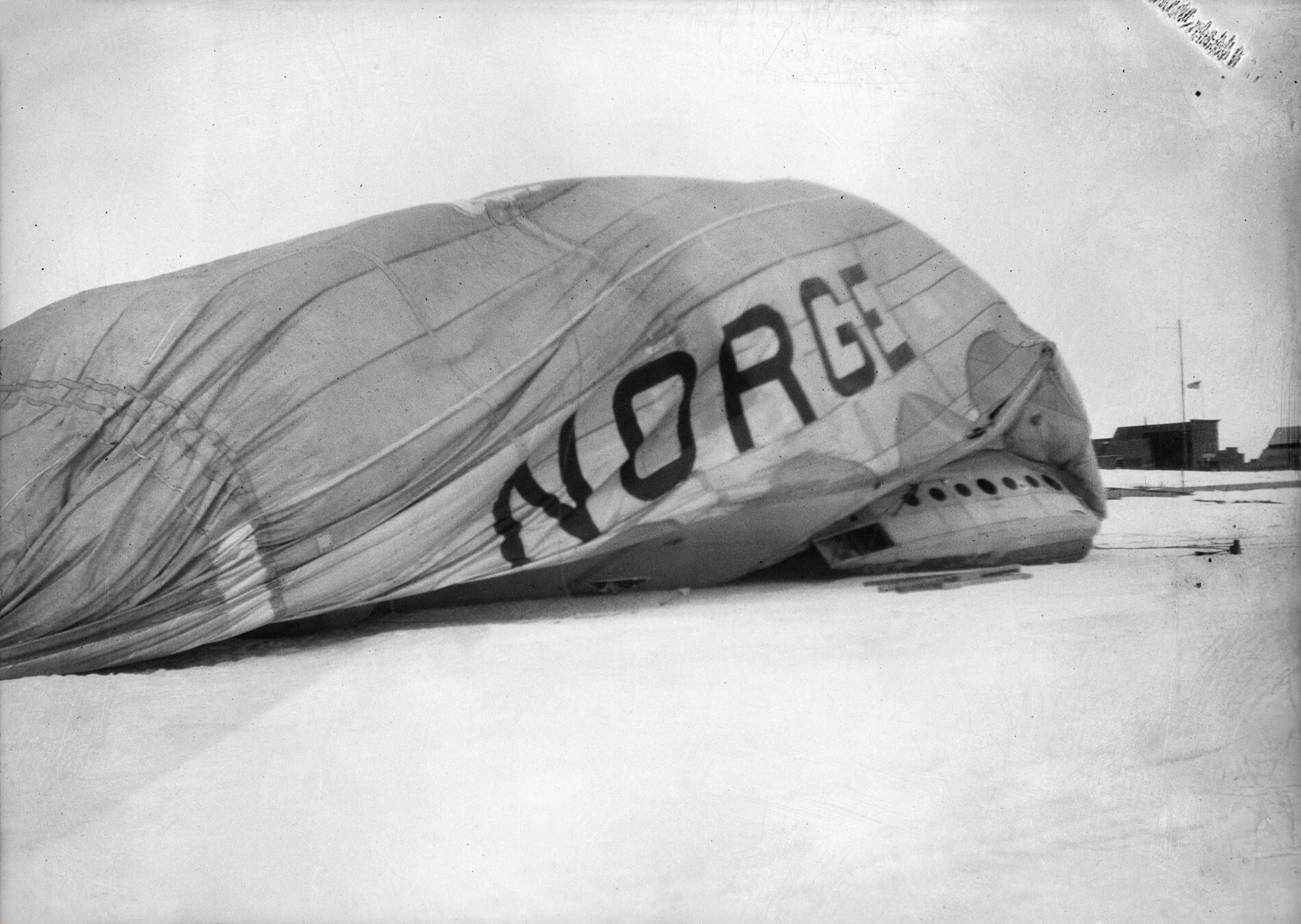
When Umberto Nobile finally landed the ship near the small village of Teller, 110 miles northwest of Nome on the Seward Peninsula in Alaska, it was May 14. The airship had been in the air for 72 hours.


Norway after the landing in Teller, Alaska, May 14, 1926.
– 1. Photo: Fredrik Ramm / NTM
– 2. Photo: Paul Berge / NTM
Long live Italy!
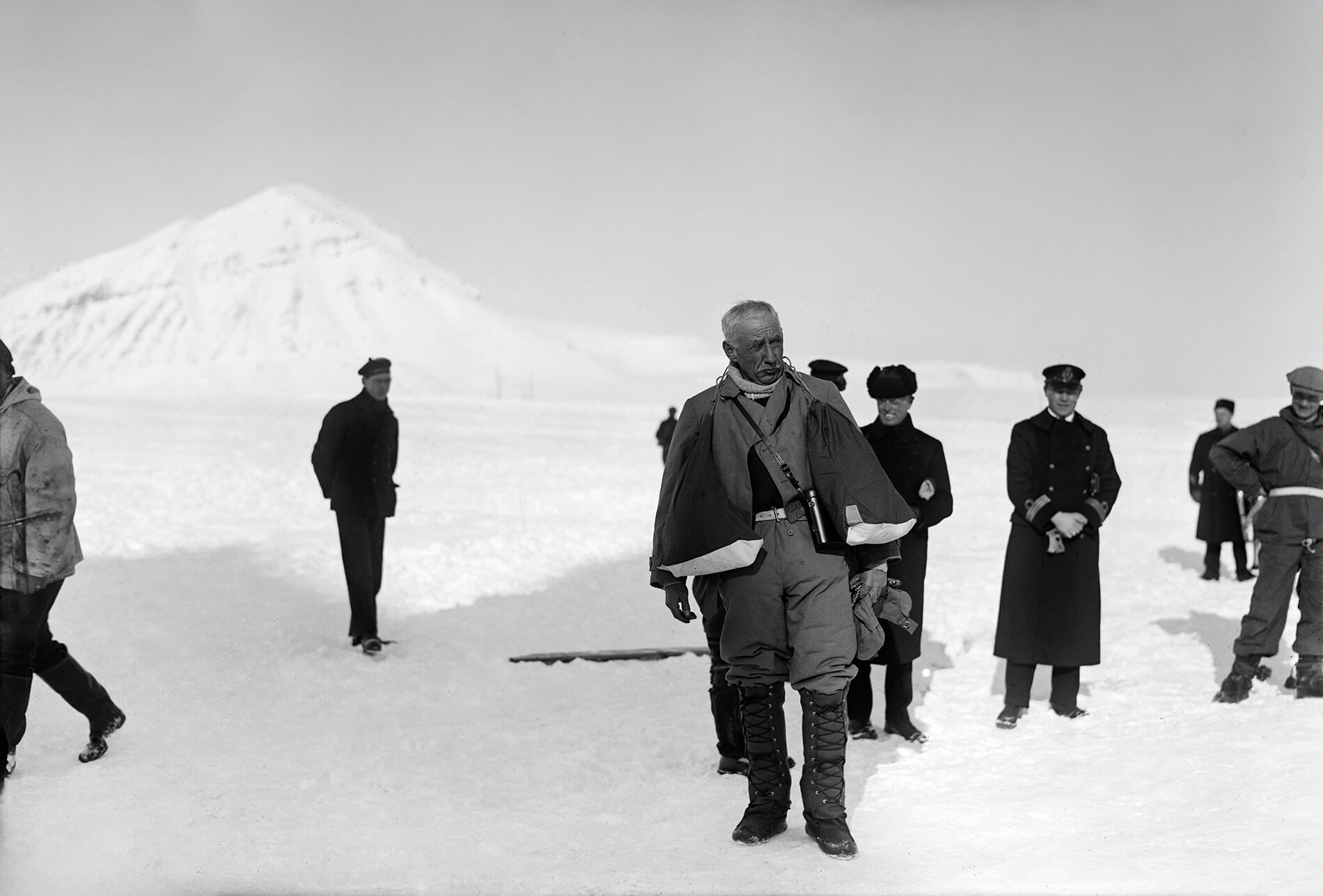
The fact that the expedition was named after three men did not prevent most Norwegians from seeing Amundsen as the real leader. In Norwegian eyes, the flight over the Arctic Ocean was primarily perceived as a Norwegian achievement, and Amundsen himself saw it that way.
The aging polar explorer therefore resented the fact that the international press, especially the American press, consistently showed more interest in Umberto Nobile than in him. Some accounts described Amundsen as a more passive passenger aboard an airship piloted by Nobile, who had also designed it.

Roald Amundsen embarks in Norway on Svalbard on May 11, 1926. Start at 8:55 a.m.
– Photo: Paul Berge / NTM
The tug-of-war over the honor for the polar feat began immediately after the landing in Teller. Amundsen had a low threshold for expressing criticism of Nobile and painted an unflattering picture of him in the book My Life as a Polar Explorer, which was published the year after the expedition.
Several people in Amundsen's circle reacted to the polar hero's behavior. Rolf Thommessen of the Norwegian Air Navigation Association wanted to distance himself from Amundsen, and in May 1926 sent a telegram to Nobile: "I am proud to be your friend and will never forget our collaboration. Long live Italy.".
Tragedy in the last act
The tug-of-war for glory and fame plays out in the final act of the drama of Amundsen and Nobile. For the Italians, it was a point to show that their country was capable of carrying out an expedition like the one in 1926 on its own. After returning to Italy, Nobile quickly set about building a new airship, a project that received support from the highest political levels. In the spring of 1928, he was once again ready to set sail north.
The new airship differed little from the previous one, except for its name: it was called Italia. It could use the same infrastructure as Norway, and starting from the base in Ny-Ålesund, the ship made a total of three flights in the Arctic. The last flight, which began on the morning of May 23, went to the North Pole. The pole point was reached, and the Italian flag was ritually thrown down onto the ice, but fog and strong winds created problems on the return trip.

The flags of the three nations were thrown out at the North Pole on May 12, 1926 at 1:25 a.m.
– Photo: Paul Berge / NTM
After two days in the air, the airship crashed into the ice with such force that the gondola detached from the balloon. Ten men, including Nobile, were left on the ice, while six men disappeared with the loose balloon. After the survivors sent a radio message, a comprehensive rescue operation was launched. In Norway, Roald Amundsen announced that he would participate.
He left Tromsø on 18 June with Leif Dietrichson and four French airmen on board a borrowed French flying boat of the Latham type, heading for Svalbard. Radio contact was lost shortly after departure, and it is believed that the plane crashed in the Barents Sea near Bjørnøya. None of those on board were ever found. In total, the Italy expedition cost the lives of 17 men, both expedition participants and rescuers included.
Nobile was the first to be rescued from the wreckage, which later attracted criticism. He had insisted on staying, but finally agreed to leave the ice when he was told that he would be most useful on land. It did little good. While Nobile had to fight to restore his honor in the years that followed, Amundsen had largely regained his. The polar hero's standing up when it really mattered helped his earlier outburst against Nobile to gradually fade into the background.