The medical book collection
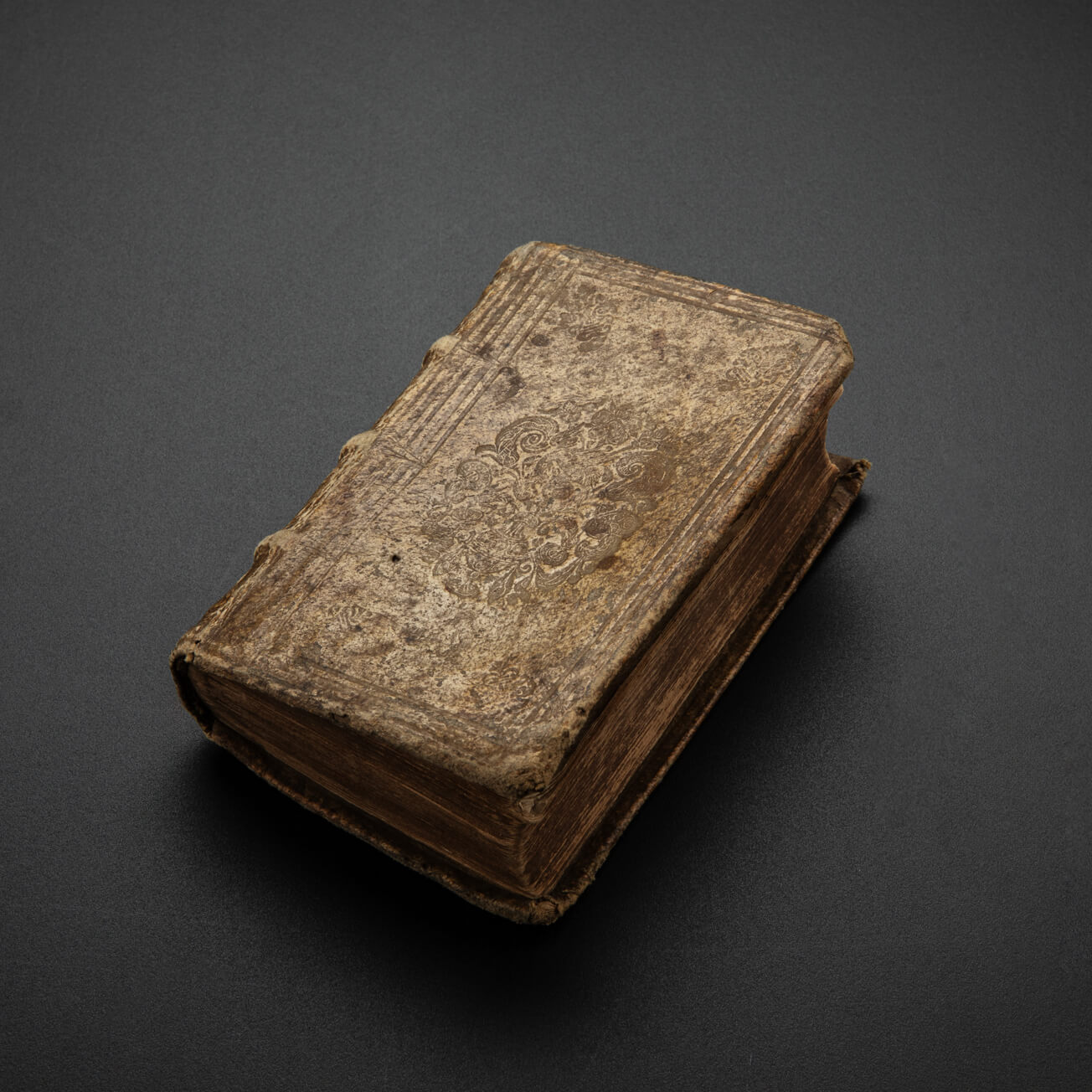
In 2002, the medical history collection of the National Hospital was donated to The Norwegian Museum of Science and Technology in connection with the establishment of the National Medical Museum. This collection contains several older medical books. The old book collection was created through the initiative of several of the doctors at the National Hospital.
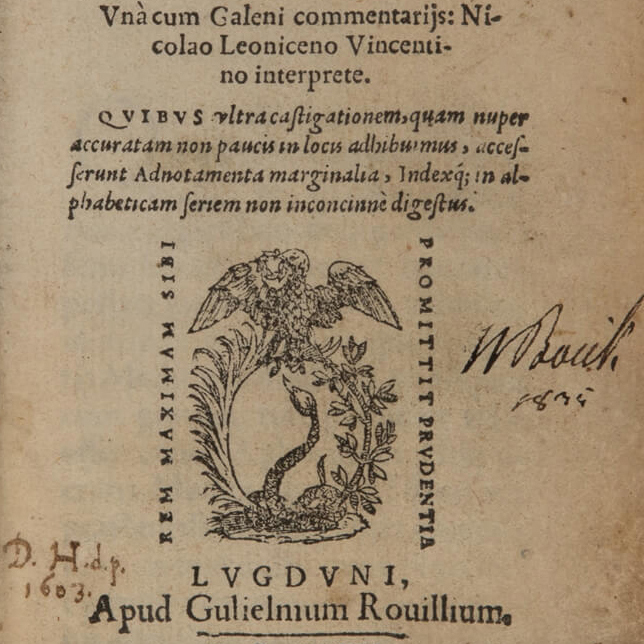
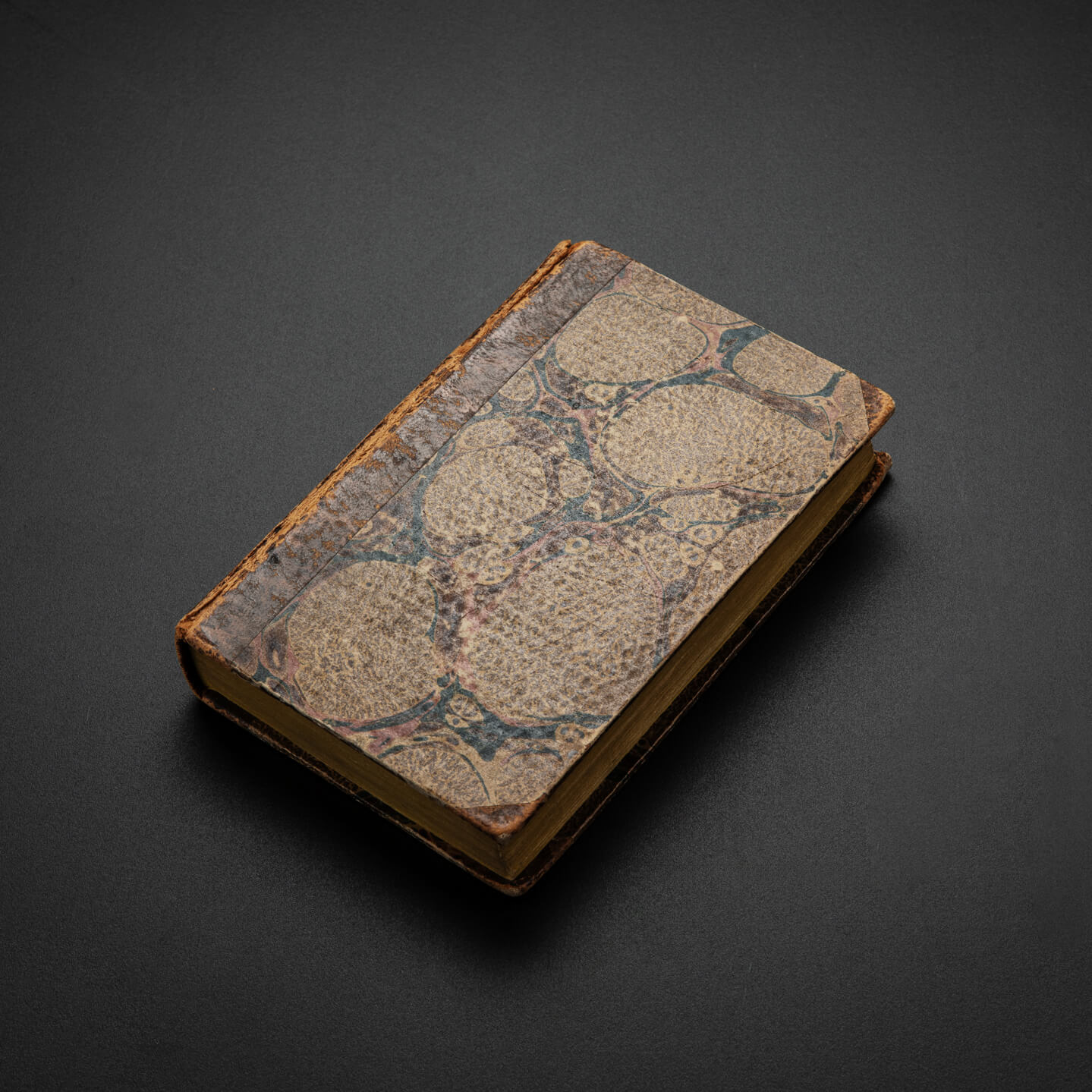
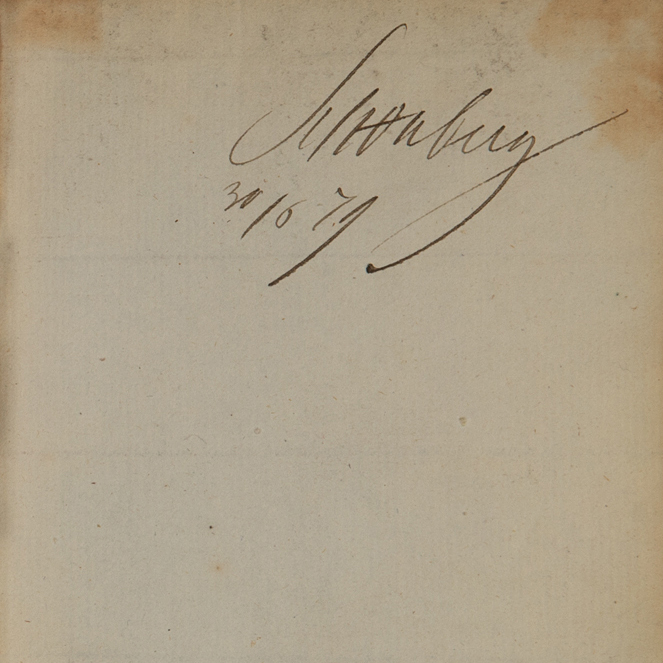
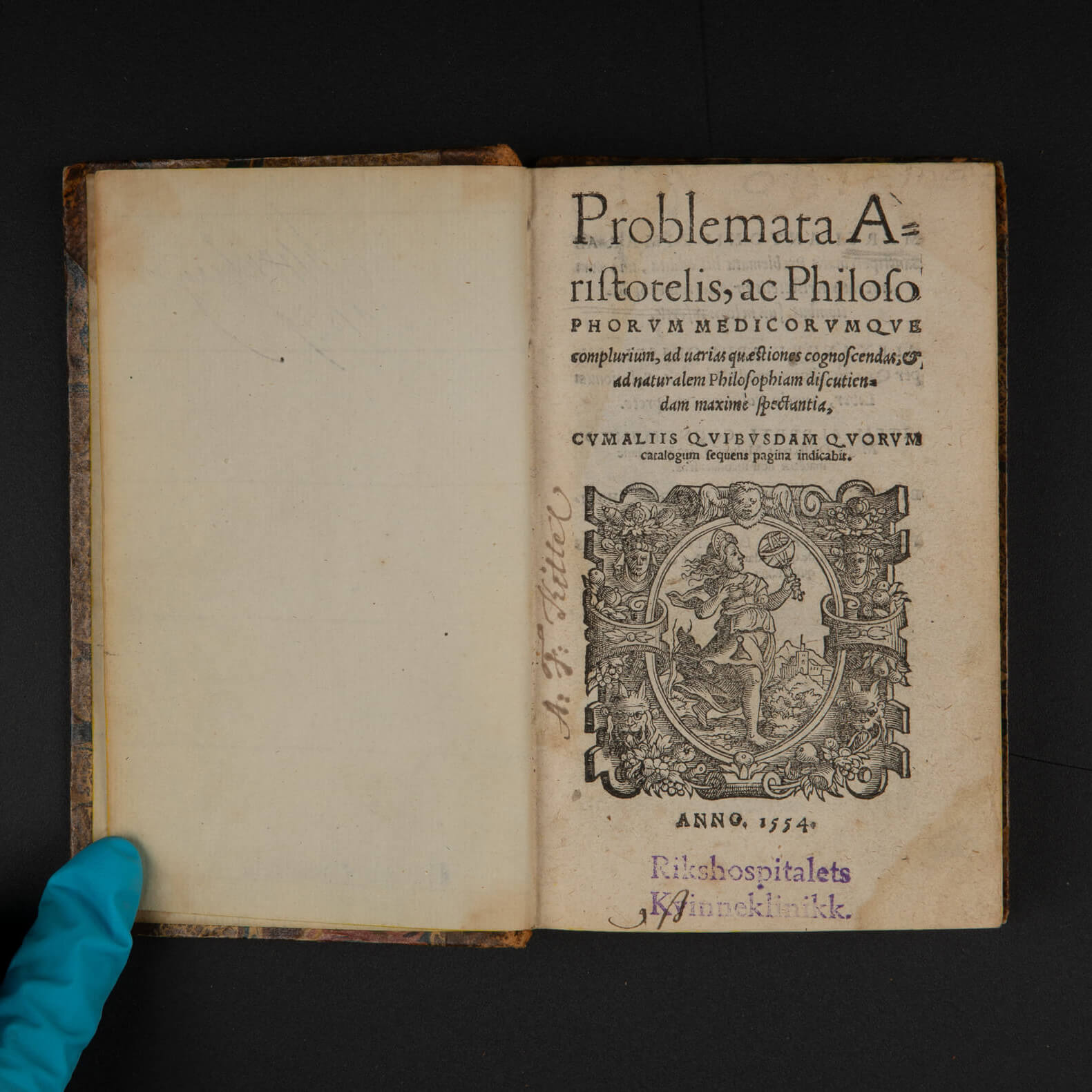
Edvard Schønberg (1831-1905) is responsible for large parts of the older book collection. He was associated with the Women's Clinic and the Birth Foundation, and had a great interest in the history of medicine. On the first page of Problemata Aristotelis he has noted his name and the date 30 June 1879, and we can assume this was the date the book came into his possession. In the second book, Aphorismi Hippocratis, we find Carl Wilhelm Boeck (1808-1875)'s signature, dated 1835. He was associated with the Skin Department at the National Hospital and is also responsible for a large part of the old book collection.


Carl Wilhelm Boeck's signature and dating to the right; To the left a former owner's signature from 1603 as well as Schønberg's signature with dating and stamp from the Christiania Birth Foundation.
The fathers of the medicine
The oldest book is Aphorismi Hippocratis Graece et Latine, Una cum Galeni commentarijs: Nicolao Leoniceno Vincentino interprete. The title means "Aphorisms of Hippocrates in Greek and Latin, together with the commentaries of Galen, translated by Niccolò Leoniceno Vincentino". An aphorism is a statement of doctrine that expresses a point or thought.
The book was printed in 1547 in Lyon by Guillaume Rouillé, who was a prominent printer of humanist works of his time. He was known, among other things, for printing Galenic treatises aimed at medical students and doctors. The book begins with a preface written by Rouillé, in which he highlights the work as very useful for those with a deep interest in medicine. He refers to Hippocrates' text as one of the oldest and most outstanding medical writings.
Rouillé justifies the choice of printing the text together with Galen's commentary on the grounds that this provides greater utility and better understanding for the reader. The book contains an alphabetical index, summaries in the margin, and references added by the printer, which was standard for scholarly books of the time.


Alphabetized index and first aphorism that starts with the well -known quote "Life is short, the art is long".
The recovery of antique medicine
At the beginning of the 16th century, there were major changes in what was understood as antique medicine, as a result of the rediscovering of several Greek texts on medicine. Galen (c. 129-200 possibly) was a lives in Rome, including for emperor Marcus Aurelius, and had been trained in the medical tradition of Hippocrates, who was referred to as "the father of medical art". After its lifetime, Galen was considered one of the largest authorities in medicine, which was further strengthened in the 1300s with the rediscovering of several of his texts.
The right knowledge of knowledge
The translator of this edition of the Aphorisms of Hippocrates, Niccolò Leoniceno (1428–1524), was known for his excellent linguistic skills in Greek and Latin. He was a trained physician and professor at the University of Ferrara. By 1492 he had built up one of the largest collections of Greek medical manuscripts, if not the largest.
It was on the basis of this collection that Leoniceno argued that the Latin texts were full of errors. The Greek texts had undergone a complex process of transmission, which led to both misunderstandings and factual errors. According to Leoniceno, it was necessary to go back to Galen's original Greek to clean up these errors and find the actual meaning of the texts. This was considered particularly important because the ancient texts were believed to contain much precious medical knowledge.
Leoniceno further argued that such a return to the original texts could resolve long-standing conflicts in the medical field, help cure new diseases, and find treatments for ailments that had previously been considered incurable. After he pointed out the errors in the existing texts, a wave of new translations of Greek medical works came. In the period 1526–1561, an average of 12 books were published per year, with a peak in 1547 when 21 editions were printed. In the years before and after this period, however, an average of only 2–4 books were printed per year.
Hippocrates' aforisms
Hippocrates' Aphorisms were a standard introductory text in medical studies at most universities, and it was common to read works commenting on them even if they were not part of the curriculum. Galen's Commentaries on Hippocrates' Aphorisms provide explanations of these. This practice, of short texts explained through commentaries, became common in medicine by the late 11th century.


Listings in the margin from a former owner and the handwritten index at the back of the book.
As mentioned earlier, the book is aimed at those with medical interest, and one can see that a former owner of this book has written notes in the margins. Such a listing was a common reading technique among scholars in early modern times, and also shows that the book owner did this to return to the book later to use it as a reference. Especially the index written by hand at the back of the book refers to extensive and time -consuming work, which shows the usefulness of the book has had for the owner.


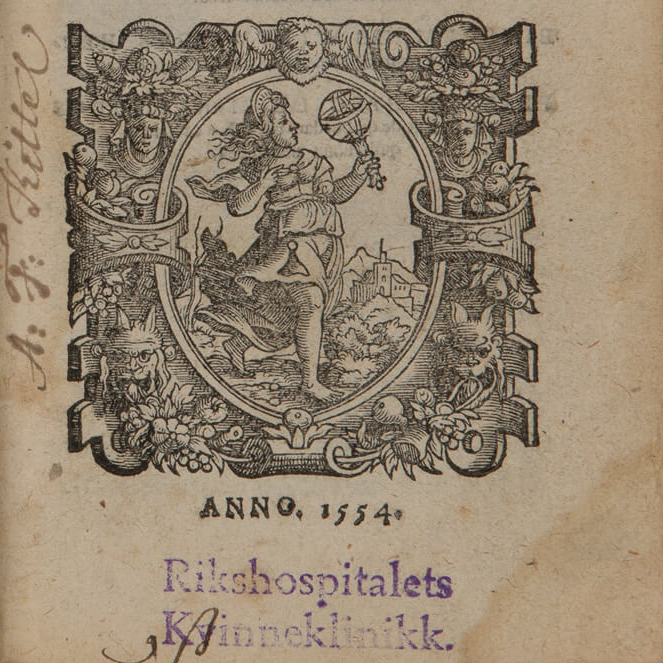
Frontispis.
Aristotle's question
The full title Problemata Aristotelis, ac Philosophorum Medicorumque complurium, ad varias quaestiones cognoscendas, et ad naturalem Philosophiam discutiendam maxime spectantia, cumaliis quibusdam quorum catalogum sequens pagina indicabit means "Problems of Aristotle, as well as of several philosophers and physicians, concerning various questions for the sake of acquaintance, and which chiefly concern the discussion of natural philosophy, with others which the catalog will show on the next page".
A more suitable translation will be "questions" instead of "problems". This is because the genre of this book, called problem data, consisted of questions and answers on causes of natural -philosophical phenomena and especially medical knowledge. Both learned science and popular science were conveyed in a clear and concise way in this genre, and it gave readers of all kinds an understanding of everyday phenomena and natural -philosophical funfacts. Questions were never asked about the fact presented, because it was believed to be so well known that it was not needed to be explained. And the answer only discussed the cause of the fact. In other words, the genre was not used to generate new knowledge.
A fraudulent writer?
Despite the title "Problems of Aristotle", Aristotle himself did not write this text. The use of "Aristotle" in the title follows a medieval tradition, where respected philosophers were named in order to associate the text with them and thus invoke the philosopher's authority. This was a way of advertising that the text was based on authoritative explanations and was trustworthy.
The popular version was based on this understanding, as can be seen in the preface to the text, where Aristotle is mentioned several times to justify curiosity about natural and everyday phenomena. This justification was also made in the hope of escaping condemnation for what was considered indecent curiosity. The text itself also mentioned well-known philosophers to make the explanations convincing.
The two problemata Aristotelis
Interestingly, there were two different texts that circulated under the short title problemata Aristotelis. One text can be referred to as a learned version, and it was written sometime in the 400-500s based on an actual Aristotelian core. The other can be called a popular version, because it has a more popular science content and was read by people of all walks of life. It was written by an anonymous author between the 13th and 1300s in what is today Germany. These two different versions had little to do with each other. The similarity is about both title and genre being the same, and both books contained texts from other thinkers.
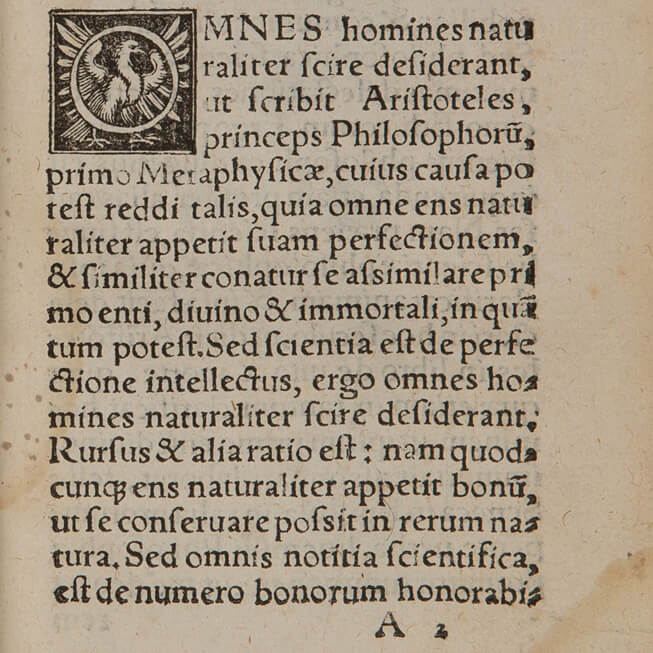
One thing that clearly separates these two different works from each other is the preface: The Popular version's preliminary words are "Omnes Homine's naturaliter scire decider ..." which means "all people naturally want to know ...". These initial words were continued in the vast majority of translations of this book, also in our book. The book we have was printed in 1554 in Frankfurt.


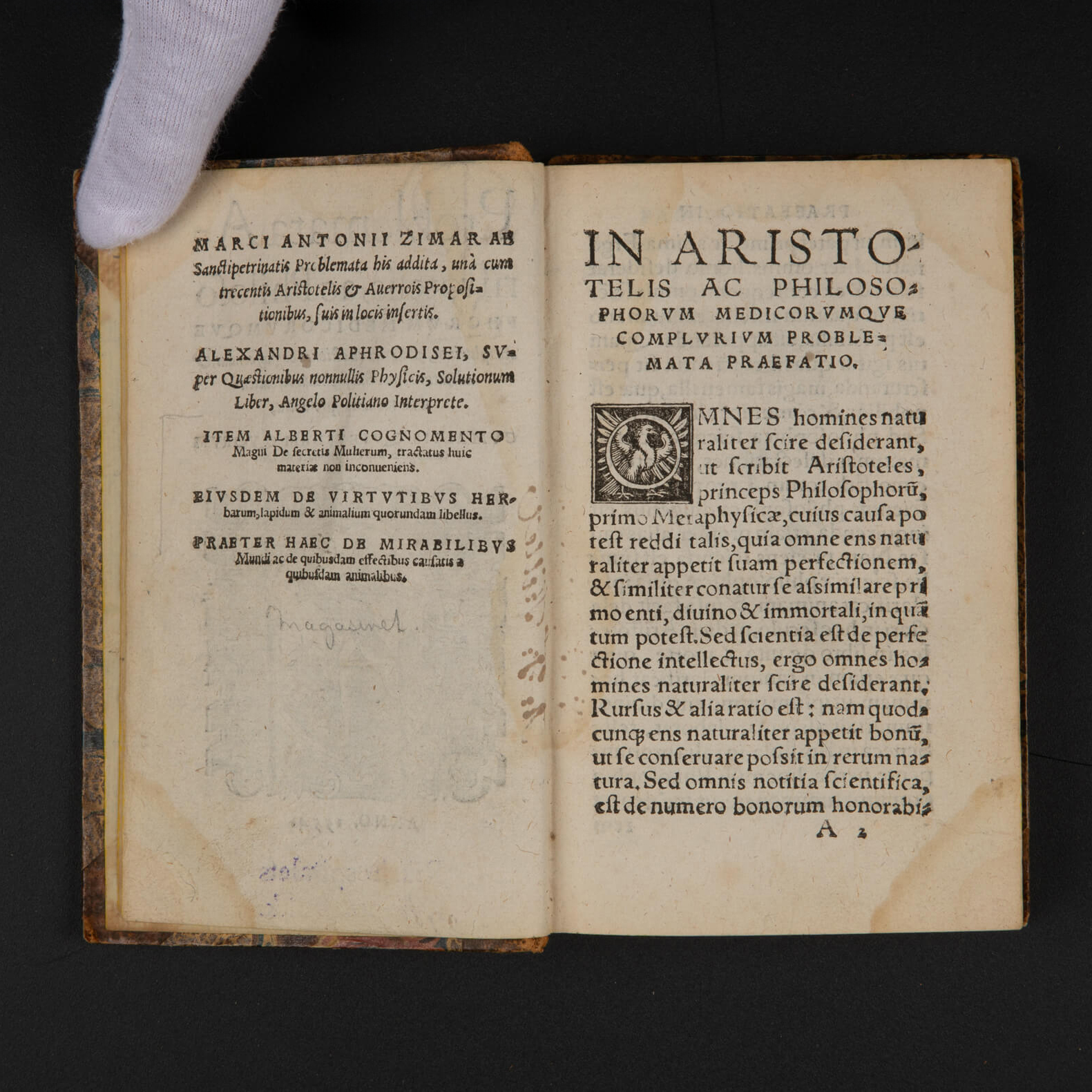
The overview of the other texts included in the book and the preface to the problemata Aristotelis with "Omnes Homines" opening.
The popular version
The oldest book is Aphorismi Hippocratis Graece et Latine, Una cum Galeni commentarijs: Nicolao Leoniceno Vincentino interprete. The title means "Aphorisms of Hippocrates in Greek and Latin, together with the commentaries of Galen, translated by Niccolò Leoniceno Vincentino". An aphorism is a statement of doctrine that expresses a point or thought.
The book was printed in 1547 in Lyon by Guillaume Rouillé, who was a prominent printer of humanist works of his time. He was known, among other things, for printing Galenic treatises aimed at medical students and physicians. The book begins with a preface written by Rouillé, in which he highlights the work as very useful for those with a deep interest in medicine. He refers to Hippocrates' text as one of the oldest and most outstanding medical writings. Rouillé justifies the choice of printing the text together with Galen's commentaries on the grounds that this provides greater utility and better understanding for the reader. The book contains an alphabetical index, summaries in the margin, and references added by the printer, which was standard for scholarly books at the time.
A former owner's interests
A previous owner of this book seems to have been particularly interested in reproduction, as a larger part of the listings made in the book has to do with this. An example do you see the question "Why are women sometimes pregnant with twins?" is being set.
The answer tells that according to Galen, there are seven cells and recipients in the uterus, and it is possible that children can be generated in three different forms, depending on how many cells the semen has fallen into and divided into. Three of the cells are found on the right side, and there can be three boys being found on the left side, where three girls can be conceived. But there is a cell in the middle, where the ancient ones say that a hermaphrodite can be conceived. Furthermore, the answer says that it would be miraculous rather than natural if a woman gave birth more than seven children.


The underlining made by a former owner and first page in Aleksander from Aphrodisias, Plutark and Marcantonio Zimara.
The other texts
There were other texts included in the book. Texts from the Greek philosophers Alexander from Aphrodisias (about 200-300 possibly) and plutark (about 45-125 possibly) were almost always included in all editions. A fun thing about Plutark's part is that the headline tells that his text is inserted to fill up empty pages, which was continued even in editions where this was not the case.
It was not only texts from ancient times that were included in problemata Aristotelis, but also more modern texts. Marcantonio Zimara (c. 1470-1537) is the modern representative in our edition. He was a philosopher taught at several universities in Italy, and was especially known for his comments on Aristotle's lyrics.


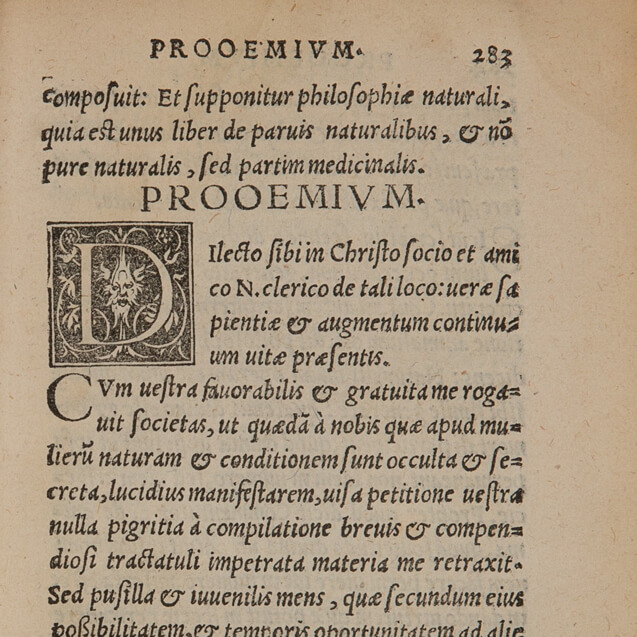
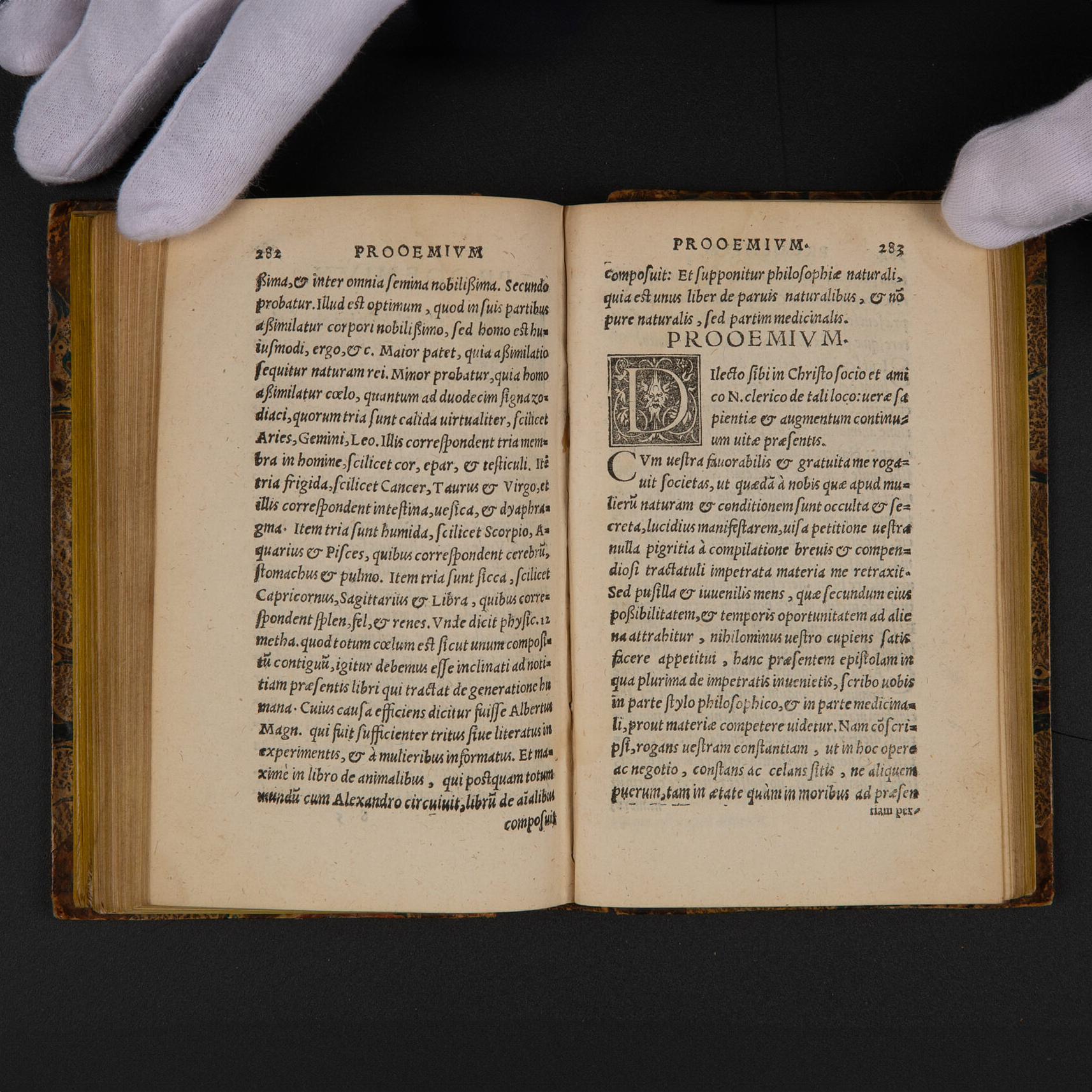
The preface to the Secretis Mulierum, where the author addresses a medium.
Monker's curiosity about women
There was a great deal of attention to human reproduction in this book. From the 1510s, there was a tradition of linking Problemata Aristotelis with other texts that also addressed this. Albertus Magnus (c. 1200-1280) was represented by three texts in our edition. He was a German Dominican monk and known as one of the greatest philosophers of the Middle Ages. One of the texts, De Secretis Mulierum, was one of the most popular texts written on female biology, and was added to the book in the 1540s.
The title means "about women's secrets" and was written between the 1200-1300s and dealt with everything around human reproduction. Although attributed to Albertus Magnus, it was most likely one of his students who had written it. The preface in this text approached a medium. The author wrote that knowledge about reproduction was hidden by women, and therefore needed to be examined by men. This was necessary knowledge to know, both to help a woman if she was sick and so that the monks could know which fines were appropriate to give to a woman for the sins she acknowledged under scripture. It is not known if this text was actually used in medical practice, or whether it was only to satisfy the curiosity of the monks on women's biology.
* The translations were made by author with the help of GPT-4 Omni.