
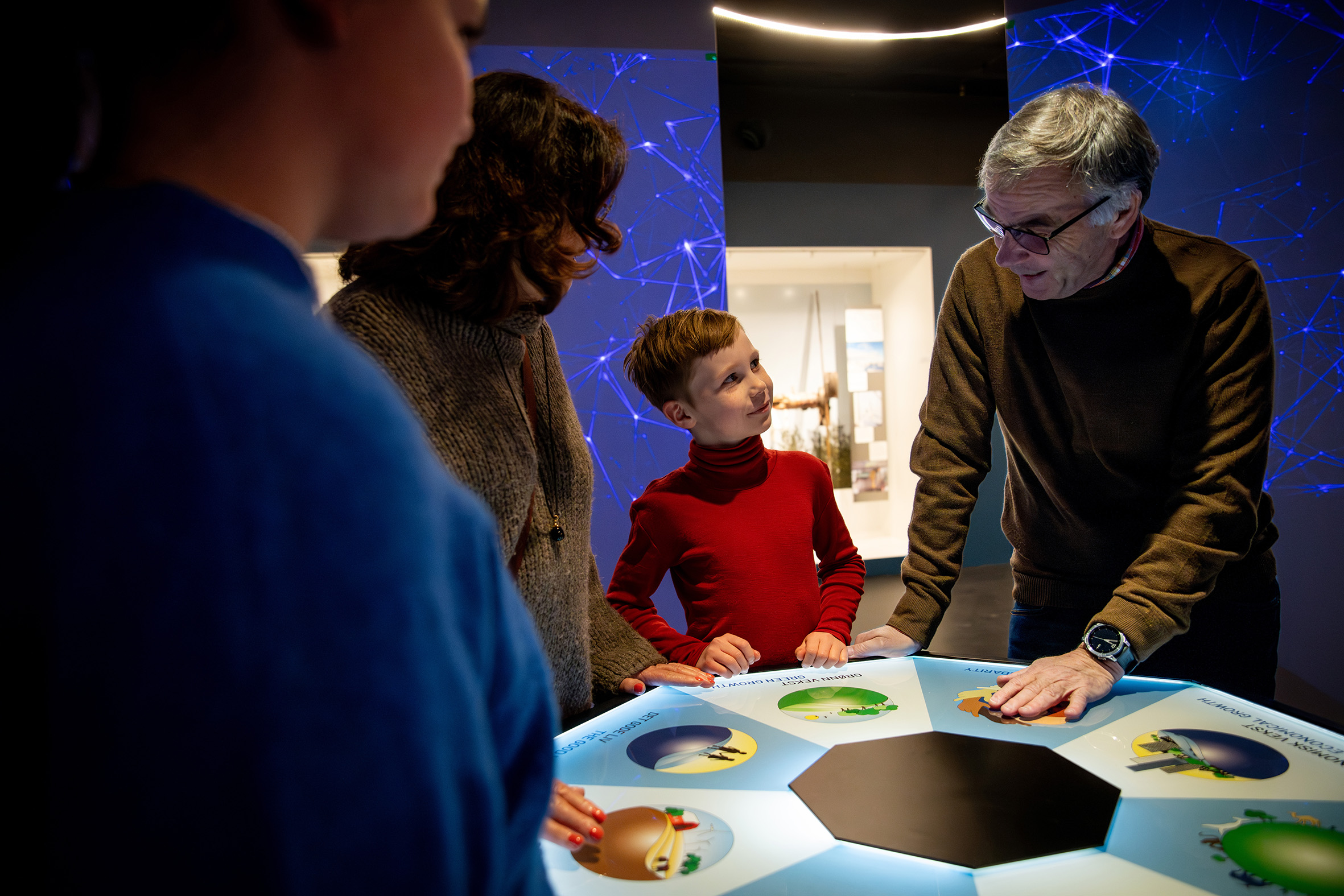
 Oracle in the exhibition. Photo: Gorm Gaare
After a hectic build-up, the exhibition ENERGY in the Time of Climate Crisis opened on January 25, 2024. As part of the opening event, the public was able to attend a panel discussion with invited guests about challenges related to the green shift. The President of the Sami Parliament, Silje Karine Muotka, presided over the official opening.
ENERGY in the time of the climate crisis is a permanent exhibition covering an area of approximately 750 square meters. The exhibition invites the public on a journey through 200 years of Norwegian energy history and consists of two parts. One part covers developments from around the beginning of the 19th century until the 1960s. The second part focuses on developments over the past 50 years and also contains an interactive installation – The Oracle – that provides perspectives on the future.
Energy can be described in technical and scientific terms, but is also related in the exhibition to broader societal contexts. Turnover and use of energy must be understood in light of political, social, economic and cultural conditions. The exhibition aims to combine the science center's focus on interactivity and specialized installations with the spacious and conceptual expressions of the classic museum exhibition. Our hope is that this "integrated model" creates a new type of museum experience.
The museum's collection of objects provides a unique opportunity to describe the development and use of various forms of energy in Norway, both fossil and renewable. Not least, this applies to the electrification of society in the industry and households from the late 1800s to the present. Although most objects are part of national stories, the exhibition also tries to highlight global perspectives. A common theme is how the emergence of today's fossil energy system worldwide has contributed to social and economic inequality that must be handled to lay the foundation for a more sustainable development.
Through the work on the exhibition, the museum has worked actively with participation from the audience and various external partners. In 2024, the museum, among other things, arranged debate meetings on nuclear power and energy use in connection with the development of artificial intelligence. The ambition is that the exhibition in the years to come will serve as a discussion platform in the public wording on energy and sustainability.
LPO architects have designed the exhibition, and it is realized with financial support from Equinor, Ocean Sun, Biogass Oslofjord, Biogass Norway, Gasum and Waste Norway.

Models and miniatures
The temporary exhibition models and thumbnails opened on November 23, 2024. The exhibition shows models used for research and teaching, design and construction, play and hobby. It contains models of the body, architectural models and model trains. The oldest models come from the Berg seminar at Kongsberg in the mid-18th century, the latest models are toys given by children this fall.
Models have always been central to the museum's exhibitions. This time they get to play the lead role. One basic idea has been that the exhibition should reflect the entire width of the museum and point to our other exhibitions, while at the same time thematizing models' different uses and significance.
The museum has about 750 models in the collection. Around 100 of them appear in the exhibition. In addition, we have lent some models from different model associations and partners. Central to the exhibition is a Lundby dollhouse of ten times the usual size, fully decorated and open to those who want to play. The exhibition also has its own play area with Brio and Lego. The car lane borrowed from the Trondheim Bilbane Center, and the large model railway is run regularly.
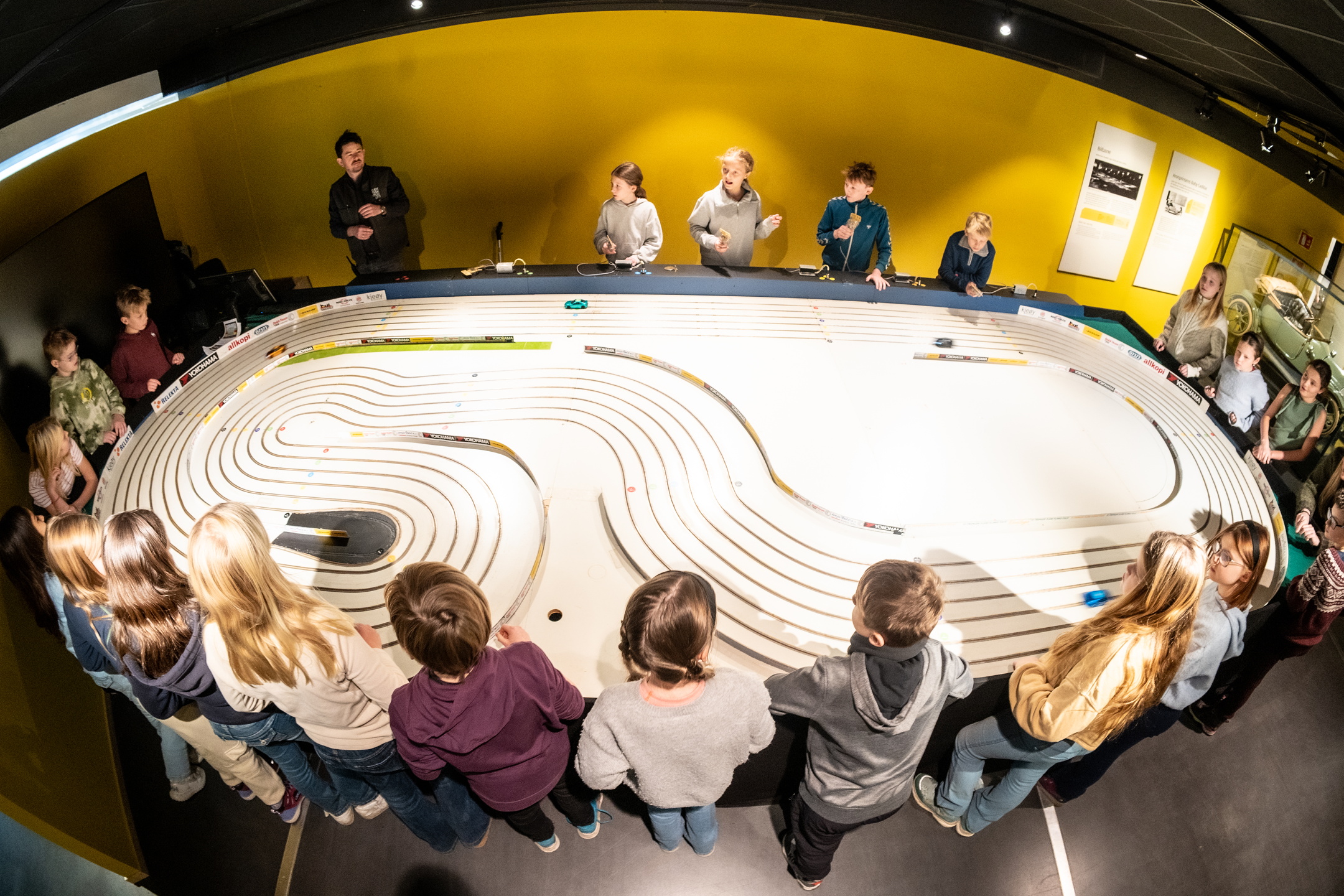 First get to the finish in the adrenaline -filled car race! Photo: Lars Opstad
Designer Ann Avranden has been responsible for the graphic work and contributed to the exhibition's design. The exhibition has received financial support from the Sapienti Foundation and the Bergesen Foundation.

From the exhibition opening The limits of privacy. Photo: Håkon Bergseth
The exhibition The Boundaries of Privacy: New Interactions - New Dividers opened at the museum in 2023 and was taken down in 2024. It dealt with themes such as privacy and digital interaction. The Boundaries of Privacy was an intimate and tactile space within a space that contrasted with the permanent main exhibition I/O, which communicates through AI and digital solutions. Visitors were invited to a sensory experience and to use their own experiences as digital users. The exhibition opened up for reflection on new social divides, polarization, loneliness and what physical proximity means for communication. The exhibition also provided insight into digitalization in the relationship between humans and animals, through the use of drones and GPS in reindeer herding.
The exhibition emerged from the research project Privatlivets Grenser: Sociability and belonging in digital everyday life at the Department of Social Anthropology, UiO and the Norwegian Institute for Natural Research. It was developed in collaboration with The Norwegian Museum of Science and Technology and the Academy of Performing Arts at Østfold University College. The research was carried out by: Marianne E. Lien, Cecilia G. Salinas, Tuva Beyer Broch and Tom Bratrud. The exhibition design was by the three master's students in scenography: Lisa Birkenbach, Irina Kommissarova and Solveig Dagsdottir. The exhibition was funded by the Research Council of Norway under the SAMKUL program.
