
Digitization of DEXTRA Photo
Dextra Photo reached a milestone in 2023, with 100,000 photographs available at the Digital Museum. In 2024, the digitization strategy has changed courses: We digitize purposefully to exhibitions and special gathering projects locally at the museum, while at the same time sending large volumes to the National Library. The National Library has digitized 19,000 images for us in 2024. 511 images have been published during the year. 5811 images are downloaded free of quality.
In order to handle the large volume of digitized images from the National Library, in 2024 we worked on the project registration trail. This project aims to find the best existing tools in handwriting recognition, artificial intelligence and simple automation to handle the increasing amount of images that are digitized, so that they are useful both for the wide audience and for students and researchers. A pragmatic handbook will be created that also benefits photo archives at other institutions. The project is funded by the Sparebankstiftelsen and is carried out in collaboration with the Preus museum and the museums in Akershus.
In 2024, nearly 230,000 new photographs came to the museum. The images supplement Dextra Photo and increase the material of the photographers we already have in the collection.
DEXTRA Photo is owned by Sparebankstiftelsen DNB and is deposited at the museum.


Lending and borrowing of museum objects
The museum lends objects and archives for exhibitions at museums and institutions at home and abroad. In 2024, the museum has lent objects to several museums, such as the Museum of Cultural History and the Jøssingfjord Science Museum. In addition, we have lent objects to Lødingen Municipality and the Oslo Street Art Festival. Some of the loans have included courier services and assistance with assembly. The museum has also lent objects and art in connection with the exhibition Models and Miniatures. In total, the museum has 63 active loans of 278 objects and 14 loan cases from institutions and private individuals for several of our permanent and temporary exhibitions.

Photography and documentation
In 2024, the museum's photographer in particular worked on photography related to the exhibition models and thumbnails, collection audit, pictures for external communication and exhibition documentation. Photography of events and ongoing individual assignments from colleagues has also been an essential part of the work. The photographer has participated in the museum's fundraising work through work on contemporary and industrial documentation. Four documentation projects have been carried out.
Oslo's main fire station from 1939 was demolished this year to make room for the new government quarter. The museum's conservator and photographer documented the empty building before the demolition, through photography and an interview with the building's long -standing chief operating officer. An article about the building "The Fire Station - a fine -tuned machine" was published on the museum's website as well as at the Digital Museum, where approx. 150 photos were published.
One of Oslo's latest radio retailers and radio workouts, Vennerød & Dahl in Bygdøy Allé was closed in 2024. The museum's conservator and photographer documented the store and interviewed the owner over the last 52 years. The pictures will be published at the Digital Museum.
The company Glamox, with a factory in Grue municipality, decided in 2024 to move lamp production to Poland. The Luxo L-1 is the most famous lamp among the Luxo products and is known as a motif in several Pixar films. The Norwegian Museum of Science and Technology was in Grue municipality, documenting the factory and production methods before dismantling and moving to Poland.
In connection with the project where The Norwegian Museum of Science and Technology is rebuilding the waterwheel that runs through three floors, the museum visited Sanne- og Soli Brug, where the museum's original waterwheel came from. The industrial heritage after the sawmill was photographed, with a focus on the remains of the waterwheels that were the power source in the mill's timber production.
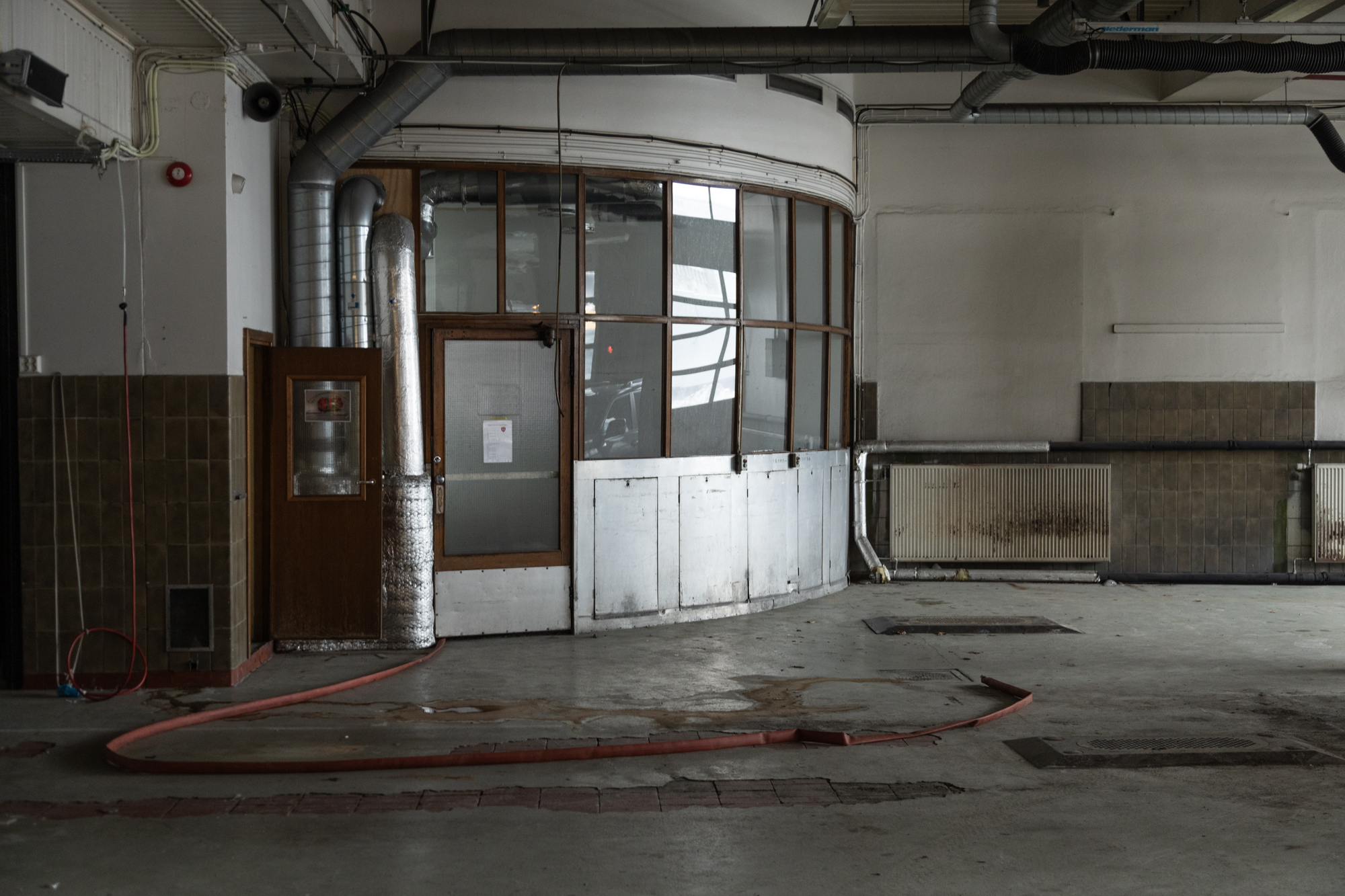 We have documented the Oslo Main Fire Station - here a glimpse of the garage. Photo: Håkon Bergseth

Library
The library contains one of Norway's largest collections of technology and industrial history literature, in addition to an extensive collection of medical history, telecommunications and science history books. Registration of the medical book collection has continued in 2024. Approximately 80 shelf meters (hm) of books have so far been entered into ASTA and are therefore searchable in Oria. The shelves have been washed, and the books are lined up with plenty of space for growth. This makes it easier to place books as the registered part grows. There remain approximately 248 (hm) unregistered books from the medical collection. Occasionally, very old and rare books appear. Those older than 1830 are packed in acid-free boxes and stored lying down in the local magazine.
The work that began in 2023 to separate special editions and serially register them in ASTA is almost complete. Large quantities of duplicate copies have been removed. The special edition collection amounts to 26 hm.
It has been purchased approx. 30 new books. The library subscribes to 8 Norwegian and 8 foreign journals in paper format, many of them also online. In addition, there is a large number of free subscriptions.
The library has been an internship for a bachelor's student who took the annual study in library and information science at OsloMet. She was introduced both into the library's tasks and the work on the historical archives. One day a week, she hospitalized with the administration where she digitized older correspondence and learned record keeping.
Archives
In 2024, the museum has registered 5 new archives/players and their archives in Asta. There are archives from the Rikshospitalet collections, mainly archives from individual doctors. The archives are published with restrictions. This is because they contain patient information with diagnoses and photographs from the 1920s. Growth has also been registered in already registered archives. The archive of the Rikshospitalet's skin department was completed in 2024. The National Hospital's large collections of special pressure were taken out of the book collection and registered in Asta during the department from which they have expired. This is 26 shelves.
Water leak
A water leak in the museum building at Kjelsås on January 10, 2024 led to several shelves with books and journals in the Bokmagasinet being damaged. The damage includes parts of the museum's historical book collection as well as vintages with foreign journals, a total of 251 shelves. The material was packed in plastic bags, laid in pallets, frozen down and secured on a freezer. Freeze drying is the best method for saving the water -damaged material. Many of the books and journals are irreplaceable due to age and rarity. Lists were led during packaging and are digitized.
Valuations and overviews have also been prepared on which journals are digitally available on various websites. An inspection has been carried out for the freezer warehouse. The valuation has not been completed, nor is it decided for what is to be saved and what is to be disposed of.
Mill
The object conservators have implemented several measures to identify and combat a larger clothing mill occurrence at the museum, which would, without treatment, pose a danger of damage to objects, including textiles and leather in the exhibitions. The measures were taken in collaboration with Rentokil and included both the location of the strategic placement of mills, as well as remediation through thorough cleaning of exposed areas, targeted use of insecticides and heat treatment of the attack interior.
With the occurrence to a large extent under control, surveillance continues using moths to ensure that any new occurrences are detected in time, so that damage to the collections can be avoided. This is part of the routine integrated pest control at the museum.