
RESEARCH PROJECTS
Research at The Norwegian Museum of Science and Technology contributes to historical and contemporary knowledge about technology, industry, natural sciences and medicine. It draws on our special advantage as a museum, and is an integrated part of the museum's other activities and takes place across disciplines. The museum's LAB was established in 2014 to further develop the interaction between research, dissemination and management, and as a place to gather different competencies.
The museum is approved as a research organization by the Research Council of Norway and participates in projects together with various institutions nationally and internationally. In 2021, the museum adopted a new research plan for the period 2021-2026, which provides guidelines for research activities at the museum and contains an overview of prioritized research areas. A joint integrity committee for research in collaboration with the National Museum, the Norwegian Folk Museum Foundation and the Holocaust Center came into effect in 2023.
Research results from the museum's employees are registered in the national database Cristin (Current Research Information System in Norway). In 2024, work has been underway to transition to NVA (National Science Archive). Several of the museum's employees contribute to research and education as colleagues, examiners and supervisors. Each year, the museum accepts students for internships. Two master's scholarships were announced for assignments related to the museum's fields of study, and one scholarship was awarded for writing a master's thesis in museology in spring 2025.
The project will explore, develop and share the museums' work on sustainability and sustainable development with an emphasis on communication. The Norwegian Museum of Science and Technology will further develop methods for including sustainability perspectives (BEN 2021-2025). This work will focus on renewing the museum's basic exhibitions on industry. The method development will, on the one hand, build on the museum's broad experience with active co-creation with school classes, family groups and young people in the design of activities and exhibitions. The project is led by the Museums in Akershus and is a collaboration between the Østfold Museums, Vitenparken Ås, Varanger Museum, Alta Museum, UiS, UiO and is supported by the Directorate of Culture, through the program Active Collaboration - three-year projects.
Sustainable Energy Narratives (SEN) focuses on the historical and contemporary mandate of museums and examines how this can be used critically to develop new narratives about energy and industry. The project is based on the premise that museums are not passive retellers of energy and industrial history, but actively participate in creating it. The goal is to increase understanding of how energy and industry have been organized, communicated and made public through the museums' narratives. The project is supported by the Arts Council's Social Role Programme and is carried out in collaboration with the Aluminium Museum (Vestfold Museums), the Workers' Museum (Oslo Museum), the Norwegian Textile Museum (Museumssenteret i Hordaland), the Norwegian Water Resources and Energy Agency and the Norwegian Petroleum Museum.
In 2024, BEN has focused on the various sub-projects for dissemination and participation at the museums, where the museum's work has been linked to the exhibition ENERGY in the time of climate crisis. Throughout the year, four writing sessions have been arranged in BEN, and seven articles are in the process of being submitted to a peer review. In addition, BEN co-organised the research seminar where the main theme was sponsorship and collaboration with industry in collaboration with MaILHoC. The project will conclude with a book publication in 2025.
The museum has participated in the research project Privatlivets grenser: sociability and belonging in digital everyday life (2020-2024). The project has been led by Professor Marianne Lien, based at the Department of Social Anthropology at UiO, and was carried out in collaboration with the Norwegian Institute for Natural Research. The exhibition Privatlivet ets grenser: Nye samvær - nye schiellinjer, opened at the museum in 2023 and was completed in 2024. The project is funded by the Research Council of Norway and the SAMKUL program.
The project Norwegian fabrics – design and industrial history deals with the large and nationwide textile industry that stretched from its beginnings in the mid-19th century to its closures 100 years later. What was produced in the factories? Who were the designers, and how were the fabrics marketed and distributed? The book project is based on the extensive Hjula Væveri archive which is at The Norwegian Museum of Science and Technology .
The book project Norwegian Photo History 1940 to 2011 is a collaboration with the Norwegian Folkemuseum, Preus Museum and the National Library on a broad photo history book about the history of photography in the post-war period. The book is based on the research project Norwegian Photo History 1940 to 2011 which was supported by the Arts Council of Norway and was completed in 2021.
The book examines the role and function of photography in the post-war period, both from the perspective of the photography industry and the field itself, and from a usage perspective ranging from public administration to family albums at home. The aim is to highlight photography's increasing presence in society and everyday life, and how it has contributed to shaping the visual culture of the post-war period.
The book will be richly illustrated, where the photographs will function as arguments and not just illustrations. The book project is supported by the Norwegian Photographers' Association and is planned to be published by Forlaget Press in 2025.
The museum is participating in the research project REDUCE – less plastic in everyday life. The interdisciplinary project aims to reduce plastic in daily life. Plastic is a widely used material that can be used for almost anything, but which creates major problems with littering and leakage of toxins into the environment. The project's three main areas: hygiene, leisure and childhood are fields with high consumption of plastic. The museum will look at how the role of plastic has developed historically, and what it means for consumption today.
The museum has contributed to an internal seminar with a digital exhibition about the history of plastic products, based on the exhibition method Object stories. The work on the digital exhibition was largely based on the scientific article When clothes became plastic – the rise and fall of nylon stockings, published in Arr, Idéhistorisk tidsskrift, 2023 3-4.
The project started in 2021 and will end in 2025. It is led by the Norwegian Institute for Consumer Research (SIFO) at OsloMet and is funded by the Research Council of Norway. https://www.oslomet.no/forskning/forskningsprosjekter/reduce
The Norwegian Museum of Science and Technology participates as an associated partner in the European research project Museums and Industry. Long Histories of Collaboration (MaILHoC). The project aims to investigate the relationship between technical museums and industry related to collaboration, sponsorship and ethical dimensions, both from a historical and a contemporary perspective.
MaILHoC is led by the Science Museum Group London, the Universitat Autònoma de Barcelona and Aix-Marseille Université, with the think tank Demos and the University of London as other associated partners. The project has received €600,000 in funding for the period 2023-2025 through the call for proposals Cultural Heritage, Society and Ethics under the Joint Programming Initiative on Cultural Heritage, managed by the French Research Council (ANR). At The Norwegian Museum of Science and Technology MaILHoC is linked to the Sustainable Energy Narratives network project.
The research project was responsible for two sessions at the conference Science, Technology, Humanity, and the Earth, organized in September 2024 by the European Society for the History of Science in Barcelona. In the same month, the projects MaILHoC and Sustainable Energy Narratives organized a joint seminar at The Norwegian Museum of Science and Technology. The main theme was sponsorship and collaboration with industry, with a particular focus on energy and sustainability. There were presentations, discussions and a separate ethics workshop, in addition to film screenings and a tour of the exhibition ENERGY in the Time of the Climate Crisis. The seminar brought together about 25 participants from Norway and abroad.

DOCTORAL STUDIES
The project is based on Rolf Hofgaard's prototype computer from 1955. It is an object in the museum's collection that will shed new light on early computer history. In 2024, the research has focused on the last period after 1945, and among other things, revealed previously unknown details about a large European company's interest in Hofgaard's relay-based accounting machine.
The research project is affiliated with the Department of Historical Studies at the Norwegian University of Science and Technology in Trondheim. The project started in the fall of 2019 and will end in the spring of 2025. Dag Andreassen with the Hofgard machine. Photo: Jill Bottolfsen
The project deals with the history of brewing and is based on the museum's historical archive of the Oslo Breweries. In order to establish a market, breweries were dependent on a stable, durable and recognizable beer that could be mass-produced. It was precisely during this period that a number of practices and theories with scientific origins were incorporated into traditional brewing, which had previously been based on experience-based knowledge.
The research project is affiliated with the Department of Historical Studies at the Norwegian University of Science and Technology (NTNU) in Trondheim. The project started in the fall of 2019 and will end in the spring of 2025.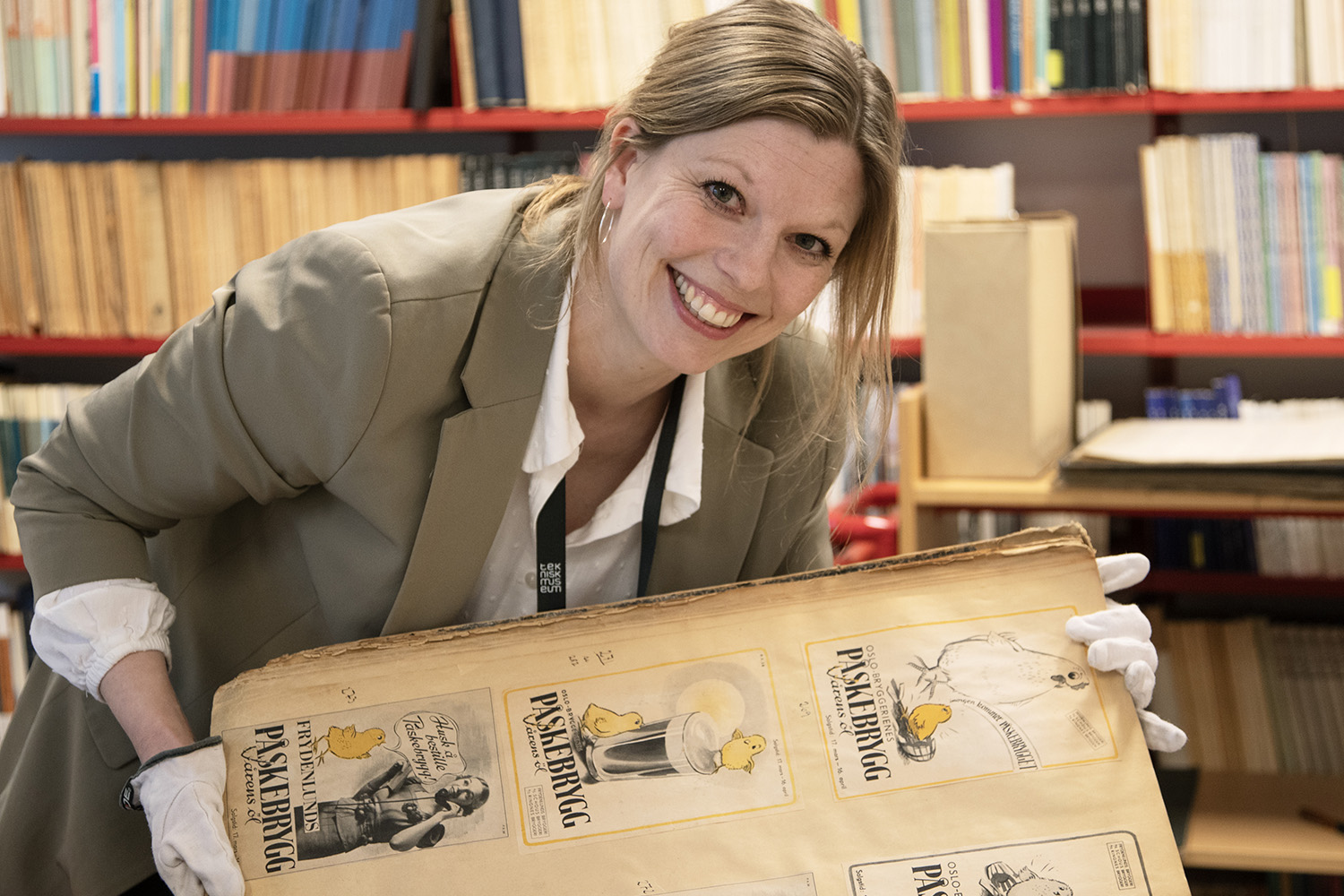 Ingebjørg Eidhammer shows off old Easter beer etiquette. Photo: Håkon Bergseth